Kazimir Malevich (1878-1935): Ukrainian founder of Suprematism & pioneer of abstract art. Explore iconic works like Black Square, geometric forms, & pure feeling's impact on 20thC art.
Exploring the Radical Geometry of Kazimir Malevich’s “Contrasting Suprematistic Elements”
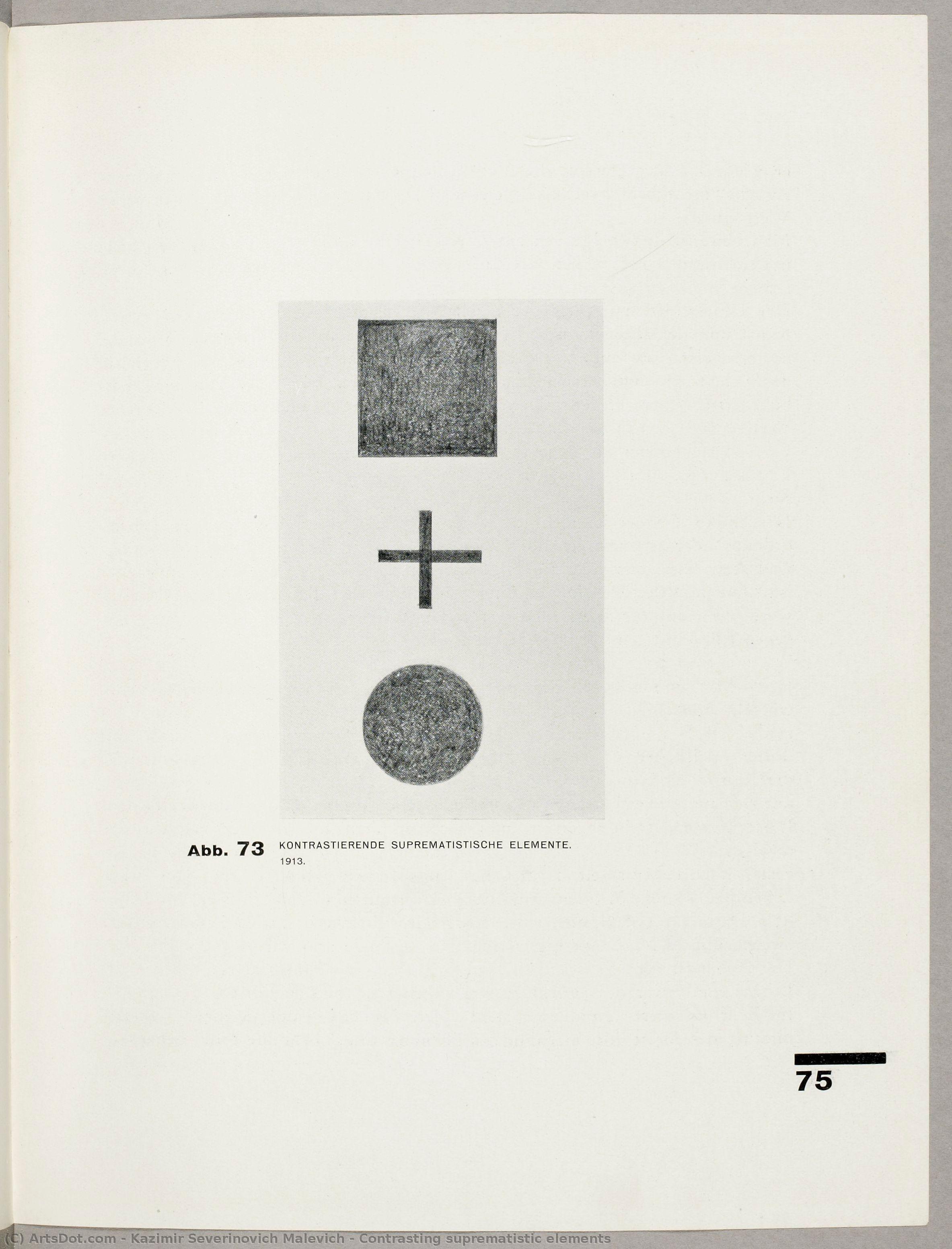
Kazimir Malevich's "Contrasting Suprematistic Elements," created in 1927, stands as a cornerstone of abstract art and a testament to the revolutionary spirit of the early Soviet avant-garde. This deceptively simple composition—a stark white background punctuated by three geometric shapes: a square, a circle, and an X symbol—commands attention not through elaborate detail but through its uncompromising assertion of pure form and color. Examining this artwork reveals layers of artistic innovation rooted in both philosophical inquiry and groundbreaking visual experimentation.
The Genesis of Suprematism
Malevich’s Suprematist movement emerged from the disillusionment following World War I and the perceived failure of representational art to convey profound truths about human experience. Rejecting illusionistic techniques, Malevich sought to distill painting down to its most fundamental elements—geometric shapes—believing they could express spiritual concepts more effectively than any depiction of the natural world. Influenced by Piet Mondrian’s equally reductive approach, Malevich championed a visual language devoid of subjective emotion or narrative content. The intention wasn't merely aesthetic; it was epistemological – an attempt to liberate art from the constraints of illusion and access a realm of pure consciousness.
Compositional Precision & Technical Execution
The photograph captures a reproduction meticulously crafted to convey the essence of Malevich’s artistic vision. Notice the deliberate flatness of the image, mirroring the lack of shading or perspective within the original painting. The subtle graininess of the print lends an air of authenticity, hinting at the photographic processes prevalent during the period. Furthermore, the textured surface of the shapes—represented by tiny dots—accurately reflects Malevich’s technique: applying pigment directly onto a primed canvas without any preparatory sketches or underdrawings. This method prioritized spontaneity and immediacy, aligning perfectly with Suprematist principles. The careful cropping ensures that the central geometric forms dominate the frame, emphasizing their dominance over the background space.
Symbolic Resonance & Conceptual Depth
Beyond its formal qualities, “Contrasting Suprematistic Elements” carries significant symbolic weight. The square represents stability and order—a deliberate antithesis to the perceived chaos of bourgeois society. The circle embodies unity and wholeness, symbolizing the cosmos and striving for transcendence. And the X symbol signifies dynamism and energy, representing the force of transformation and spiritual aspiration. Malevich’s choice of these forms wasn't arbitrary; they were carefully selected to embody philosophical concepts derived from Russian Orthodox mysticism and Nietzschean thought—concepts that challenged conventional notions of reality and morality.
A Legacy of Minimalism & Artistic Influence
“Contrasting Suprematistic Elements” continues to inspire artists and designers today, serving as a powerful reminder of the transformative potential of abstract art. Its influence can be seen in subsequent movements such as Minimalism and Conceptual Art, where artists sought to strip away extraneous elements and focus on core ideas. Reproductions like this allow viewers to appreciate Malevich’s groundbreaking contribution to modern art history—a legacy defined by uncompromising simplicity and a profound belief in the power of geometric abstraction to communicate universal truths. Explore high-quality reproductions at ArtsDot for an immersive experience of Suprematism's enduring beauty.