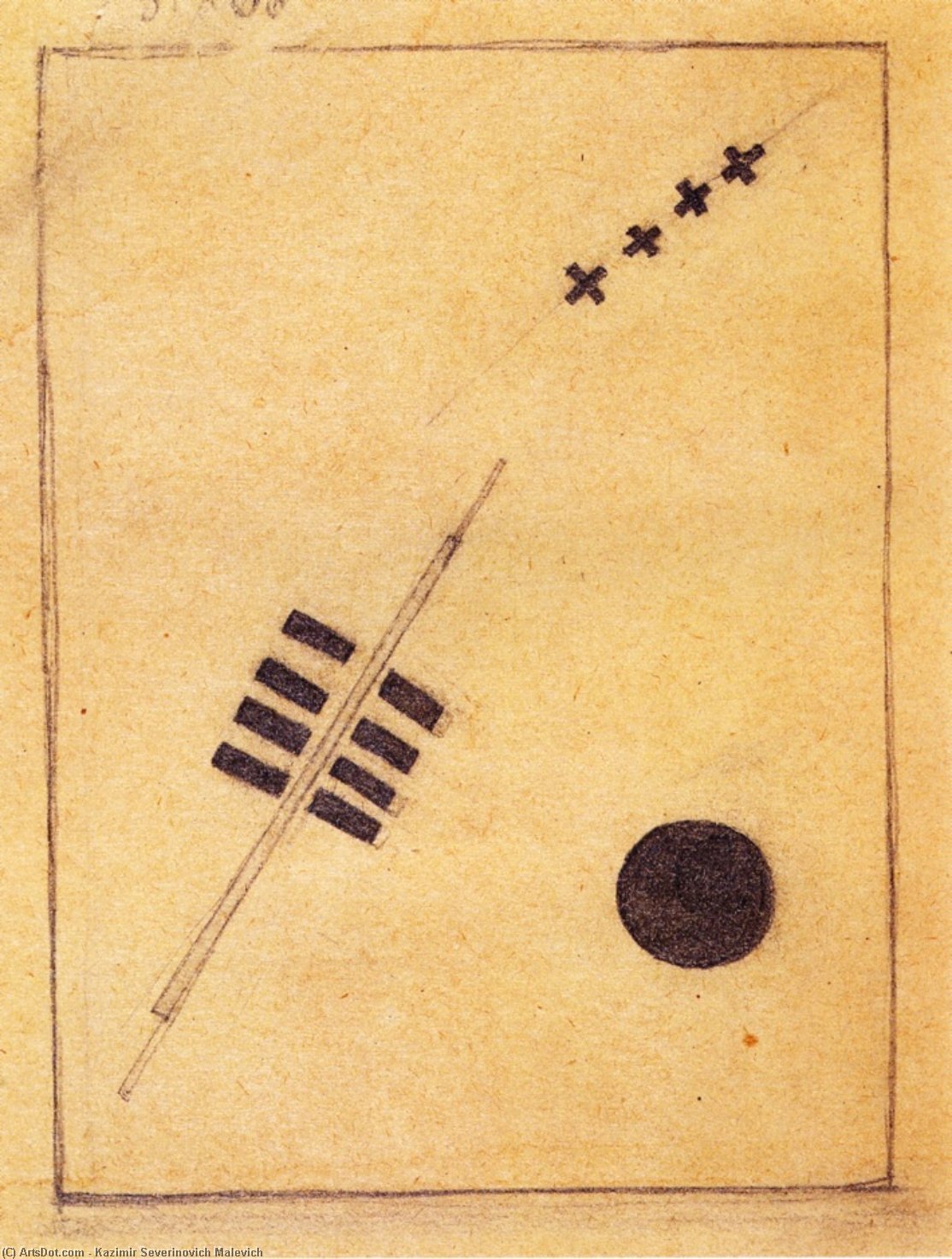
Kazimir Malevich’s groundbreaking Suprematism masterpiece ‘Cosmos,’ painted in 1917, presents a bold geometric abstraction featuring a central circle and upward-pointing arrow against a horizontal line – an iconic symbol of pure visual sensation. Explore this seminal artwork and bring its timeless elegance into your home.
Kazimir Malevich (1878-1935): Ukrainian founder of Suprematism & pioneer of abstract art. Explore iconic works like Black Square, geometric forms, & pure feeling's impact on 20thC art.
Kazimir Malevich’s Cosmos: A Radical Departure from Representation
Malevich's "Cosmos," painted in 1917, stands as a cornerstone of Suprematism—a movement he spearheaded that fundamentally challenged the conventions of Western art. More than just an image on canvas; it embodies a profound philosophical statement about the nature of perception and artistic expression. The painting’s deceptively simple composition – consisting of a circle, a line, and an arrow – belies its revolutionary significance.
The Birth of Suprematism
Born in Kyiv Oblast, Ukraine in 1878, Kazimir Malevich's formative years were steeped in Ukrainian folklore and rural traditions. However, his artistic ambitions quickly propelled him beyond these roots, leading him to Moscow and immersing him in the vibrant currents of European avant-garde thought. Influenced by Impressionism, Symbolism, Fauvism, and Cubism initially, Malevich recognized that true innovation demanded a decisive break from traditional representational art. This realization culminated in his groundbreaking declaration: “Nonobjective Art.” He sought to liberate painting from illusionistic depiction, aiming instead for pure geometric abstraction—a concept he termed Suprematism.
Geometric Simplicity and Visual Resonance
The execution of "Cosmos" exemplifies Malevich’s unwavering commitment to this principle. Created on paper with pencil, the artwork eschews color and shading entirely, focusing solely on three basic shapes: a circle dominating the center, a horizontal line traversing the canvas widthwise, and an upward-pointing arrow positioned in the upper right quadrant. These forms are rendered with meticulous precision, conveying a sense of calm stability despite their starkness. The deliberate absence of detail invites contemplation, prompting viewers to consider the fundamental elements of visual experience.
Symbolic Significance: Beyond Form
Beyond its formal qualities, "Cosmos" carries considerable symbolic weight. Malevich envisioned the circle as representing wholeness and unity—a reflection of the universe itself—while the line symbolizes dynamism and movement, mirroring the flow of cosmic energy. The arrow signifies aspiration and transcendence, pointing towards a higher realm of consciousness. These symbols aren’t merely decorative; they are integral to Malevich's philosophical project, asserting that art should communicate ideas rather than simply imitate reality.
A Legacy of Minimalism
“Cosmos” continues to resonate with artists and audiences alike today. Its influence can be seen in subsequent minimalist movements and its enduring appeal speaks to the timeless power of pure abstraction. Reproductions of this seminal artwork offer a captivating glimpse into Malevich’s visionary aesthetic—a testament to his unwavering belief that art could transform our understanding of the world.