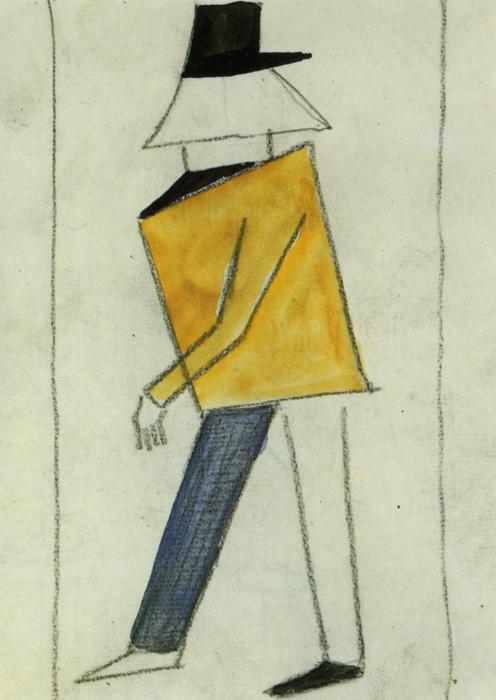
Kazimir Malevich’s striking Constructivist sketch captures a solitary figure walking away, embodying quiet contemplation amidst the bold geometric forms characteristic of his era. Explore this evocative artwork and bring Malevich's vision home.
Kazimir Malevich (1878-1935): Ukrainian founder of Suprematism & pioneer of abstract art. Explore iconic works like Black Square, geometric forms, & pure feeling's impact on 20thC art.
A Study in Minimalism: Kazimir Malevich’s “Coward”
Kazimir Malevich's "Coward," executed in 1913, stands as a cornerstone of Constructivism and embodies the radical simplification championed by Russian avant-garde artists at the dawn of the twentieth century. This deceptively unassuming sketch offers a profound glimpse into Malevich’s evolving artistic vision—a deliberate rejection of representational illusionism in favor of pure geometric abstraction. The artwork's stark monochrome palette, predominantly black and white, immediately establishes a mood of quiet contemplation and understated vulnerability.
The Style of Constructivism
Malevich’s foray into Constructivism stemmed from his fervent belief that art should serve as a tool for social transformation—a concept deeply rooted in the intellectual ferment surrounding Vladimir Lenin's rise to power. Unlike Impressionism or Cubism, which sought to capture fleeting sensory impressions, Constructivism prioritized clarity and functionality, aiming to distill visual language down to its essential elements. Malevich’s approach mirrored this ethos; he stripped away superfluous detail, reducing his subject matter—here a solitary figure—to fundamental geometric forms: a rectangle and a square—creating an image that prioritizes conceptual impact over aesthetic ornamentation.
Technique and Material Considerations
The execution of “Coward” reveals Malevich’s meticulous attention to technique. Created with charcoal on paper, the drawing demonstrates a masterful control of tonal gradation—though subtle—to convey depth and form. The artist skillfully utilizes hatching and cross-hatching to delineate contours and suggest texture, subtly hinting at the human figure's posture and movement. This deliberate choice of medium underscores Constructivism’s commitment to materiality; Malevich wasn’t interested in creating an illusion but rather capturing a moment of observation with honest artistic expression.
Historical Context: The Seeds of Revolution
“Coward” emerged during a period of immense social upheaval—the Russian Revolution of 1917—which profoundly impacted the arts. Malevich, along with other artists like Vladimir Tatlin and Aleksandr Rodchenko, actively engaged in disseminating revolutionary ideals through their artwork. This sketch isn’t merely an aesthetic exploration; it's imbued with symbolic resonance reflecting the anxieties and uncertainties of a nation undergoing dramatic change. The posture of the figure—walking away—can be interpreted as representing retreat from convention and embracing a new path forward—a visual metaphor for the broader societal shift toward abstraction and social reform.
Emotional Resonance: Quiet Reflection
Despite its minimalist aesthetic, “Coward” possesses an undeniable emotional depth. The monochrome palette evokes feelings of melancholy and introspection, prompting viewers to contemplate themes of courage and vulnerability. Malevich’s masterful simplification invites contemplation about what it means to confront fear—to step away from the familiar in pursuit of a more authentic existence. This artwork continues to inspire artists and designers alike who appreciate its enduring power to communicate complex ideas through deceptively simple visual language.