Kazimir Malevich’s Cubo-Futurist Composition: A Fractured Dawn
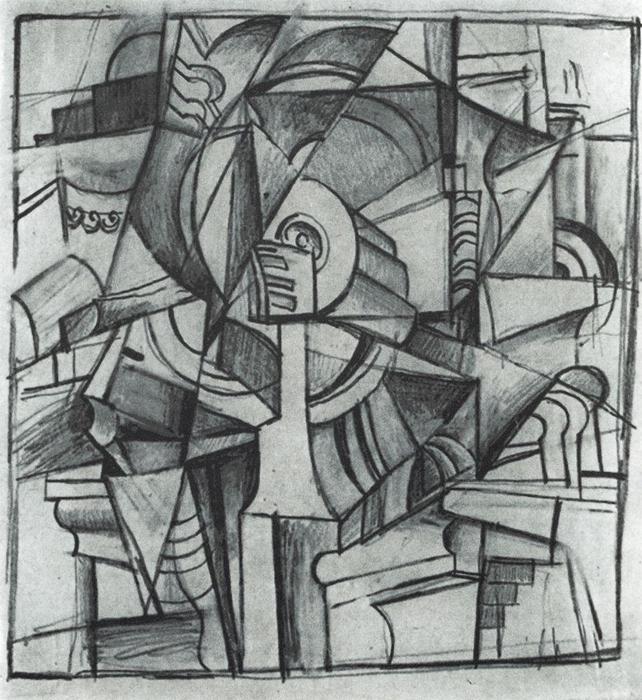
Kazimir Malevich's 1912 painting, “Cubo-Futurist Composition,” isn’t merely a visual exercise; it’s a profound distillation of the anxieties and aspirations swirling through early 20th-century Europe. Rendered in stark monochrome – a deliberate rejection of color’s emotive power – this work embodies the radical experimentation of Cubo-Futurism, a movement that sought to dismantle traditional artistic conventions and forge a new language of abstraction. It's a piece that invites prolonged contemplation, revealing layers of meaning beneath its seemingly chaotic arrangement of geometric forms.
The painting’s genesis lies within the turbulent context of post-Impressionist Europe. Malevich, deeply influenced by movements like Cubism and Futurism, was grappling with how to represent the world in a way that captured not just what *looked* like reality, but also its underlying dynamism and emotional resonance. He rejected the notion of fixed perspective, instead opting for a fragmented, multi-faceted approach—a deliberate mirroring of the fractured experience of modern life. The influence of Russian avant-garde movements is palpable, particularly in the shared desire to move beyond representational art and explore new modes of expression.
Deconstructing Form: Composition and Technique
At first glance, “Cubo-Futurist Composition” appears a bewildering jumble of circles, ovals, rectangles, and angular lines. However, closer inspection reveals a meticulously constructed system. Malevich employs a sophisticated technique of layering shapes, creating an illusion of depth through size and placement – smaller forms receding into the distance while larger ones dominate the foreground. Hatching and cross-hatching are skillfully deployed to subtly modulate tones and suggest volume, lending a surprising sense of physicality to the predominantly abstract composition.
- Geometric Precision: The shapes themselves—circles, ovals, rectangles—are rendered with remarkable precision, suggesting an underlying mathematical order.
- Dynamic Overlap: The overlapping and intersecting forms create a dynamic tension, conveying a sense of movement and instability.
- Monochromatic Palette: The deliberate use of grayscale amplifies the structural qualities of the composition, stripping away any potential distraction from the interplay of shapes.
Symbolic Resonance: Beyond Geometry
While ostensibly an abstract work, “Cubo-Futurist Composition” is rich in symbolic meaning. Malevich wasn’t simply interested in creating visually stimulating forms; he sought to communicate a deeper truth through their arrangement. The collage elements—a postage stamp depicting the Czar, fragments of text, and even a thermometer – introduce a layer of social commentary, hinting at the anxieties surrounding authority, communication, and measurement within a rapidly changing world.
The use of *zaum*—a term coined by Russian Futurists—is particularly significant. This technique involved employing non-referential linguistic forms—simple phonemes, letters, and nonsense words—to bypass rational understanding and communicate emotion directly. The fragmented shapes and disjointed arrangements can be interpreted as a reflection of this principle, suggesting that art should transcend the limitations of language and logic to access a more primal level of experience.
A Fragmented Vision: Emotional Impact
“Cubo-Futurist Composition” is not a comfortable or easily digestible work. It’s unsettling, demanding, and profoundly evocative. The painting's fractured composition mirrors the anxieties and uncertainties of its time—the collapse of established order, the rise of industrialization, and the looming threat of war. Yet, within this apparent chaos lies a powerful sense of dynamism and energy, suggesting a belief in the possibility of creating something new from the ruins of the old.
Ultimately, Malevich’s “Cubo-Futurist Composition” remains a testament to the transformative power of abstraction—a bold declaration that art could exist independently of representation, offering instead a direct and visceral engagement with the viewer's emotions and intellect. It is a pivotal work in the history of modern art, inviting us to reconsider our perceptions of form, space, and meaning.