The Essence of Pure Feeling: Unveiling Dynamic Suprematism
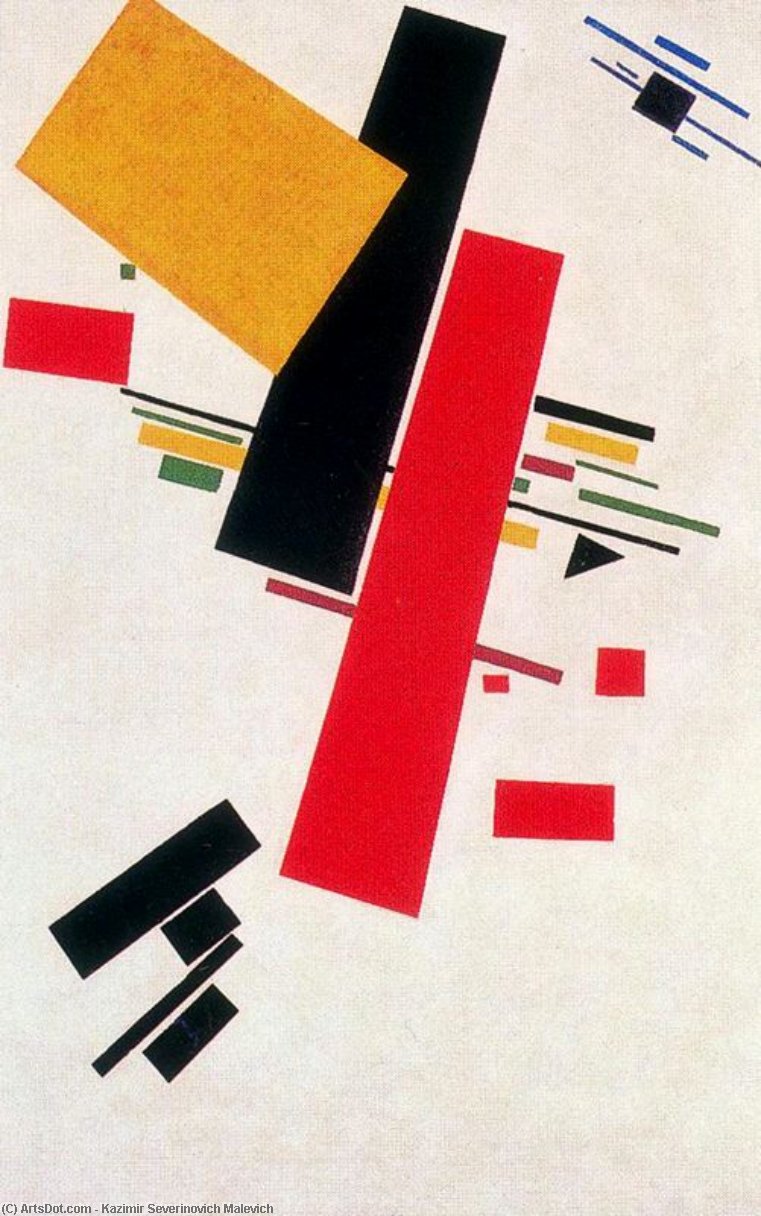
To encounter Kazimir Malevich’s Dynamic Suprematism is to step away from the familiar world of objects and enter a realm of pure, unadulterated sensation. Painted during the transformative years of 1915 or 1916, this masterpiece serves as a profound manifesto of the Russian avant-garde. At a time when the world was gripped by the tremors of global conflict and rapid industrialization, Malevich sought to liberate art from the heavy burden of representation. He did not wish to paint trees, faces, or landscapes; instead, he aimed to capture the supremacy of pure feeling through the language of geometry. The canvas becomes a cosmic stage where weightlessness and energy collide, inviting the viewer to transcend the physical and contemplate the infinite.
The visual language of the piece is one of radical simplification and striking tension. Eschewing the descriptive details of traditional painting, Malevich utilizes a vocabulary of bold, geometric forms—primarily rectangles and lines—that seem to float within a vast, white void. The composition is far from static; it is a choreographed dance of movement. Through the strategic arrangement of horizontal and vertical elements, the artist creates a sense of dynamic equilibrium. The eye does not rest on a single focal point but is instead propelled across the canvas by the intersecting trajectories of color and shape, mimicking the kinetic energy of a modernizing world.
A Symphony of Color and Texture
The palette of Dynamic Suprematism is both disciplined and emotionally explosive. Malevich relies on a high-contrast selection of hues—most notably a piercing crimson red and a vibrant cadmium yellow—to anchor the composition. These colors are not used to mimic nature but to act as fundamental energies. The red carries a weight of revolutionary passion, while the yellow injects a sense of light and vitality. Against the stark, pristine white background, these pigments vibrate with an intensity that demands attention, making the work an ideal centerpiece for contemporary spaces that value bold, intellectual statements.
Beyond the visual impact of color, the physical presence of the painting is defined by its tactile quality. Malevich applied his oil paints with a deliberate thickness, creating a textured surface that catches the light and adds a sculptural dimension to the abstract forms. This impasto technique ensures that the work is not merely a flat graphic design but a monumental object with depth and character. For the discerning collector or interior designer, this texture provides a sophisticated layer of complexity, allowing the artwork to interact dynamically with the ambient lighting of a room, whether in a minimalist gallery setting or a luxurious residential lounge.
A Legacy for the Modern Interior
Owning a reproduction of Dynamic Suprematism is more than an aesthetic choice; it is an engagement with one of the most significant intellectual shifts in art history. As a cornerstone of the Suprematist movement, this work continues to inspire those who seek to surround themselves with art that challenges the status quo and celebrates the beauty of structural truth. Its clean lines and powerful color blocks harmonize effortlessly with modern architectural styles, from Mid-Century Modern to ultra-minimalist aesthetics.
For the interior designer, this piece offers a way to introduce movement and intellectual rigor into a space. It functions as a window into the soul of the twentieth century, providing a conversation piece that bridges the gap between historical significance and contemporary elegance. Whether displayed in a professional studio or a private collection, Malevich’s vision remains an enduring symbol of the human desire to find order, energy, and pure beauty within the chaos of existence.