A Crimson Revolution: Decoding Malevich’s Female Portrait
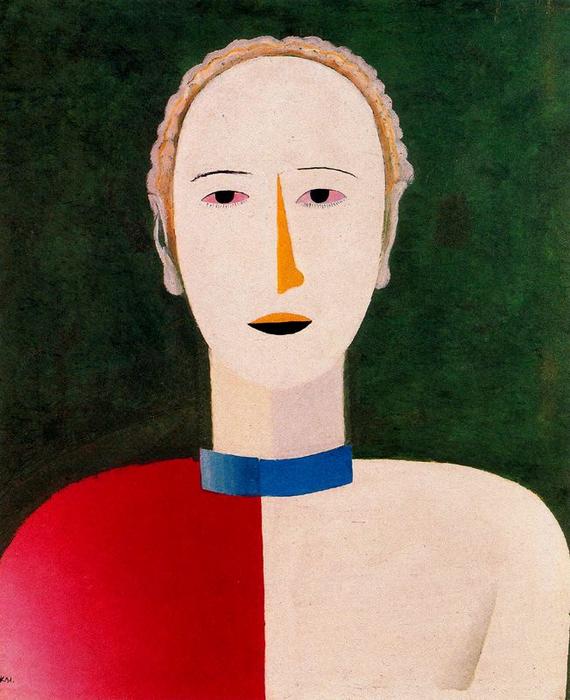
In the vast, transformative landscape of the early twentieth-century avant-garde, few images capture the tension between the human soul and geometric abstraction as poignantly as Kazimir Malevich’s Female Portrait. At first glance, the viewer is met with a striking, almost visceral confrontation: a woman’s face emerging from a deep, pulsating crimson backdrop. This is not merely a portrait in the traditional sense; it is a fragment of a revolution. Malevich, a pioneer who would eventually dismantle the very concept of representation through Suprematism, uses this piece to bridge the gap between the recognizable world and the pure, unadulating power of color and form. The woman’s gaze, directed slightly away from the observer, invites a sense of profound introspection, suggesting a narrative that exists just beyond the visible plane, pulling the viewer into her silent, contemplative orbit.
The brilliance of this work lies in its masterful command of Cubist influence and geometric fragmentation. Rather than rendering soft flesh and delicate features, Malevich dissects the subject into a series of angular, intersecting planes. This technique serves to deconstruct the physical identity of the sitter, transforming her into an architectural arrangement of light and shadow. Through this lens, the portrait becomes an exploration of structure itself. For the discerning collector or interior designer, this piece offers a sophisticated interplay of movement and stillness, where the sharp edges of the composition are softened by the emotional weight of the subject's expression.
Symbolism in Color and the Weight of History
Color in Malevich’s oeuvre is never merely decorative; it is a psychological instrument. The dominant red that saturates the canvas acts as a primal force, embodying passion, energy, and the turbulent spirit of the Russian avant-garde era following World War I. This fiery hue provides a dramatic stage for the subtle, cooling intervention of a blue necklace. This small but significant detail introduces a vital chromatic tension, a moment of serenity amidst the surrounding heat, which prevents the composition from becoming overwhelming. The contrast between the warmth of the background and the coolness of the blue creates a rhythmic pulse that keeps the eye wandering across the canvas, discovering new depths within the layers of pigment.
To possess a reproduction of this masterpiece is to hold a piece of art history that embodies the quest for universality. Created during a period of immense social and political upheaval, the painting reflects an urgent desire to break free from academic constraints and forge a new visual language—one that speaks to the spirit rather than just the eye. For those looking to infuse a contemporary space with intellectual depth, this artwork provides a focal point that is both historically significant and aesthetically timeless. It stands as a testament to the moment when art ceased to be a mirror of reality and began to become a reality of its own.