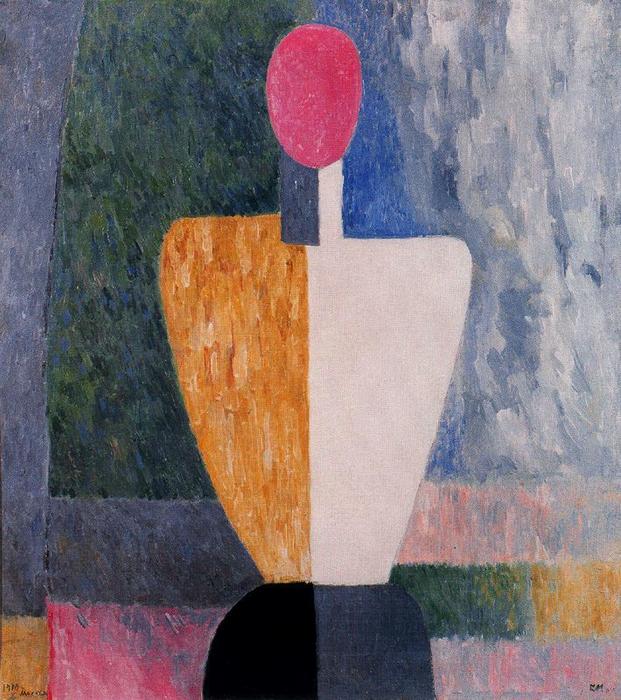
A bold Cubist dissection of the human form into vibrant geometric shapes defines Kazimir Malevich's Half-length Figure 1, a masterpiece of Suprematism inviting you to explore the power of pure abstraction.
Kazimir Malevich (1878-1935): Ukrainian founder of Suprematism & pioneer of abstract art. Explore iconic works like Black Square, geometric forms, & pure feeling's impact on 20thC art.
Kazimir Malevich’s Half-length Figure 1: A Bold Statement of Geometric Supremacy
Malevich's "Half-length Figure 1" stands as a cornerstone of abstract art, embodying the revolutionary spirit of Constructivism and representing a decisive break from traditional artistic conventions. Painted sometime between 1915 and 1920—precise dating remains elusive—this artwork exemplifies Malevich’s unwavering commitment to pure geometric abstraction, pushing the boundaries of visual representation and establishing him as one of the most influential figures in twentieth-century art history.
The Style of Geometric Supremacy
The painting's aesthetic is undeniably Cubist, albeit profoundly transformed by Malevich’s conceptual framework. However, unlike Picasso or Braque’s fragmented portraits, Malevich eschewed illusionistic depth and perspective altogether. Instead, he dissected the human form into fundamental geometric shapes—primarily rectangles and circles—creating a flattened plane of color that prioritizes visual impact over realistic depiction. This deliberate simplification wasn't merely stylistic; it was driven by an intellectual conviction that art should transcend subjective experience and communicate universal truths through pure abstraction. Malevich famously declared, “The cube is the ultimate form,” articulating his belief in the supremacy of geometric forms as a means of expressing spiritual essence.
Technique and Color Palette
Malevich employed tempera on canvas—a technique favored by Russian avant-garde artists—resulting in vibrant hues that retain remarkable luminosity despite the passage of time. The dominant color scheme is striking: a bold yellow occupies the torso, contrasted sharply against a serene blue backdrop. These colors aren’t chosen arbitrarily; they resonate with symbolic significance within Malevich's worldview. Yellow represents enlightenment and spiritual energy, while blue symbolizes tranquility and contemplation—a deliberate juxtaposition intended to convey a harmonious balance between opposing forces. The meticulous application of tempera ensures that the painting retains its textural quality, hinting at the artist’s tactile engagement with his materials.
Historical Context: Constructivism and Artistic Revolution
“Half-length Figure 1” emerged during a period of intense artistic ferment in Russia following the October Revolution of 1917. Constructivism—a movement championed by Malevich alongside artists like Vladimir Tatlin—rejected bourgeois aesthetics and embraced industrial materials and geometric abstraction as tools for social transformation. Artists sought to liberate art from decorative concerns, believing it should serve as a vehicle for conveying ideological ideas and promoting utilitarian functionality. This artwork embodies the spirit of Constructivist experimentation, reflecting the broader cultural anxieties and aspirations of the era.
Symbolism Beyond Representation
Despite its lack of recognizable imagery, “Half-length Figure 1” is laden with symbolic meaning. Malevich’s reduction to geometric forms isn't simply a stylistic choice; it’s an attempt to distill human experience into its purest essence—a gesture akin to Zen Buddhism’s pursuit of enlightenment through meditation. The figure itself becomes less about portraying an individual and more about representing the universal human condition, embodying stillness and contemplation amidst the chaos of existence. It invites viewers to engage in a dialogue with the artwork beyond mere visual perception, prompting reflection on fundamental questions of spirituality and artistic purpose.
Emotional Impact: A Quiet Assertion of Vision
Ultimately, “Half-length Figure 1” communicates an emotional resonance that transcends its formal simplicity. The bold colors and geometric precision instill a sense of calm confidence—a quiet assertion of Malevich’s unwavering belief in the transformative power of abstraction. It's a painting that speaks to the viewer not through narrative or emotion but through pure visual experience, leaving behind a lasting impression of intellectual rigor and artistic conviction.