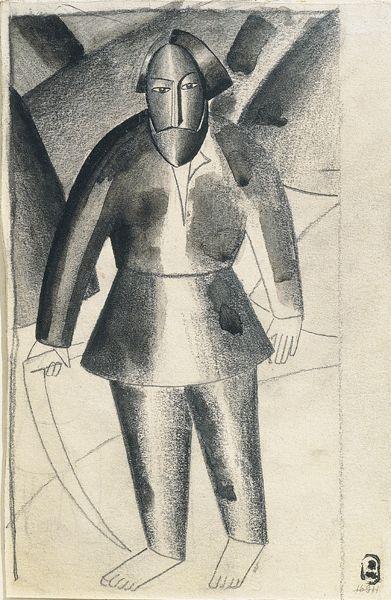
Mower

Explore Kazimir Malevich’s ‘Mower,’ a striking monochrome abstraction embodying Suprematism. Discover its geometric forms & enigmatic symbolism in this 1912 masterpiece.


Kazimir Malevich (1878 - 1935)

Kazimir Malevich (1878-1935): Ukrainian founder of Suprematism & pioneer of abstract art. Explore iconic works like Black Square, geometric forms, & pure feeling's impact on 20thC art.

Kazimir Malevich’s “Mower” (1912): A Proto-Suprematist Vision

  • Subject & Composition: “Mower” presents a strikingly stylized depiction of a figure, presumably a peasant or worker engaged in agricultural labor. However, Malevich moves far beyond simple representation. The figure is fragmented and reconstructed using geometric forms – cylinders, rectangles, and planes – creating an almost abstract presence. This isn’t a portrait aiming for likeness; it's an exploration of form *as* subject. The composition is vertically oriented, emphasizing the elongated, somewhat imposing stature of the mower against a backdrop of similarly fractured shapes.
  • Style & Technique: Executed in graphite or charcoal on paper, “Mower” exemplifies Malevich’s transitional period. While still rooted in figuration, it foreshadows his revolutionary Suprematist style. The technique is characterized by deliberate linear shading – hatching and cross-hatching build up tonal values without blending, maintaining sharp delineations between forms. This creates a textured surface and emphasizes the artwork's graphic quality. The simplification of form aligns with Cubo-Futurist tendencies prevalent at the time, yet possesses a unique, distinctly Malevichian sensibility.
  • Historical Context & Artistic Evolution: 1912 was a pivotal year for Malevich. Following a trip to Paris, he absorbed influences from Picasso and Braque’s Cubism, but quickly began forging his own path. “Mower” represents this crucial stage – a departure from traditional representation towards the pure abstraction that would define Suprematism. It's a stepping stone between his earlier explorations of Impressionism, Symbolism, and Fauvism, and the radical geometric compositions he’d soon become famous for.
  • Symbolism & Interpretation: The figure of the mower holds symbolic weight. In early 20th-century Russia, peasants represented a vital link to national identity and tradition. Malevich's deconstruction of this figure can be interpreted as a commentary on societal shifts and the changing role of rural life in an increasingly industrialized world. The fragmented background might symbolize disruption or the breakdown of traditional structures. The helmet-like headpiece adds an element of anonymity, perhaps suggesting the collective experience of labor rather than individual identity.
  • Emotional Impact & Aesthetic Qualities: “Mower” evokes a sense of austerity and isolation. The monochromatic palette and angular forms contribute to a somewhat unsettling atmosphere. While not overtly emotional, the artwork possesses a powerful visual impact through its stark simplicity and geometric rigor. It’s a work that demands contemplation, inviting viewers to consider the relationship between form, representation, and meaning.
  • For Collectors & Designers: “Mower” offers a rare glimpse into the artistic genesis of one of the 20th century's most influential artists. Its bold graphic quality and limited palette make it a versatile piece for modern interiors, complementing minimalist or industrial design schemes. A high-quality reproduction captures the textural nuances of the original charcoal work, adding depth and sophistication to any space.