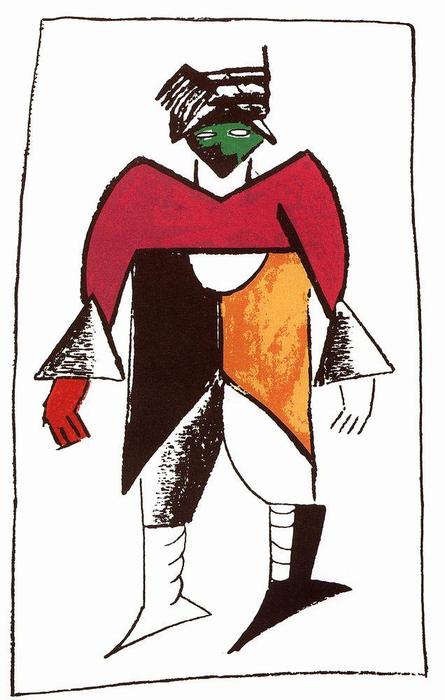
Kazimir Malevich’s ‘New Man’ (1913) – a groundbreaking Suprematist abstraction. Bold lines, geometric forms & symbolic figures explore reality. Discover this iconic artwork!
Kazimir Malevich (1878-1935): Ukrainian founder of Suprematism & pioneer of abstract art. Explore iconic works like Black Square, geometric forms, & pure feeling's impact on 20thC art.
A Vision of Modernity: Decoding Malevich’s “New Man”
Kazimir Malevich's "New Man" (1913) is a pivotal work bridging the artist’s explorations of Cubism and his imminent development of Suprematism – a radical departure in abstract art. This piece isn’t simply a portrait; it’s a statement about the evolving identity of humanity at the dawn of a new era, rendered through a strikingly unconventional visual language.
Subject & Style: Deconstructing the Figure
The artwork presents a stylized figure, clearly human but fragmented and reassembled in a manner that prioritizes geometric form over realistic representation. The subject is adorned with costume elements – a hat, cloak, and what appears to be a mask or head covering – suggesting a performative aspect to identity. Malevich deliberately dismantles traditional notions of portraiture. The style leans heavily towards abstraction, echoing the influence of Cubism but pushing beyond its analytical approach toward something more emotionally charged and spiritually oriented. The vertical composition emphasizes the figure’s presence while simultaneously isolating it against a stark white background, enhancing the sense of otherness.
Technique & Materials: Lines as Building Blocks
“New Man” is executed with bold, angular lines that define the figure's body and clothing. The technique appears to involve direct application of ink or marker on paper, creating a graphic quality and a somewhat rough aesthetic. The lack of traditional shading and modeling flattens the perspective, reinforcing the two-dimensional nature of the work and emphasizing its conceptual focus over illusionistic depth. Texture is implied through the density and interplay of lines rather than explicitly rendered, inviting close inspection and contemplation.
Historical Context: The Avant-Garde in Kyiv & Beyond
Created in 1913, “New Man” emerges from a period of intense artistic experimentation. Malevich, born in Ukraine to a Polish family, was deeply influenced by the vibrant cultural landscape of Kyiv and his subsequent exposure to the Parisian avant-garde. This work predates the full articulation of Suprematism, but it embodies the artist’s growing dissatisfaction with representational art and his search for a purely abstract visual language capable of expressing inner spiritual realities. It reflects the broader anxieties and aspirations of a world on the cusp of profound change, grappling with industrialization, urbanization, and new philosophical ideas.
Symbolism & Interpretation: The Alienated Self
The fragmented form and masked visage of the figure in “New Man” can be interpreted as symbolic representations of alienation, distortion, or a fractured sense of self. The costume elements suggest a constructed identity, raising questions about authenticity and the roles individuals play within society. The geometric simplification may also represent an attempt to reduce human experience to its essential components – a precursor to the pure abstraction that would define Suprematism.
Emotional Impact & Aesthetic Appeal
Despite its abstract nature, “New Man” evokes a powerful emotional response. The starkness of the composition and the angularity of the lines create a sense of tension and unease. Yet, there is also a compelling beauty in the work’s formal rigor and its exploration of fundamental visual elements. For collectors and interior designers, “New Man” offers a sophisticated statement piece – a visually arresting artwork that embodies the spirit of modernism and invites ongoing interpretation. Its monochrome palette lends itself well to contemporary interiors, adding a touch of intellectual depth and artistic intrigue.