Malevich’s exploration of geometric abstraction challenged conventions and paved the way for future artistic breakthroughs.
Kazimir Malevich (1878-1935): Ukrainian founder of Suprematism & pioneer of abstract art. Explore iconic works like Black Square, geometric forms, & pure feeling's impact on 20thC art.
A Bold Vision of Movement: Kazimir Malevich’s “Running Man”
Kazimir Severinovich Malevich stands as a monumental figure in the Russian avant-garde, an artist who irrevocably altered the trajectory of modern art. His seminal work, "Runing Man," transcends mere depiction; it embodies a radical reimagining of artistic expression rooted in Suprematism – a movement dedicated to distilling painting down to its purest geometric forms and conveying raw emotion without illusionistic representation. This captivating canvas, executed in oil on canvas, offers a profound glimpse into Malevich’s revolutionary thinking and his enduring influence on subsequent generations of artists.
Historical Context & The Birth of Suprematism
Born in Kyiv Oblast in 1878 to Polish parents, Malevich's formative years were steeped in Ukrainian folklore and artistic traditions—influences that subtly informed his later stylistic choices. However, it was his immersion into the vibrant intellectual milieu of Moscow’s avant-garde circles that truly ignited his creative fervor. The burgeoning artistic debates surrounding Cubism and Futurism propelled him toward a decisive break from traditional realism. Malevich championed Suprematism as a response to what he perceived as the decadence and stagnation of Western European art, arguing passionately for an aesthetic liberated from objective observation. This philosophical stance demanded a visual language stripped bare—a focus on fundamental geometric shapes like squares and circles – prioritizing pure feeling over accurate representation.
Composition & Technique: Fragmented Form Meets Dynamic Energy
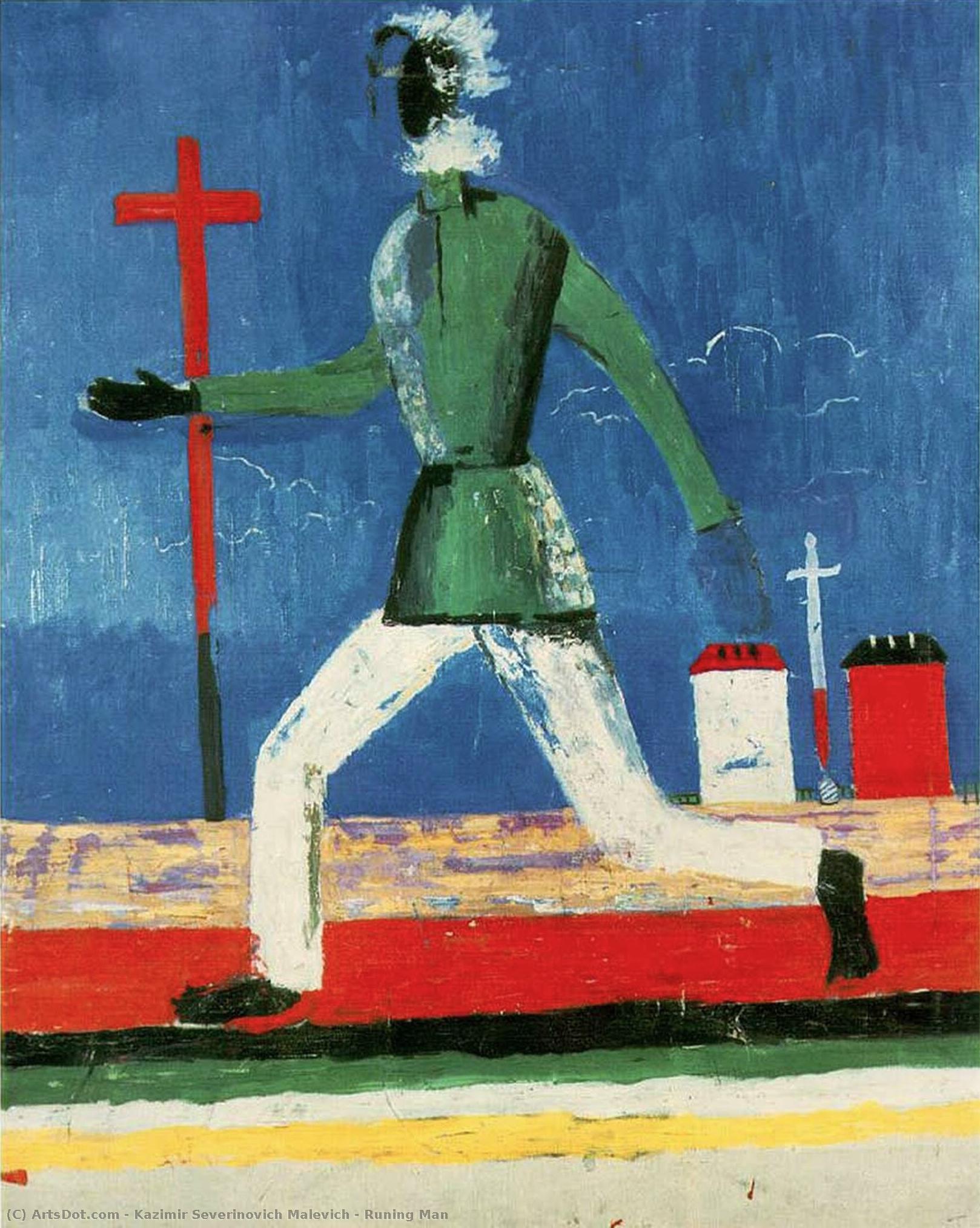
“Runing Man” exemplifies Malevich’s masterful manipulation of Cubist principles, albeit filtered through the lens of his Suprematist dogma. The painting presents a simplified depiction of a man in motion, powerfully conveying an impression of speed and vitality. Despite its apparent austerity, the composition is meticulously crafted; the figure's legs are positioned apart to accentuate movement, while outstretched arms contribute to the overall dynamism. A cross dominates the background—a deliberate symbol referencing Christian iconography but interpreted by Malevich as representing universal spiritual aspiration. The artist’s bold use of color – primarily vibrant reds and yellows – amplifies this emotional impact. Thick brushstrokes create textural surfaces that heighten visual interest and reinforce the painting's expressive character.
Symbolism & Emotional Resonance
Beyond its formal elements, “Runing Man” resonates with deeper symbolic meanings. The running figure itself symbolizes freedom, progress, and an escape from constraints—themes central to Malevich’s philosophical worldview. The inclusion of birds soaring above underscores this sense of elevation and transcendence. More than just a visual spectacle, the painting invites contemplation on concepts of spirituality and human aspiration. Malevich aimed not merely to depict reality but to communicate an inner state – a feeling of unrestrained energy and optimism—a testament to his conviction that art could serve as a conduit for profound emotional experience.
Legacy & Influence Beyond Russia
Malevich’s groundbreaking approach to abstraction profoundly impacted the development of modern art globally, inspiring artists like Piet Mondrian and Josef Albers who embraced similar geometric explorations. “Runing Man” stands as an enduring emblem of Suprematism's radical vision—a challenge to conventional artistic conventions that continues to inspire artists today. Its influence extends beyond purely aesthetic considerations, prompting discussions about the role of art in conveying spiritual values and expressing fundamental human emotions. A reproduction of this iconic artwork offers a captivating glimpse into Malevich’s revolutionary spirit and his indelible contribution to the history of art.