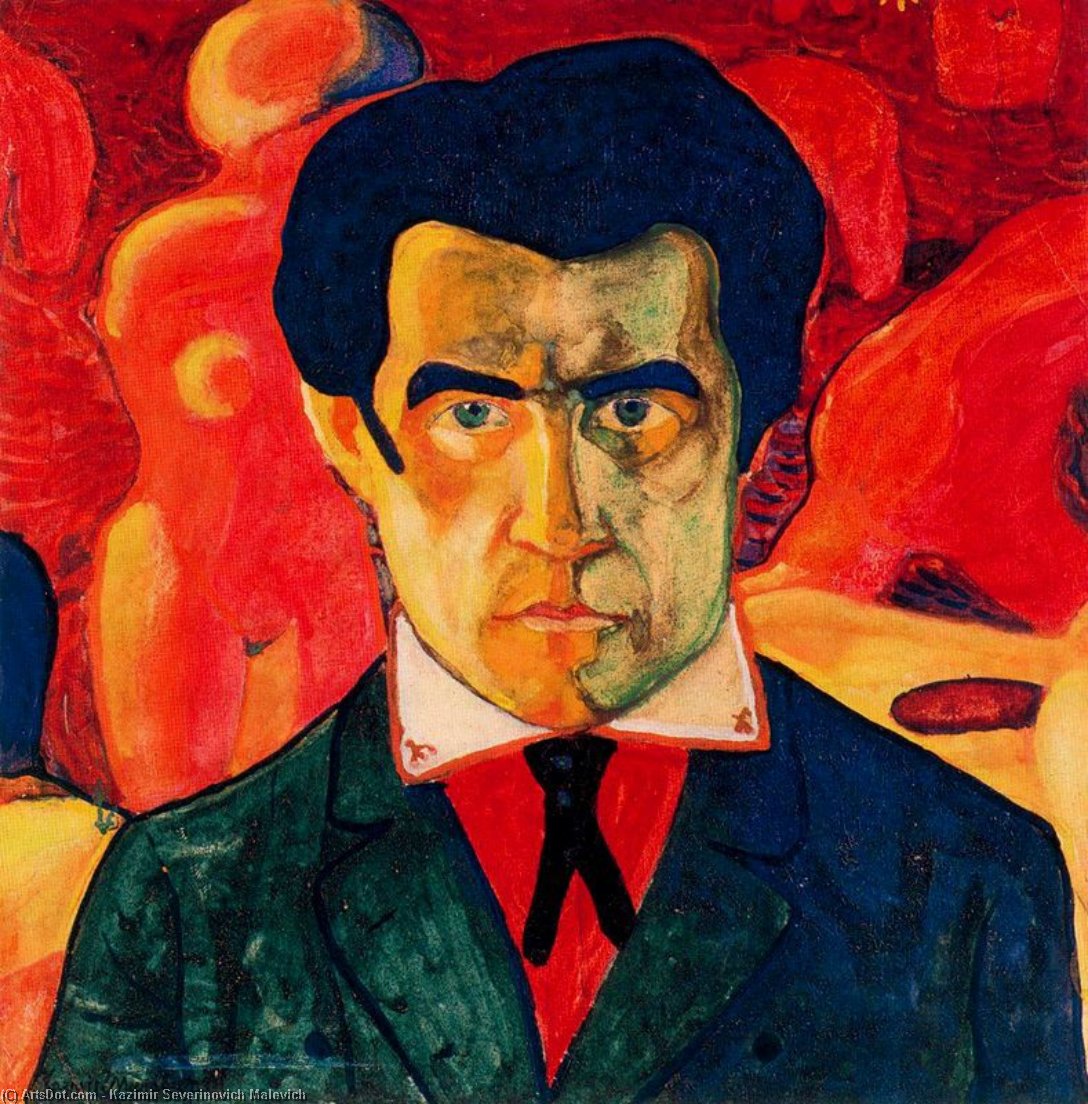
A Glimpse into the Soul: Kazimir Malevich’s Self-Portrait
This striking self-portrait by
Kazimir Severinovich Malevich, rendered in a captivating Expressionistic style, offers a profound insight into the mind of one of the 20th century's most revolutionary artists. The artwork presents a close-up view of a man with a beard, formally dressed in a black suit and tie – a figure radiating seriousness and introspection. However, this is no conventional likeness; it’s a powerful distillation of character through bold form and intense color.
Deconstructing Reality: Style & Technique
The painting is dominated by fiery reds and oranges, creating an unsettling yet compelling atmosphere. Malevich masterfully employs angular lines to define the subject's face and clothing, contrasting them with swirling, blurred forms in the background. This technique immediately signals a departure from traditional portraiture. The use of thick impasto brushstrokes adds physicality and texture, emphasizing the emotional weight of the piece. While rooted in Cubism – evidenced by the fragmented planes and geometric shapes – Malevich transcends mere imitation, forging his own unique visual language. He doesn’t simply *represent* a man; he conveys an internal state through abstract means.
Historical Context: A Revolutionary Era
Created during a period of immense social and artistic upheaval, this self-portrait reflects the spirit of experimentation that characterized the early 20th century. Malevich was at the forefront of the Russian avant-garde, actively challenging conventional notions of art. His development of Suprematism – an abstract style focused on pure geometric forms and spiritual feeling – would soon redefine the boundaries of artistic expression. This work predates his most radical Suprematist paintings like *Black Square*, but it demonstrates a crucial step in that direction: a deliberate dismantling of representational form to access deeper emotional truths.
Symbolism & Emotional Resonance
The intense color palette is not merely aesthetic; it’s deeply symbolic. The reds and oranges evoke passion, anxiety, and perhaps even inner turmoil. The subject's direct gaze confronts the viewer, demanding attention and inviting contemplation. The flattened perspective and lack of realistic depth contribute to a sense of claustrophobia and psychological intensity. This isn’t simply a portrait *of* Malevich; it’s a portrait *into* his psyche – a raw and honest exploration of selfhood in a rapidly changing world.
Influence & Legacy
Malevich's influence extends far beyond the confines of Suprematism. His radical ideas paved the way for Minimalism, abstract expressionism, and countless other movements that followed. He inspired generations of artists to question established norms and explore new possibilities in art. This self-portrait serves as a powerful reminder of his enduring legacy – a testament to the transformative power of abstraction and the courage to challenge artistic conventions.
- Style: Expressionism, influenced by Cubism
- Technique: Oil on canvas, impasto brushstrokes
- Key Themes: Self-reflection, psychological intensity, artistic innovation
- Emotional Impact: Provocative, unsettling, deeply introspective
This artwork is not just a visual statement; it’s an invitation to engage with the complexities of human emotion and the boundless potential of abstract art. It would be a compelling addition to any collection, adding depth and intellectual intrigue to both modern and traditional interiors.