A Prelude to Pure Feeling: Exploring Malevich’s ‘Singer in the Chorus’
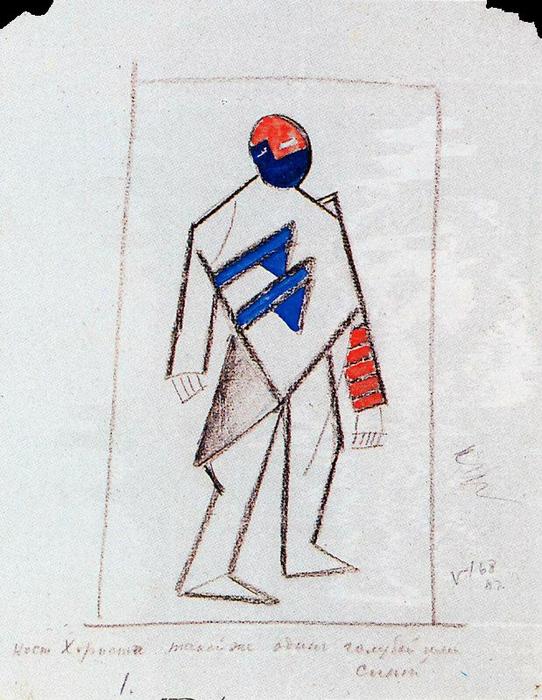
This captivating sketch offers a rare glimpse into the formative stages of Kazimir Malevich's revolutionary artistic journey. Created likely as a costume or set design study, *Singer in the Chorus* is not merely a preparatory drawing; it’s a vital stepping stone toward his groundbreaking Suprematist theories and a testament to his relentless pursuit of non-objective art.
Deconstructing Form: Style & Technique
The artwork immediately strikes the viewer with its bold, geometric abstraction. Malevich eschews traditional representation, instead dissecting the human figure into angular planes – rectangles, triangles, and trapezoids – rendered in a striking palette of primary colors: red, blue, and yellow. The lines are deliberately sketchy and loose, indicative of a rapid ideation process. This isn’t about meticulous detail; it's about capturing *essence* through simplified form.
The technique is primarily pencil on paper, lending an immediacy and rawness to the composition that feels incredibly modern even today. The flat application of color, devoid of shading or blending, further emphasizes the two-dimensionality and rejects illusionistic space.
Historical Context: From Cubo-Futurism to Suprematism
Born in Ukraine in 1878, Malevich was a pivotal figure in the Russian avant-garde. His early work absorbed influences from Impressionism, Symbolism, Fauvism, and notably, Cubism. *Singer in the Chorus* reflects this transitional period – a clear echo of Cubo-Futurism’s dynamic fragmentation of form. However, even within these stylistic nods, Malevich is already pushing boundaries. He's not simply replicating Cubist principles; he’s using them as a springboard to explore something entirely new:
pure artistic feeling. This work predates his fully realized Suprematist paintings like *Black Square*, but it contains the seeds of that radical aesthetic – the prioritization of geometric form and spiritual resonance over representational accuracy.
Symbolism & Interpretation
While seemingly abstract, the title “Singer in the Chorus” offers a crucial entry point for interpretation. The figure, though fragmented, retains a sense of movement and dynamism, perhaps suggesting the energy and rhythm of performance. The bold colors could symbolize emotion or the vibrancy of the stage. More broadly, Malevich’s abstraction can be seen as a rejection of material reality in favor of a higher spiritual plane – an attempt to express universal truths through the language of form.
It's a visual poem about the power of art to transcend the mundane.
Emotional Impact & Interior Design
*Singer in the Chorus* evokes a sense of both energy and restraint. The fragmented forms create a dynamic tension, while the limited color palette lends a sophisticated air. This artwork would be a striking addition to any modern or contemporary interior. Its geometric abstraction complements minimalist spaces, adding visual interest without overwhelming them.
- Its bold colors can serve as an accent piece in neutral palettes.
- The work’s historical significance adds intellectual depth to a collection.
- As a reproduction, it offers a unique conversation starter and a nod to art history.
Ultimately, *Singer in the Chorus* is more than just a sketch; it's a window into the mind of an artistic visionary – a glimpse of the moment when abstraction began to liberate itself from representation and embark on its own extraordinary journey.