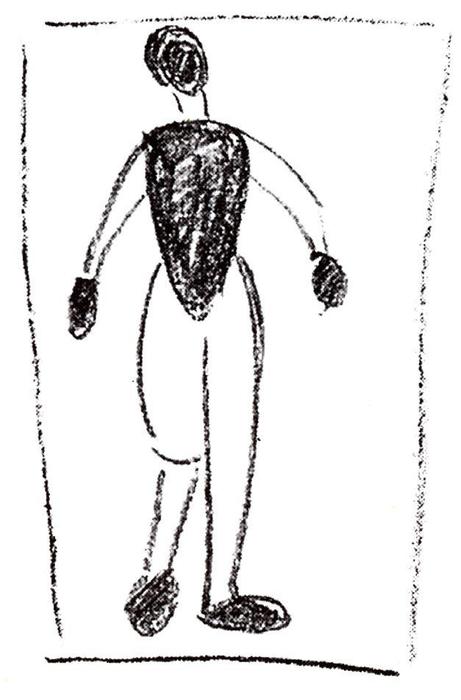
Explore Kazimir Malevich's minimalist masterpiece – ‘Standing Figure.’ This stark black and white Suprematist depiction prioritizes geometric forms, embodying austerity and exploring fundamental abstraction.
Kazimir Malevich (1878-1935): Ukrainian founder of Suprematism & pioneer of abstract art. Explore iconic works like Black Square, geometric forms, & pure feeling's impact on 20thC art.
Kazimir Malevich’s Standing Figure: A Minimalist Echo of Suprematism
Kazimir Malevich's "Standing Figure" stands as a cornerstone of early Suprematism, representing not merely an image but a profound conceptual exploration into the very essence of visual art. Created sometime between 1917 and 1920 – coinciding with the fervent fervor of Russia’s avant-garde movement – this deceptively simple monochrome composition transcends representational concerns to embody the core tenets of Malevich's revolutionary aesthetic vision. It’s a piece that speaks volumes about artistic ambition, intellectual rigor, and the desire to distill art down to its purest form.
The Geometry of Absence: Style and Technique
Malevich’s approach is strikingly reductive; he abandons illusionistic depth and color entirely in favor of geometric abstraction. The artwork employs hatching and cross-hatching—a technique honed during his formative years experimenting with Cubism—to achieve tonal variations within the stark black and white palette. These meticulous lines aren't merely decorative; they are actively employed to define the figure’s contours, creating a palpable sense of solidity despite its apparent emptiness. The deliberate flatness of the image reflects Malevich’s conviction that true artistic expression resided in rejecting traditional perspective and embracing pure geometric abstraction as a path toward spiritual liberation. This meticulous execution underscores Malevich's dedication to conveying complex ideas through deceptively simple visual elements.
Historical Context: Suprematism and Beyond
“Standing Figure” emerged from the crucible of Suprematism, a movement spearheaded by Malevich himself that sought to liberate art from the constraints of realism. Influenced by Piet Mondrian’s equally austere explorations of geometric abstraction, Suprematists aimed to express spiritual truths through pure visual forms—squares, rectangles, circles—stripped bare of any decorative or narrative content. This artistic rebellion mirrored broader societal anxieties surrounding the aftermath of World War I and the burgeoning communist revolution in Russia, reflecting a yearning for clarity and order amidst turbulent times. Malevich’s work directly challenged established artistic conventions, positioning Suprematism as a radical departure from Western art traditions.
Symbolism Within Simplicity: Form and Emotion
Despite its apparent lack of visual complexity, “Standing Figure” is laden with symbolic significance. The circle representing the head embodies wholeness and unity—a deliberate antithesis to the fragmented perspectives prevalent in earlier artistic styles. Similarly, the inverted triangle or trapezoid form delineating the torso symbolizes stability and grounding, providing a counterbalance to the upward thrust of the figure’s posture. These geometric shapes aren't merely structural elements; they convey an emotional resonance that speaks to themes of contemplation and resilience. Malevich believed that these fundamental forms could communicate profound spiritual ideas without resorting to figurative representation.
A Legacy of Minimalism: Emotional Impact
Ultimately, “Standing Figure” resonates with a powerful sense of austerity and detachment—qualities characteristic of Suprematism’s broader philosophical underpinning. It invites viewers to consider the beauty inherent in simplicity, prompting reflection on the relationship between form and emotion. The artwork's enduring appeal lies in its ability to capture a moment of intellectual conviction and artistic daring—a testament to Malevich’s unwavering commitment to pursuing an uncompromising vision of abstract art that continues to inspire artists and collectors today. It serves as a poignant reminder that profound ideas can be conveyed through remarkably restrained visual expression.