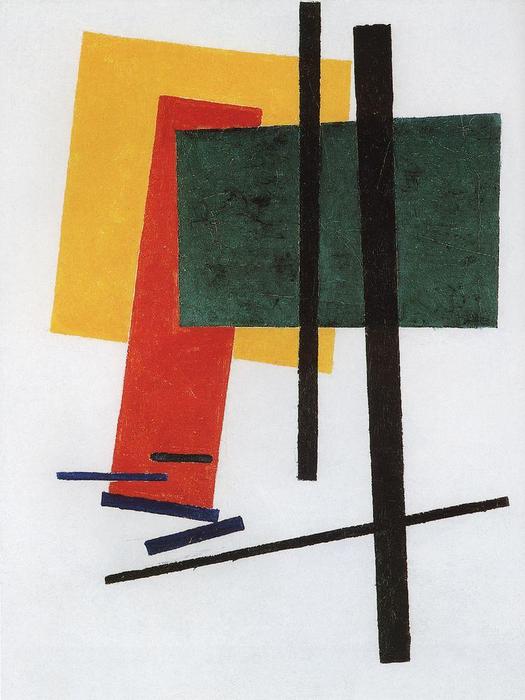
Kazimir Malevich’s Suprematism (1915) explodes with vibrant geometric shapes – squares, triangles, and rectangles – in a bold color palette of red, yellow, blue, and black. This iconic work from the pioneer of abstract art offers a stunning visual experience; discover or own this masterpiece.
Kazimir Malevich’s Suprematism: A Revolution in Form
Suprematism (11), a vibrant explosion of color and geometric abstraction created by Kazimir Malevich in 1915, stands as a monumental achievement in the history of art. This painting isn't merely a decorative piece; it’s a profound statement – a radical rejection of representational imagery and an assertion of pure feeling expressed through fundamental shapes. Born from the fertile ground of early 20th-century artistic experimentation, Suprematism represents Malevich’s groundbreaking exploration into the very essence of art itself.
The Birth of a New Vision
Kazimir Malevich, born in Kyiv Oblast, Ukraine in 1878, was a restless spirit, constantly seeking new ways to translate his experiences and emotions onto canvas. His early artistic training encompassed a diverse range of styles – Impressionism, Symbolism, Fauvism, and Cubism – reflecting a deep engagement with the prevailing currents of European art. However, it was his pivotal trip to Paris in 1912 that proved transformative. Immersed in the radical ideas circulating within the Parisian avant-garde, Malevich began to question the traditional role of art as a mirror to reality. He sought something more fundamental, a way to express pure emotion and spiritual truth without relying on illusion or imitation.
Geometric Abstraction and Symbolic Intent
Suprematism (11) embodies this shift perfectly. The painting’s composition is dominated by a dynamic arrangement of squares, triangles, and rectangles in bold hues of red, green, yellow, blue, black, and white. These shapes aren't randomly placed; they are meticulously constructed to create a visual hierarchy that guides the viewer’s eye and evokes a sense of balance and harmony. Malevich himself described his aim as creating “zero form,” a concept rooted in Russian Orthodox spirituality – a pure, unadulterated expression of divine energy. The colors themselves hold symbolic weight, representing fundamental forces and spiritual concepts. Red signifies passion and vitality, while blue embodies tranquility and the infinite.
Technique and Historical Context
Executed in 1915, this work demonstrates Malevich’s mastery of color theory and his innovative approach to composition. The application of paint is deliberately rough and textured, adding a tactile quality to the artwork and emphasizing its raw energy. Within the context of early 20th-century Russia, *Suprematism* emerged during a period of immense social and political upheaval. The rise of industrialization, coupled with revolutionary fervor, challenged traditional values and spurred artists to seek new forms of expression. Malevich’s work aligned with this spirit of innovation, anticipating the development of abstract art movements that would profoundly influence the 20th century.
A Legacy of Innovation
Suprematism (11) remains a powerful and enduring symbol of artistic revolution. It’s a testament to Malevich's courage in challenging convention and his unwavering belief in the power of abstraction. Today, this artwork continues to inspire artists and captivate viewers with its bold colors, dynamic composition, and profound philosophical implications. A hand-painted reproduction offers an exceptional opportunity to experience the full impact of this seminal work within your own space.