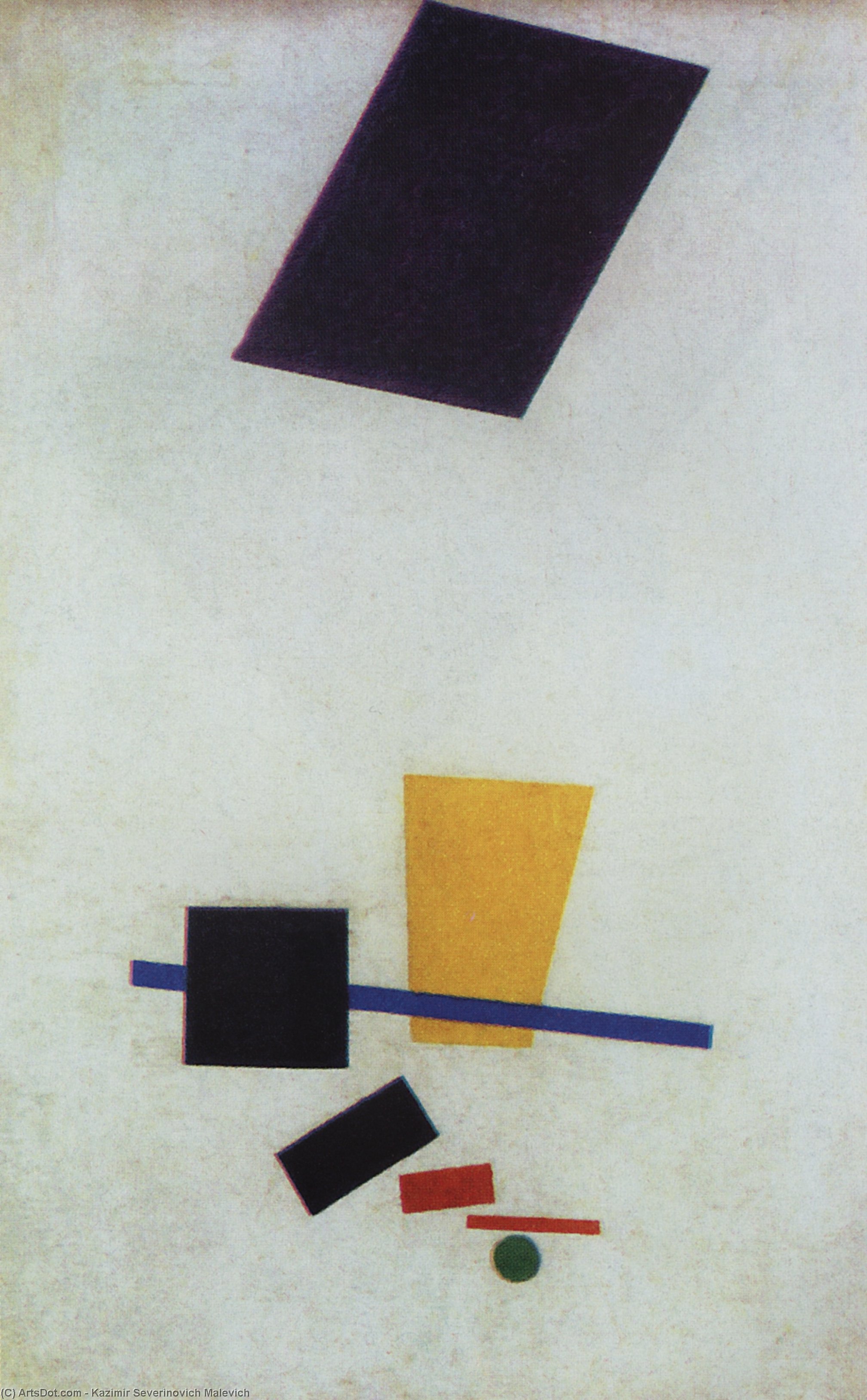
Kazimir Malevich’s Suprematism (13) explodes onto the canvas with a bold black square dominating a pristine white expanse—a revolutionary emblem of geometric abstraction born in 1915. Explore this iconic piece and bring Malevich's groundbreaking vision into your home.
Kazimir Malevich (1878-1935): Ukrainian founder of Suprematism & pioneer of abstract art. Explore iconic works like Black Square, geometric forms, & pure feeling's impact on 20thC art.
Suprematism (13): A Bold Statement Against Representation
Kazimir Malevich’s Suprematism (13), painted in 1915, stands as a monumental achievement of abstract art and a cornerstone of the Russian avant-garde. More than just a visual experiment, it embodies a profound philosophical rejection of traditional artistic conventions—a deliberate dismantling of illusion and an assertion of pure geometric form as the ultimate expression of human consciousness. This painting isn’t merely about color and shape; it's about conveying an idea, a spiritual quest for transcendence.
The Genesis of Geometric Suprematism
Malevich’s journey to abstraction began with influences ranging from Ukrainian folk art—a connection to his roots—to the vibrant energy of Parisian avant-garde circles. He had absorbed Impressionism, Symbolism, Fauvism and Cubism before decisively abandoning representational imagery altogether. The trip to Paris in 1912 proved transformative, immersing him in the revolutionary ideas circulating amongst artists like Picasso and Braque who were actively dismantling perspectival space and exploring fragmented forms. This exposure fueled his conviction that art should liberate itself from mimetic constraints—that it could communicate directly with the viewer’s intellect and emotions without relying on visual deception.
A Composition of Pure Form: Technique and Visual Impact
The painting itself is deceptively simple in its execution. Against a stark white background, Malevich employs a bold black square – dominating the center – flanked by smaller squares of varying hues. Two circles punctuate the composition, positioned strategically at opposite corners. The technique—characterized by meticulous brushwork and careful consideration of color placement—is designed to maximize visual impact. Malevich utilized tempera on canvas, applying thin layers of pigment with precision to achieve a luminous surface that emphasizes the purity of geometric shapes. The deliberate flatness of the painting reinforces its conceptual core: it rejects depth and illusion, presenting instead an idealized vision of reality stripped down to its essential elements.
Symbolism Beyond Color
Beyond its formal qualities, Suprematism is laden with symbolic significance. Malevich’s choice of black—representing negation and emptiness—contrasts sharply with the vibrant colors surrounding it. These colors – predominantly yellow, red, and blue – are not intended to depict objects but rather to evoke emotional responses and convey spiritual ideas. The square itself symbolizes stability and permanence, while simultaneously representing the cosmos—the infinite expanse of space. Malevich believed that these geometric forms could capture the essence of existence, reflecting a desire for unity and transcendence beyond the limitations of sensory experience.
Legacy and Influence
Suprematism profoundly impacted the trajectory of 20th-century art. It served as an inspiration for artists across Europe and solidified Malevich’s position as one of the pioneers of abstract expressionism. Its uncompromising commitment to pure form continues to resonate with contemporary artists and designers who seek to communicate ideas powerfully and aesthetically. Reproductions of Suprematism (13) offer a captivating glimpse into this groundbreaking artistic vision—a testament to Malevich's unwavering belief in the transformative potential of abstraction.