The Essence of Pure Form: A Journey into Suprematism
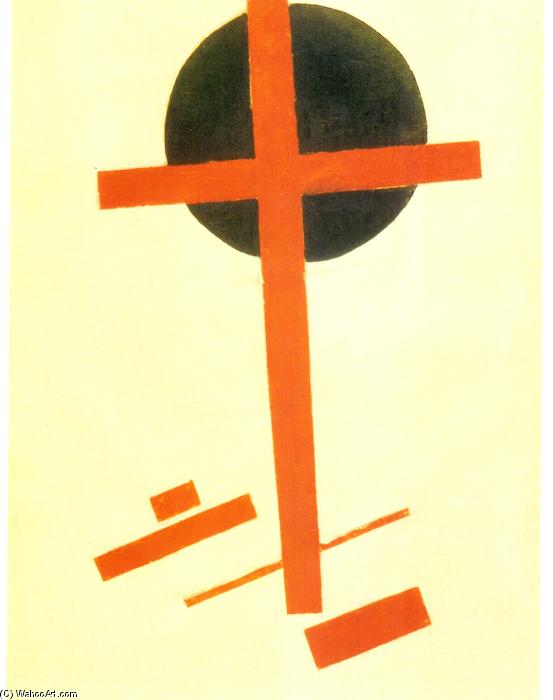
In the vast landscape of twentieth-century modernism, few works command attention with such stark, uncompromising authority as Kazimir Malevich’s Suprematism (20). Created in 1927, this masterpiece serves as a profound manifesto of the avant-garde, capturing a moment when the art world sought to shatter the mirrors of reality and gaze directly into the soul of abstraction. At first glance, the canvas presents a deceptively minimalist arrangement: a bold, dark cross intersected by a vibrant red circle. Yet, to view this work merely as a geometric exercise is to miss its revolutionary heartbeat. It is an invitation to transcend the physical world and enter a realm where color and shape exist in a state of pure, unadutlerated feeling.
The technique employed by Malevich reflects his radical departure from the traditions of the past. Utilizing oil on canvas, the artist eschews the delicate textures of Impressionism or the heavy shadows of Baroque painting in favor of flat, decisive planes of color. There is no attempt at three-dimensional illusion or atmospheric perspective; instead, the power of the piece lies in its planar tension. The way the red circle sits upon the cross creates a rhythmic vibration, a visual pulse that draws the eye into a meditative state. For the discerning collector or interior designer, this painting offers a sophisticated focal point—a piece that does not compete with its surroundings but rather anchors them through its monumental simplicity and structural integrity.
A Revolution of Symbolism and Spirit
To understand Suprematism (20), one must look back to the turbulent era of the Russian avant-garde. Malevich was a pioneer who sought to liberate art from the "shackles" of representational subject matter. While his earlier explorations were steeped in the influences of Cubism and Futurism, by 1927, he had distilled his vision into what he termed Suprematism—the supremacy of pure artistic feeling. The motifs within this specific work carry a heavy symbolic weight; the cross, traditionally a symbol of religious devotion, is recontextualized here. By stripping it of its figurative sanctity and pairing it with the celestial energy of the red circle, Malevich suggests a new, universal spirituality found not in dogma, but in the cosmic harmony of geometry.
This interplay between the dark, grounded weight of the cross and the luminous, floating quality of the red circle evokes a sense of profound balance. It is a visual dialogue between stability and movement, earth and sky. For those looking to integrate fine art into a contemporary living space, this work provides an unparalleled emotional depth. It brings a sense of intellectual rigor and quiet contemplation to any room, acting as a window into a higher dimension of thought. Owning a high-quality reproduction of such a seminal work is more than an aesthetic choice; it is an embrace of the historical courage that defined the birth of modern abstraction.