Kazimir Malevich (1878-1935): Ukrainian founder of Suprematism & pioneer of abstract art. Explore iconic works like Black Square, geometric forms, & pure feeling's impact on 20thC art.
Suprematism (21): A Bold Statement of Geometric Abstraction
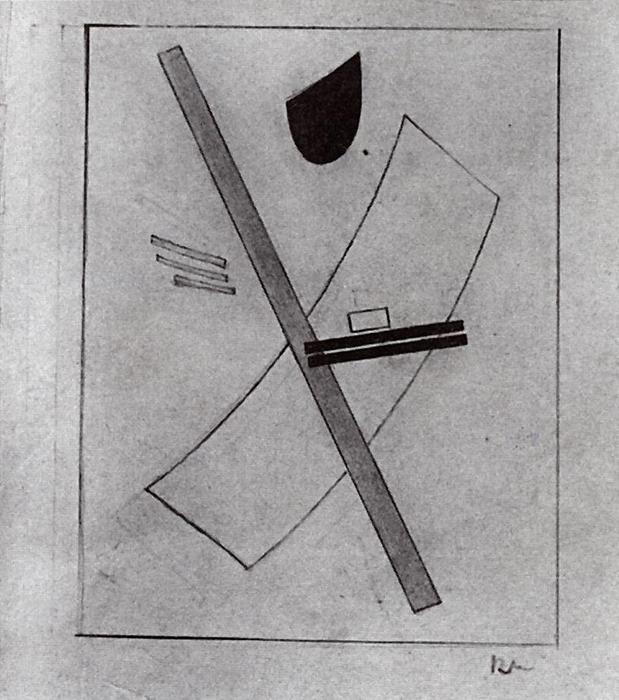
Kazimir Malevich’s “Suprematism” stands as a monumental achievement in the history of art, representing not merely an aesthetic exploration but also a profound philosophical assertion about the nature of visual perception and artistic expression. Created in 1913, this monochrome sketch embodies the core tenets of Suprematism—a movement spearheaded by Malevich himself—and continues to fascinate audiences with its uncompromising simplicity and unsettling power.
The Essence of Geometric Reduction
At first glance, “Suprematism” appears deceptively austere. It’s a black and white drawing executed on paper, dominated by bold diagonal lines intersecting with carefully positioned geometric shapes: a tilted square or rectangle, a horizontal bar, a rounded form resembling a droplet, and several vertical lines clustered together on the left side. Malevich deliberately eschewed representational imagery altogether, rejecting the conventions of Cubism and Futurism that preceded it. Instead, he sought to distill art down to its purest forms—the basic geometric elements—believing they could convey universal truths beyond subjective experience. This radical simplification wasn’t merely stylistic; it was a deliberate attempt to liberate painting from illusionistic representation and tap into the subconscious mind.
A Dynamic Composition Rooted in Line
The composition itself is remarkably dynamic despite its apparent stillness. The prominent diagonal line commands attention, pulling the viewer's gaze upwards and creating tension with the horizontal bar below. These lines aren’t merely decorative; they actively define the spatial relationships between the shapes, suggesting movement and instability. Malevich meticulously crafted each element to contribute to this overall effect—a visual language that speaks of both order and chaos simultaneously. The textured paper surface subtly enhances the impact of these crisp, decisive lines, grounding the abstraction in a tangible material.
Symbolism Beyond Representation
While devoid of recognizable objects or scenes, “Suprematism” possesses an undeniable symbolic resonance. Malevich envisioned his geometric forms as representing spiritual concepts—the "Square" symbolizing the cosmos and the "Circle" embodying unity and eternity. The deliberate imbalance of the composition reflects Malevich’s belief that true artistic expression transcends rational thought, accessing a realm of pure feeling and intuition. It's an artwork designed to provoke contemplation and challenge viewers to reconsider their understanding of art and its role in conveying profound ideas.
Technique and Material Considerations
The drawing technique—likely charcoal or pencil—is characterized by precise lines and careful shading, demonstrating Malevich’s mastery of artistic craft. The paper substrate contributes to the artwork's visual impact, providing a subtle textural contrast to the smooth linearity of the geometric shapes. This meticulous attention to detail underscores Malevich’s commitment to conveying his vision with uncompromising clarity and conviction.
A Legacy of Minimalism
“Suprematism” remains an influential work of art today, serving as a cornerstone of minimalist aesthetics and inspiring generations of artists. Its enduring appeal lies in its ability to communicate complex ideas through the simplest possible means—a testament to Malevich’s genius and his unwavering belief in the transformative power of abstraction. Reproductions offer a remarkable opportunity to experience this iconic artwork firsthand, bringing its bold geometric forms and unsettling stillness into contemporary interiors and collections.