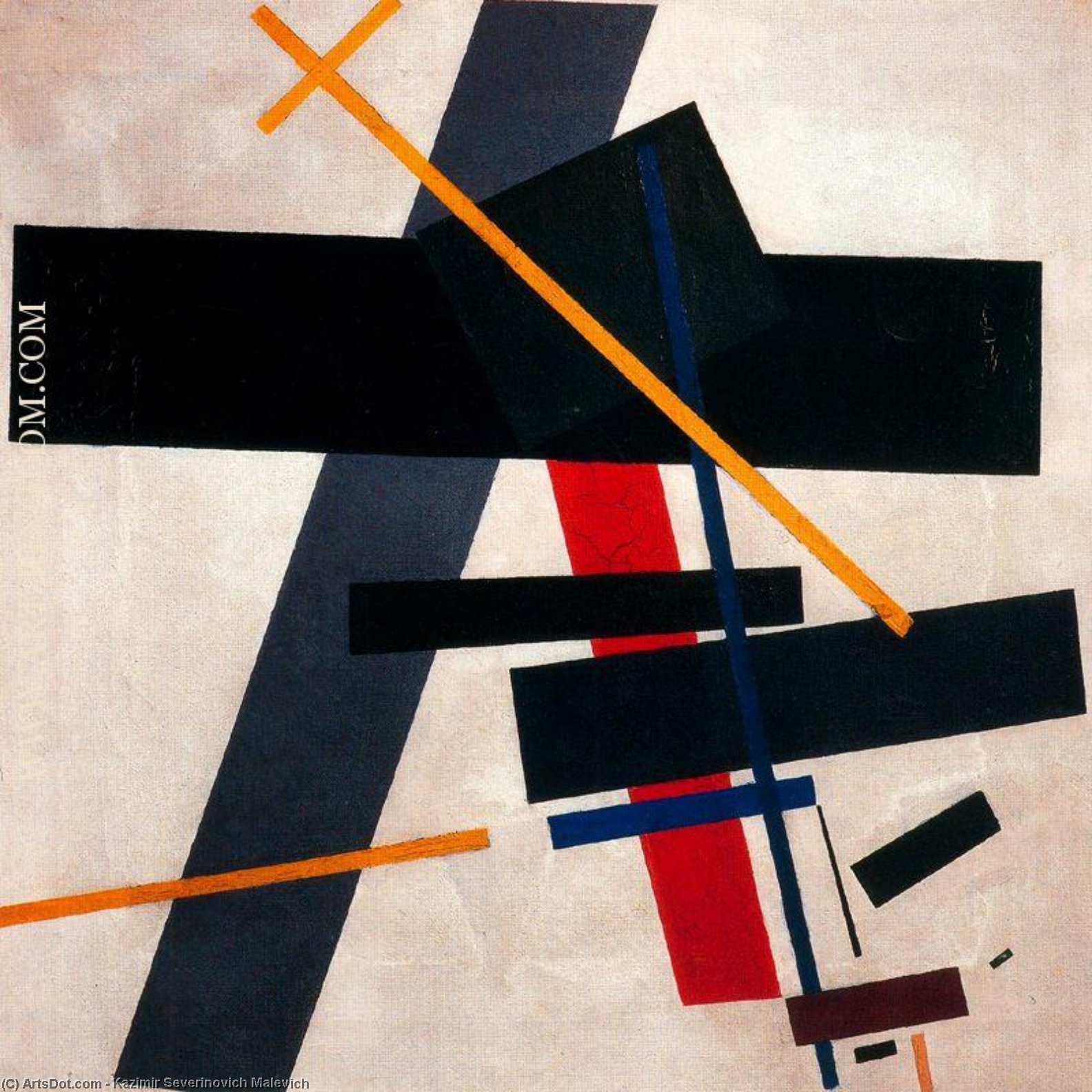
The Architecture of Silence: Rediscovering Suprematism 3
In the vast, turbulent landscape of early twentieth-century modernism, few works possess the quiet, tectonic power of Kazimir Malevich’s Suprematism 3. To gaze upon this canvas is to step away from the noisy, representational world and enter a realm of pure, unadulterated feeling. Created during the feverish years between 1910 and 1915, this masterpiece serves as a visual manifesto for a movement that sought to strip art of its duty to mimic reality. Instead, Malevich offers us a sanctuary of geometry, where the weight of the physical world dissolves into a dance of fundamental forms. It is not merely an arrangement of shapes; it is an exploration of the spiritual void, a deliberate attempt to find truth in the absolute simplicity of a square, a line, and a primary hue.
The composition functions through a sophisticated, almost rhythmic tension. The eye does not rest on a single focal point but is instead invited to wander across a dynamic equilibrium of black, white, and red elements. Bold geometric shapes—rectangles and squares that seem to float in an infinite, weightless expanse—are punctuated by sharp, yellow lines that slice through the composition like sudden bursts of light. This meticulous calibration creates a profound paradox: while the individual elements appear static and stable, their arrangement suggests a latent, kinetic energy. For the discerning collector or interior designer, this piece offers a unique architectural quality, providing a sense of structured movement that can anchor a room with both intellectual depth and modern elegance.
A Revolution Carved in Geometry
To understand the emotional gravity of Suprematism 3, one must look back to the radical shifts occurring in the artist's soul. Malevich, born in the rich cultural tapestry of Ukraine, began his journey through the lenses of Impressionism and Cubism, yet he found these styles too tethered to the "dead weight" of the visible world. He sought a "non-objective" reality—a state where art exists for its own sake, free from the burden of storytelling or portraiture. This painting is the embodiment of that liberation. The use of tempera on primed birch bark, a choice reflecting his connection to raw, elemental materials, lends the work an organic, grounded texture that contrasts beautifully with its abstract subject matter.
The symbolism within the piece transcends simple decoration. The stark contrast between the deep black forms and the pristine white ground represents the struggle between presence and absence, between the known and the infinite. The sudden intrusion of red and yellow acts as a pulse, a heartbeat within the void, reminding the viewer that even in total abstraction, there is life, heat, and vitality. For those looking to integrate fine art into contemporary living spaces, Suprematism 3 provides more than just aesthetic appeal; it offers a meditative focal point. It is a piece that demands contemplation, inviting anyone who stands before its reproduction to find beauty in the balance of chaos and order, and to experience the profound peace found in the essence of form.