The Essence of Pure Feeling: A Journey into Suprematism
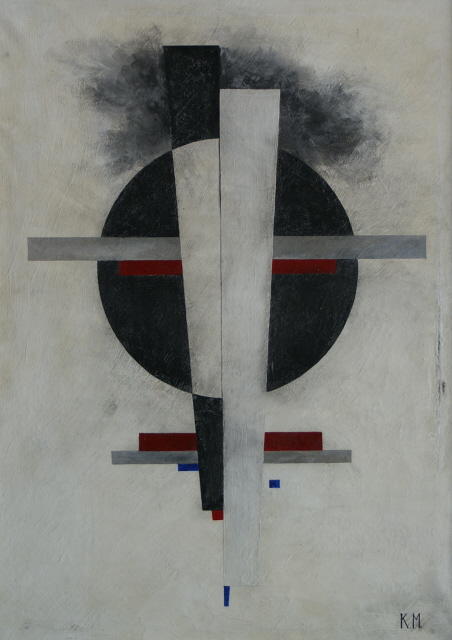
To encounter Kazimir Malevich’s Suprematism is to step away from the noisy, representational world and enter a realm of profound, silent clarity. Completed in 1920, this work serves as a radical manifesto of the early twentieth-century avant-garde, marking a decisive break from the obligation of art to mimic nature. Instead of landscapes or portraits, Malevich presents us with a distilled visual language—a composition where a singular circle, traced with a delicate blue outline, is intersected by a bold red line. This is not merely a geometric exercise; it is an invitation to experience the supremacy of pure feeling, stripped of all worldly distractions and reduced to its most essential, spiritual components.
The piece functions as a window into the "zero point" of creativity. By utilizing black and white lithography on paper, Malevich achieved a level of conceptual precision that avoids any unnecessary decorative flourish. The starkness of the medium forces the viewer to confront the weight of the shapes themselves. There is an undeniable tension in the way the red line cuts through the blue-rimmed circle, creating a sense of dynamic equilibrium. For the modern collector or interior designer, this painting offers a sophisticated focal point that commands attention through its minimalism, providing a sense of intellectual depth and structural balance to any curated space.
Symbolism and the Cosmic Infinite
Beyond its striking visual geometry, Suprematism is steeped in deep philosophical symbolism. The circle, rendered with its ethereal blue boundary, acts as a metaphor for the cosmos—a symbol of infinite space, unity, and the eternal. It represents a state of being that transcends the physical boundaries of our daily lives. When the red line intersects this celestial form, it introduces the concept of the "zero point." This is not an act of destruction or annihilation, but rather a moment of profound beginning. It signifies the birth of pure consciousness and the limitless potential of the human imagination when liberated from the constraints of objective reality.
Malevich’s journey from the lush landscapes of his Ukrainian upbringing to the radical abstractions of the Russian avant-garde is etched into every stroke of this work. He sought to find a "new truth" that could not be found in the imitation of objects, but only in the vibration of color and the arrangement of form. For those seeking to decorate a contemporary environment, this artwork brings an aura of contemplative stillness. It serves as a reminder that within simplicity lies complexity, and within the void, there is infinite possibility.
A Timeless Legacy for Modern Interiors
In the context of modern art history, Malevich’s 1920 masterpiece remains an undiminable cornerstone of abstraction. Its influence can be felt in everything from mid-century modernism to contemporary minimalist architecture. The painting does not merely sit upon a wall; it transforms the atmosphere of a room, injecting a sense of historical importance and avant-garde spirit. Whether placed in a professional gallery setting or as a centerpiece in a high-end residential lounge, its clean lines and striking contrast harmonize beautifully with modern textures like polished concrete, natural wood, or sleek glass.
Owning a high-quality reproduction of this work allows one to possess a fragment of the revolution that redefined what art could be. It is an investment in a legacy of courage—the courage to strip away the known and embrace the unknown. For the discerning eye, Suprematism is more than a painting; it is a profound encounter with the infinite, captured in a moment of perfect, geometric grace.