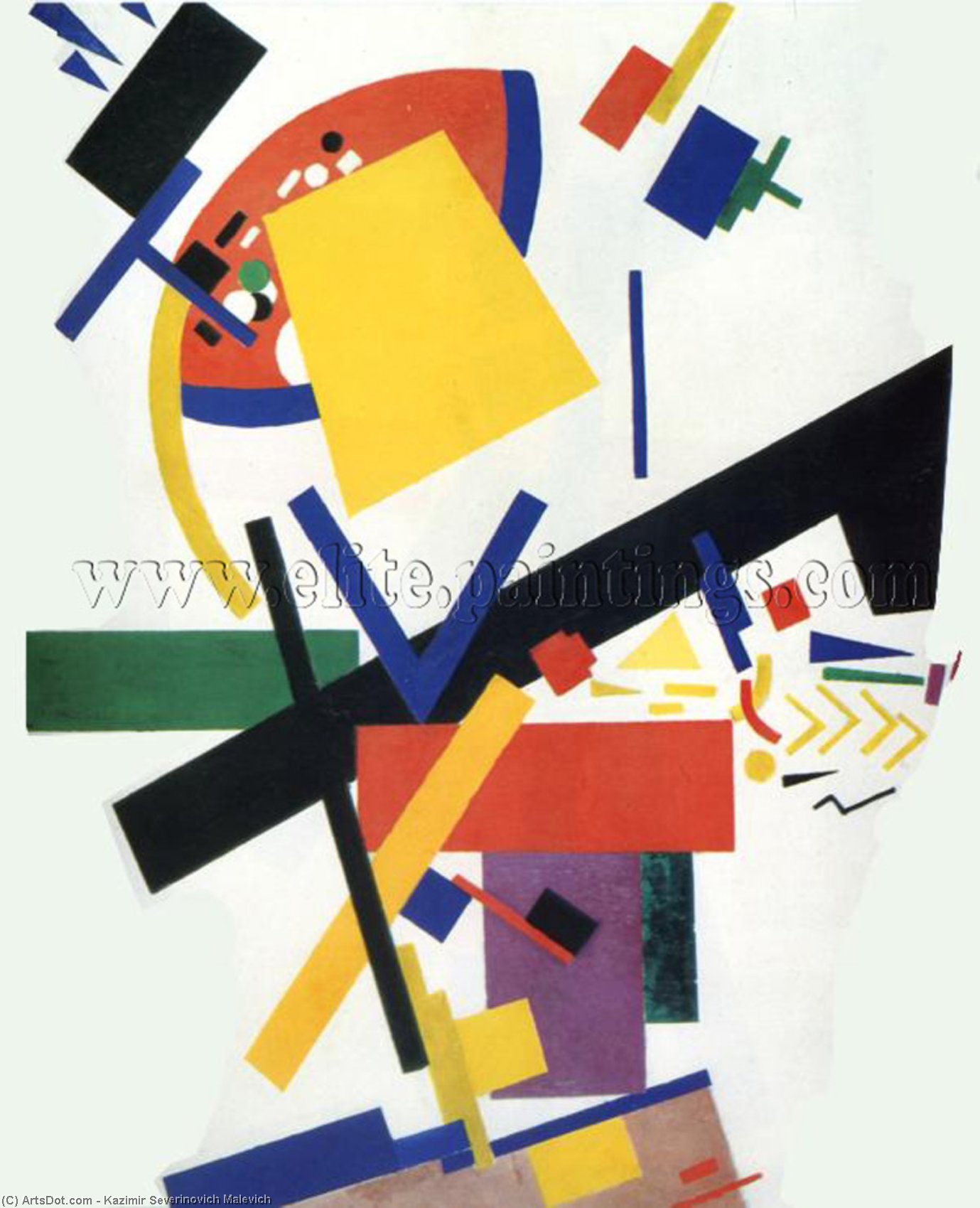
Experience Kazimir Malevich’s Suprematism – a bold geometric abstraction featuring a dominant red circle surrounded by yellow and blue hues, embodying the revolutionary spirit of 1915 Russian art. Explore this iconic masterpiece and bring its timeless beauty into your home.
Kazimir Malevich (1878-1935): Ukrainian founder of Suprematism & pioneer of abstract art. Explore iconic works like Black Square, geometric forms, & pure feeling's impact on 20thC art.
Suprematism: A Bold Statement Against Representation
The painting “Suprematism,” created by Kazimir Malevich in 1915, stands as a monumental achievement of abstract art and a cornerstone of the Russian avant-garde. More than just a visual experiment, it represents a radical rejection of traditional artistic conventions—a deliberate dismantling of illusionism to arrive at pure geometric form. This striking image depicts a single red circle surrounded by concentric yellow and blue circles, an arrangement that immediately commands attention and invites contemplation.
The Genesis of Geometric Suprematism
Malevich’s artistic journey began with influences rooted in Ukrainian folk art and broadened dramatically through his Parisian encounters. Initially dabbling in Impressionism, Symbolism, Fauvism, and Cubism—styles prevalent at the time—he recognized their limitations in conveying profound emotional truths. The Parisian trip solidified this conviction; Malevich was captivated by the dynamism of Futurism and Constructivism, movements that championed technological progress and challenged established artistic hierarchies. However, it was his own internal quest for a new visual language that ultimately propelled him toward Suprematism.
A Technique Defined by Simplicity
The execution of “Suprematism” is remarkably understated yet profoundly impactful. Malevich employed a meticulous layering technique—primarily using oil paints—to achieve the luminous quality of the circles. He meticulously applied thin washes of color, building up tonal variations to create depth and texture without resorting to realistic depiction. The deliberate flatness of the composition reinforces the artist’s intention: to eliminate perspective and illusionistic space, focusing solely on the fundamental elements of geometric abstraction. This technique prioritizes clarity and purity of form, mirroring Malevich's philosophical belief that art should transcend subjective experience and communicate universal truths.
Symbolism Beyond Color
While seemingly simple in its visual vocabulary, “Suprematism” is laden with symbolic significance. The red circle—Malevich’s iconic motif—represents the sun, symbolizing life force and spiritual energy. Its dominance asserts itself as a primal element, embodying the essence of existence. Surrounding it are concentric yellow and blue circles, which represent complementary colors believed to harmonize and balance each other. These hues evoke feelings of serenity and contemplation, countering the anxieties of wartime Europe. The repetition of circles underscores Malevich’s conviction that geometric forms embody the fundamental building blocks of reality—a concept central to his philosophical worldview.
A Legacy of Artistic Revolution
“Suprematism” irrevocably altered the course of art history, establishing Malevich as a prophet of abstraction and inspiring generations of artists. It signaled the triumph of intellect over emotion, prioritizing conceptual clarity over visual realism. Its influence extends far beyond the realm of painting, impacting architecture, design, and even theater. Today, reproductions of this seminal artwork continue to resonate with collectors and interior designers alike—serving as a reminder that art can communicate profound ideas without relying on conventional imagery. It remains a testament to Malevich’s unwavering commitment to artistic innovation and his enduring vision of a world liberated from illusion.