Kazimir Malevich’s Suprematism (9): A Radical Declaration of Form
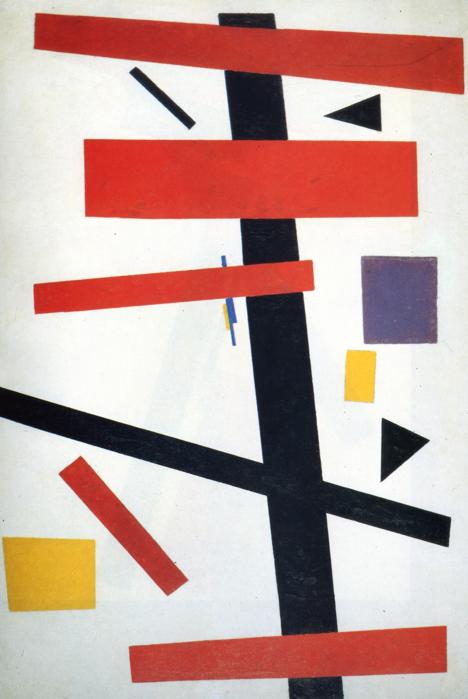
This striking artwork, titled "Suprematism (9)," offers a profound glimpse into the revolutionary artistic vision of Kazimir Malevich, one of the pioneers of abstract art. Executed in 1915, this piece transcends mere representation, embodying a radical shift towards pure geometric form and color – a cornerstone of the Suprematist movement that would profoundly influence 20th-century art.
The composition immediately commands attention with its bold juxtaposition of a vibrant red cross against a stark black background. However, to reduce this work solely to a simple cross is to miss its deeper significance. Scattered throughout the foreground are meticulously arranged triangles and circles, creating a dynamic interplay of shapes that seem to float within the space. These forms aren’t merely decorative; they represent Malevich's attempt to distill art down to its most fundamental elements – pure feeling expressed through geometric abstraction. The small circles in the lower right corner add an element of subtle complexity, perhaps hinting at the cyclical nature of existence or the universe itself.
The Birth of Suprematism: Context and Influences
Created during a period of immense social and artistic upheaval – the early 20th century – "Suprematism (9)" reflects Malevich’s desire to break free from traditional representational art. His journey began in Kyiv Oblast, Ukraine, where he absorbed the influence of Ukrainian folk art and its emphasis on symbolic imagery. This foundation informed his later explorations of Impressionism, Symbolism, Fauvism, and Cubism before he embarked on his radical experiment.
A pivotal moment arrived with his 1912 trip to Paris, exposing him to the avant-garde movements flourishing across Europe. This immersion fueled his desire for a completely new artistic language – one that prioritized pure feeling over objective reality. Malevich sought to create art that would be universally understood and timeless, unburdened by the constraints of depicting the visible world.
Decoding the Symbolism: Red, Black, and Geometric Forms
The color palette itself is laden with symbolic weight. The red cross, a potent emblem of faith and sacrifice, is stripped of its religious connotations within Suprematism, becoming a pure visual element. The black background represents emptiness, void, or the infinite – a canvas upon which Malevich’s geometric forms could exist without limitation. The triangles, often associated with stability and spiritual ascent, are arranged in a deliberate manner to create a sense of dynamism and movement. Circles, representing wholeness and unity, provide a grounding element within this otherwise abstract composition.
Malevich believed that these shapes possessed an inherent power to evoke emotion and convey meaning directly to the viewer, bypassing the need for narrative or subject matter. “Suprematism (9)” is not simply a painting; it’s a declaration – a bold assertion of form as the ultimate expression of artistic truth.
Technical Details & Acquisition
This hand-painted reproduction faithfully captures the essence of Malevich's original work, meticulously recreating the layering and texture achieved through his distinctive technique. Measuring 97 x 66 cm, this artwork is ideally suited for a variety of interior design settings – from modern minimalist spaces to more eclectic environments. It’s a powerful statement piece that will undoubtedly spark conversation and admiration.