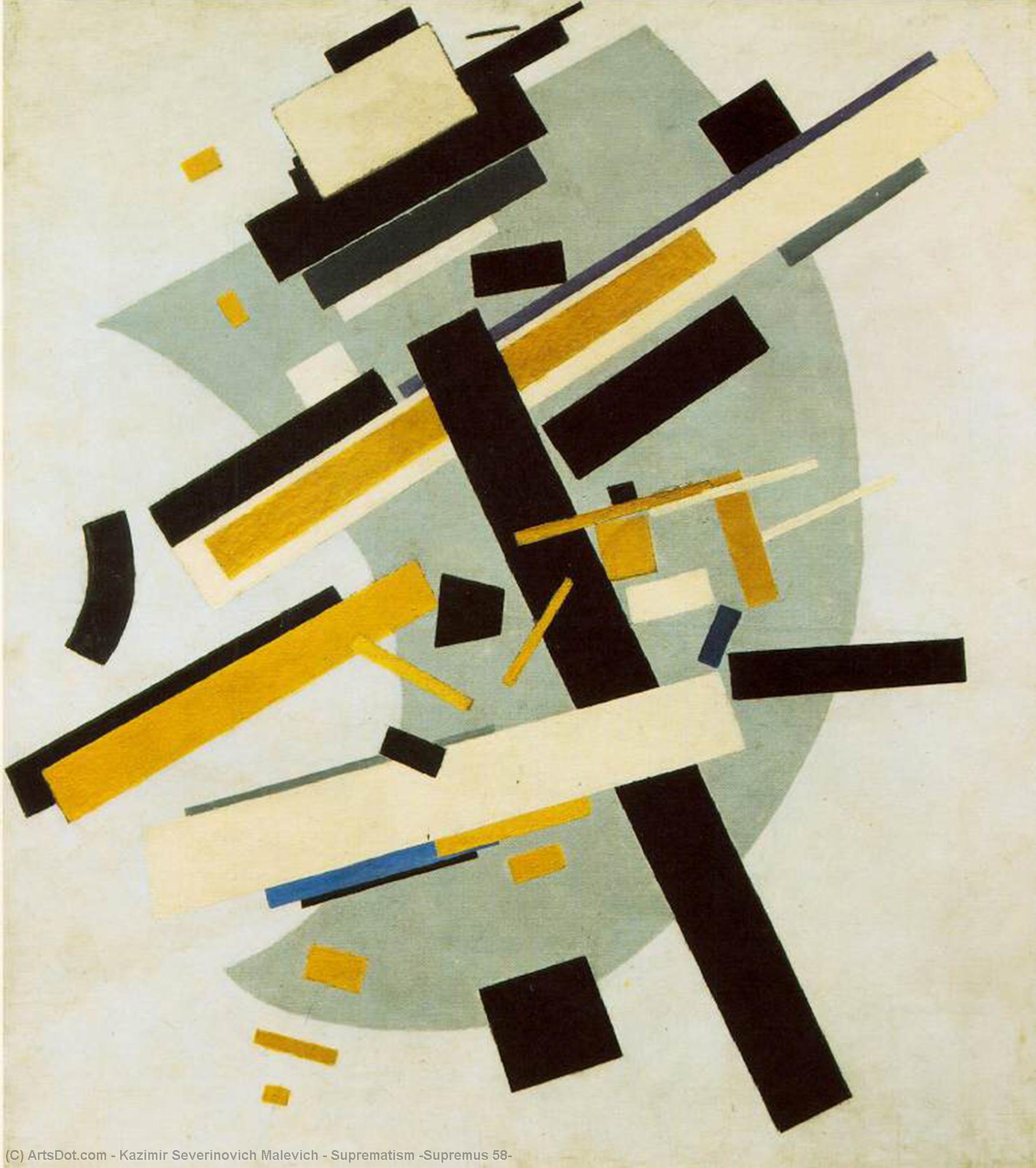
Suprematism (Supremus 58): A Bold Leap into Pure Feeling
Kazimir Malevich’s Supremus 58 stands as a cornerstone of abstract art, encapsulating the revolutionary spirit of Suprematism – a movement that irrevocably altered the trajectory of artistic expression in the early 20th century. Founded in Moscow in 1913, Suprematism rejected representational imagery altogether, prioritizing geometric forms and a deliberately restrained color palette to unlock what Malevich termed “the supremacy of pure feeling.” This wasn’t merely about aesthetics; it was a profound philosophical assertion – an attempt to transcend the limitations of perception and access a realm beyond visual representation.
- Artist: Kazimir Severinovich Malevich (1879-1935)
- Nationality: Russian
- Movement: Suprematism
- Date Created: 1916
- Medium: Oil on Canvas
The painting itself is deceptively simple. At first glance, it presents a striking composition dominated by a large circle bisected by horizontal and vertical lines. Smaller circles are strategically positioned within the larger one, creating an intricate interplay of shapes that defies easy categorization. However, beneath this apparent visual minimalism lies a complex conceptual framework rooted in Malevich’s unwavering belief in the transformative power of abstraction.
Historical Context: Suprematism emerged during a period of intense artistic experimentation and intellectual ferment—the aftermath of World War I and the burgeoning influence of avant-garde ideas. Malevich's declaration that art should liberate itself from the constraints of objective reality resonated deeply with artists grappling with new ways to express emotion and explore spiritual concepts. The painting was created in 1916, a pivotal year marked by escalating tensions leading up to the outbreak of World War I.
Symbolism & Technique: Malevich’s deliberate use of color—primarily yellow and black against a stark white background—was not arbitrary. Yellow represented optimism and spiritual energy, while black symbolized negation and death – concepts deliberately juxtaposed to provoke contemplation and challenge conventional artistic conventions. The geometric forms themselves weren't merely decorative; they functioned as visual metaphors for fundamental principles of existence. Malevich’s meticulous brushwork contributes to the painting’s textural richness, emphasizing the materiality of the canvas and grounding the abstract forms in a tangible reality.
Emotional Impact: Supremus 58 transcends mere visual depiction; it aims to elicit an emotional response from the viewer. The stark simplicity forces contemplation on the nature of perception and invites viewers to consider alternative ways of experiencing the world. It’s a painting that speaks to the core of Malevich's artistic vision—a desire to bypass rational thought and tap into the subconscious realm where pure feeling reigns supreme.
Further Information: You can delve deeper into Suprematism and Kazimir Malevich’s legacy at ArtsDot.com or explore related resources on Wikipedia: Wikipedia. Don’t miss the opportunity to visit The State Russian Museum in St. Petersburg, Russia, where numerous Malevich masterpieces reside.