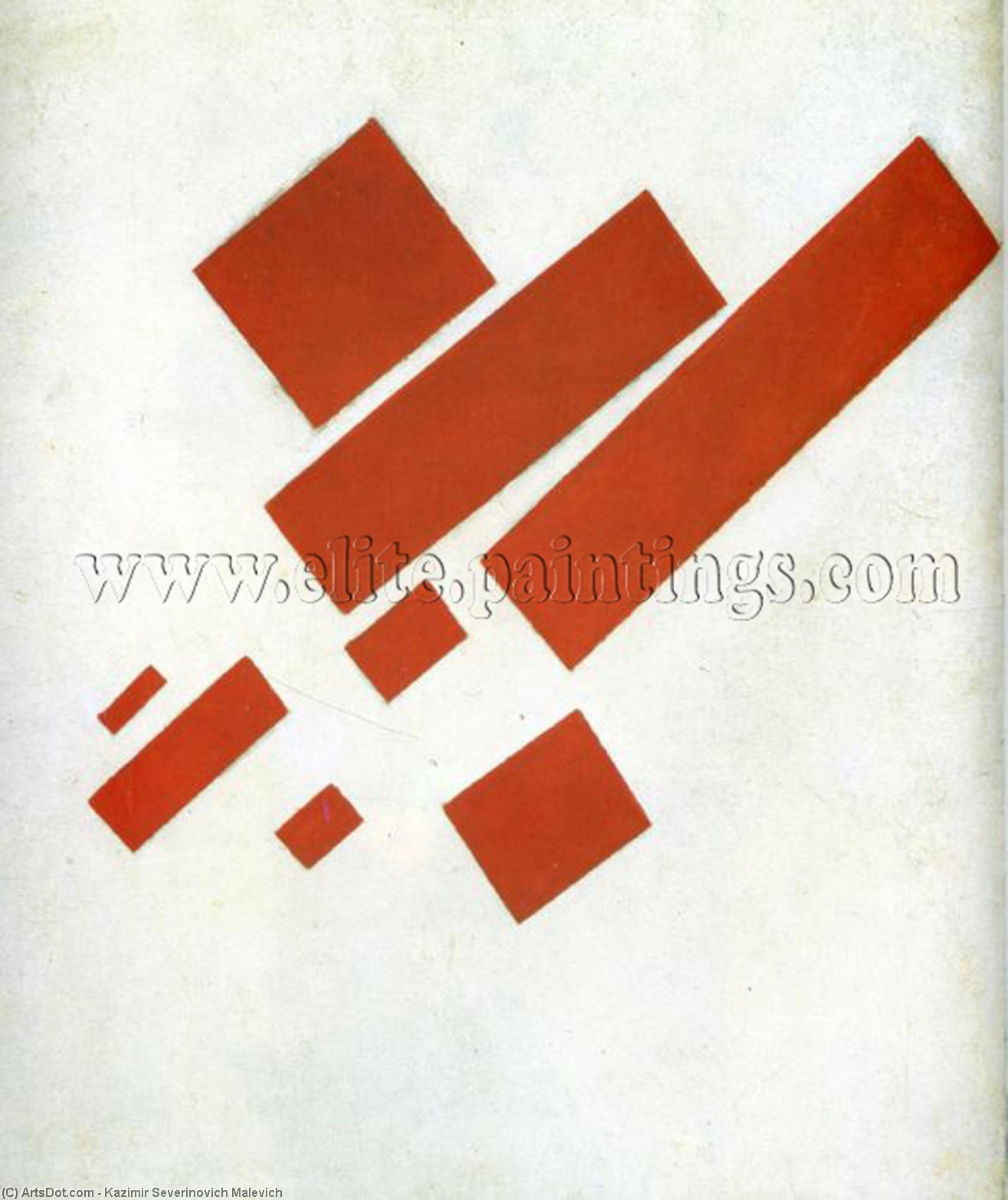
Kazimir Malevich’s Suprematism masterpiece explodes onto canvas with bold red squares against pristine white—a revolutionary exploration of geometric abstraction born in 1915. Witness the genesis of modern art and bring home this iconic piece.
Kazimir Malevich (1878-1935): Ukrainian founder of Suprematism & pioneer of abstract art. Explore iconic works like Black Square, geometric forms, & pure feeling's impact on 20thC art.
Suprematism. Two Dimensional Self Portrait – A Bold Statement of Geometric Abstraction
Kazimir Malevich’s “Suprematism. Two Dimensional Self Portrait,” painted in 1915, stands as a cornerstone of abstract art and embodies the radical spirit of its time. This monumental canvas—measuring 80 x 62 cm—immediately confronts the viewer with an uncompromising visual language: a stark white background punctuated by four prominent red squares and rectangles arranged in complex patterns. It’s not merely a painting; it's a declaration, a rejection of traditional artistic conventions and a fervent belief in the primacy of pure geometric form as expressive medium.
The Genesis of Suprematism
Malevich’s journey to abstraction began amidst the vibrant intellectual ferment of Moscow’s avant-garde scene following his influential visit to Paris in 1912. Inspired by Cubism's fragmentation and Futurism’s dynamism, he sought a more profound articulation of artistic ideas—one that transcended mere imitation of reality. Alongside artists like Vladimir Tatlin and Aleksandr Rodchenko, Malevich championed Suprematism – “Supermatism” – as a revolutionary aesthetic philosophy rooted in the concept of “zero consciousness.” This wasn't about eliminating color or texture; it was about stripping away everything superfluous to arrive at the purest possible visual experience—a realm where form alone dictated meaning.
Technique and Composition: Precision Meets Emotion
The execution of "Suprematism. Two Dimensional Self Portrait" exemplifies Malevich’s meticulous approach to abstraction. Using tempera on canvas, he achieved remarkable tonal precision, capturing subtle variations in shade within the dominant red hues. The arrangement of the squares isn't random; it’s deliberately conceived as a visual hierarchy—the larger square positioned centrally commands attention while smaller rectangles contribute to an overall sense of balance and dynamism. Despite its apparent simplicity, the composition is remarkably sophisticated, reflecting Malevich’s deep understanding of geometric principles and their capacity to convey emotional resonance.
Symbolism Beyond Representation
While devoid of recognizable imagery, “Suprematism. Two Dimensional Self Portrait” resonates with powerful symbolic significance. The red square—a color traditionally associated with passion, energy, and spirituality—represents the fundamental element of existence: pure feeling. Malevich believed that art should liberate the human spirit from the constraints of illusion and engage directly with the viewer’s subconscious mind. The geometric abstraction isn't merely a stylistic choice; it’s an attempt to capture the essence of consciousness itself – a quest for universal harmony achieved through reductive visual language.
A Legacy of Bold Innovation
“Suprematism. Two Dimensional Self Portrait” cemented Malevich’s position as one of the most important figures in 20th-century art history. Its influence extended far beyond Russia, inspiring artists across Europe and shaping the trajectory of abstract expressionism. Today, reproductions of this iconic artwork continue to captivate audiences with its uncompromising vision and enduring power—a testament to Malevich’s unwavering commitment to artistic experimentation and his profound belief in the transformative potential of geometric abstraction.