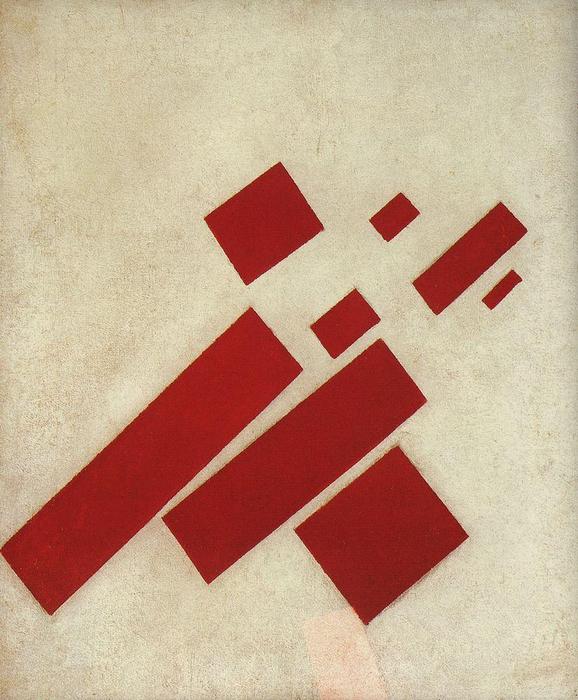
Kazimir Malevich’s Suprematism with Eight Rectangles: A Bold Declaration of Form
Suprematism with eight rectangles, painted in 1915 by the visionary Kazimir Malevich, stands as a monumental testament to the birth of abstract art. This striking composition – a dominant red square encircled by eight smaller squares – isn’t merely a painting; it's a radical assertion of pure feeling and form, a rejection of representational imagery in favor of an intensely spiritual and geometric language. Malevich, born in Kyiv Oblast, Ukraine in 1878, was already a figure grappling with artistic evolution before this pivotal work. His early influences, rooted in the Ukrainian folk traditions and his exposure to European avant-garde movements, culminated in this singular moment of artistic liberation.
The Genesis of Suprematism
- Context: Created during a period of immense social and political upheaval – the dawn of the 20th century marked by rapid industrialization, war, and revolutionary ideas – *Suprematism with eight rectangles* reflects a desire to strip away the superficial layers of reality and confront viewers with fundamental truths.
- Theoretical Foundation: Malevich developed Suprematism as a philosophical movement alongside his art. It aimed to achieve “pure feeling” through non-objective shapes, rejecting illusionism and advocating for art that directly expressed spiritual concepts.
- Geometric Reduction: The painting’s power lies in its distilled essence – the reduction of all forms to their most basic geometric elements: squares, circles, and lines. This simplification wasn't arbitrary; it was a deliberate attempt to transcend the limitations of perspective and create a visual experience that bypassed the intellect and appealed directly to the viewer’s emotions.
Technique and Materiality – A Red Statement
The painting’s impact is immediately heightened by Malevich's masterful use of color and technique. The dominant red, a hue associated with passion, energy, and spirituality, commands immediate attention. While the exact materials used remain somewhat debated amongst scholars, it’s believed that Malevich employed oil paints on canvas, applying them in layers to build up depth and intensity. The bold, almost brutal application of paint contributes to the work's raw power and uncompromising aesthetic. The precision with which the smaller squares are arranged around the central square speaks to a meticulous process, yet the overall effect is one of spontaneous creation.
Symbolic Resonance – Beyond Representation
Beyond its formal qualities, *Suprematism with eight rectangles* carries significant symbolic weight. The large red square can be interpreted as representing “the Suprematist Square,” a symbol of absolute spiritual freedom and the ultimate goal of Malevich’s artistic vision. The smaller squares surrounding it are often seen as representing the various aspects of reality that have been subsumed within this fundamental form. The arrangement itself – concentric circles, echoing ancient cosmological diagrams – suggests a desire to capture the essence of the universe in its most basic state. This work is not about depicting a scene; it’s about evoking a feeling, a spiritual experience rooted in pure geometric abstraction.
A Legacy of Innovation
Kazimir Malevich's *Suprematism with eight rectangles* remains one of the most influential works of modern art. It fundamentally altered the course of artistic history, paving the way for movements like Constructivism and influencing generations of artists who sought to explore the possibilities of abstraction. A hand-painted reproduction offers a unique opportunity to experience this pivotal moment in art history firsthand, bringing Malevich’s radical vision into your space.