A World Reduced to Form: Exploring Kazimir Malevich's *Suprematist Drawing*
Kazimir Malevich, a pivotal figure in the 20th-century art world, didn’t simply paint; he sought to dismantle the very foundations of representation. His Suprematism movement, born from the tumultuous backdrop of early 20th-century Russia, aimed to transcend the limitations of depicting the external world and tap into a realm of pure feeling and spiritual essence. *Suprematist Drawing*, a deceptively simple composition of geometric shapes rendered in stark black and white, stands as a foundational testament to this radical vision – a visual distillation of Malevich’s core principles and a gateway into understanding his revolutionary approach to art.
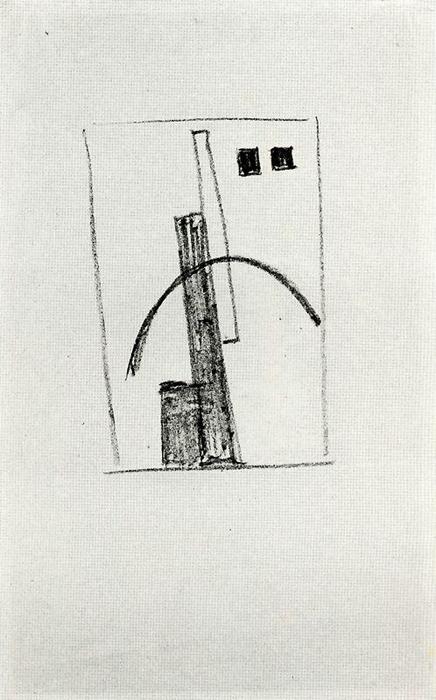
The drawing itself is remarkably restrained. A central vertical rectangle dominates the canvas, acting as an anchor for a series of carefully positioned elements. A curved arc, reminiscent of a segment of a circle or perhaps a simplified wing, intersects this rectangle diagonally from the lower right, creating a dynamic tension within the composition. Smaller squares are strategically placed in the upper left corner, adding to the sense of balance and controlled asymmetry. The entire arrangement is contained within a roughly drawn rectangular border – a subtle reminder of the canvas itself, grounding the abstract forms in a tangible reality.
The Language of Pure Feeling: Suprematism’s Theoretical Underpinnings
To fully appreciate *Suprematist Drawing*, it's crucial to understand the theoretical framework that underpinned Malevich’s artistic endeavors. Suprematism wasn’t merely an aesthetic choice; it was a deliberate philosophical and spiritual project. Rejecting the conventions of Western art, which he felt were rooted in imitation of nature, Malevich sought to create art that existed independently of any representational reference. He believed that true artistic expression could be found by reducing forms to their most fundamental elements – squares, circles, lines – stripping away all traces of illusion and subjectivity. This pursuit was deeply influenced by Russian mystical traditions and theories of non-Euclidean space, suggesting a reality beyond the confines of our everyday perception.
Malevich’s manifesto, “The Non-Objective World,” articulated this philosophy with striking clarity: "Art must be objective." This wasn't simply about depicting objects accurately; it was about creating an art that communicated directly through feeling and intuition. The geometric forms themselves were intended to evoke specific emotional responses – a sense of dynamism, balance, and spiritual transcendence. The stark black and white palette further amplified this effect, eliminating the distraction of color and focusing attention on the essential shapes and their relationships.
A Legacy in Geometry: Historical Context and Influence
*Suprematist Drawing* emerged during a period of profound social and political upheaval in Russia. The Russian Revolution of 1917 had shattered traditional values and ushered in an era of radical experimentation across all fields, including art. Malevich’s work resonated deeply with the revolutionary spirit of the time, offering a visual language for expressing new ideas about freedom, spirituality, and the potential of human consciousness. His exploration of pure abstraction paved the way for subsequent movements such as Constructivism and De Stijl, profoundly influencing generations of artists.
The drawing’s influence extends beyond its purely artistic merit. It represents a pivotal moment in the history of art – a bold assertion that art could exist independently of representation, opening up entirely new possibilities for creative expression. *Suprematist Drawing* remains a powerful symbol of this revolutionary spirit and a testament to Malevich's enduring legacy as one of the most important artists of the 20th century.