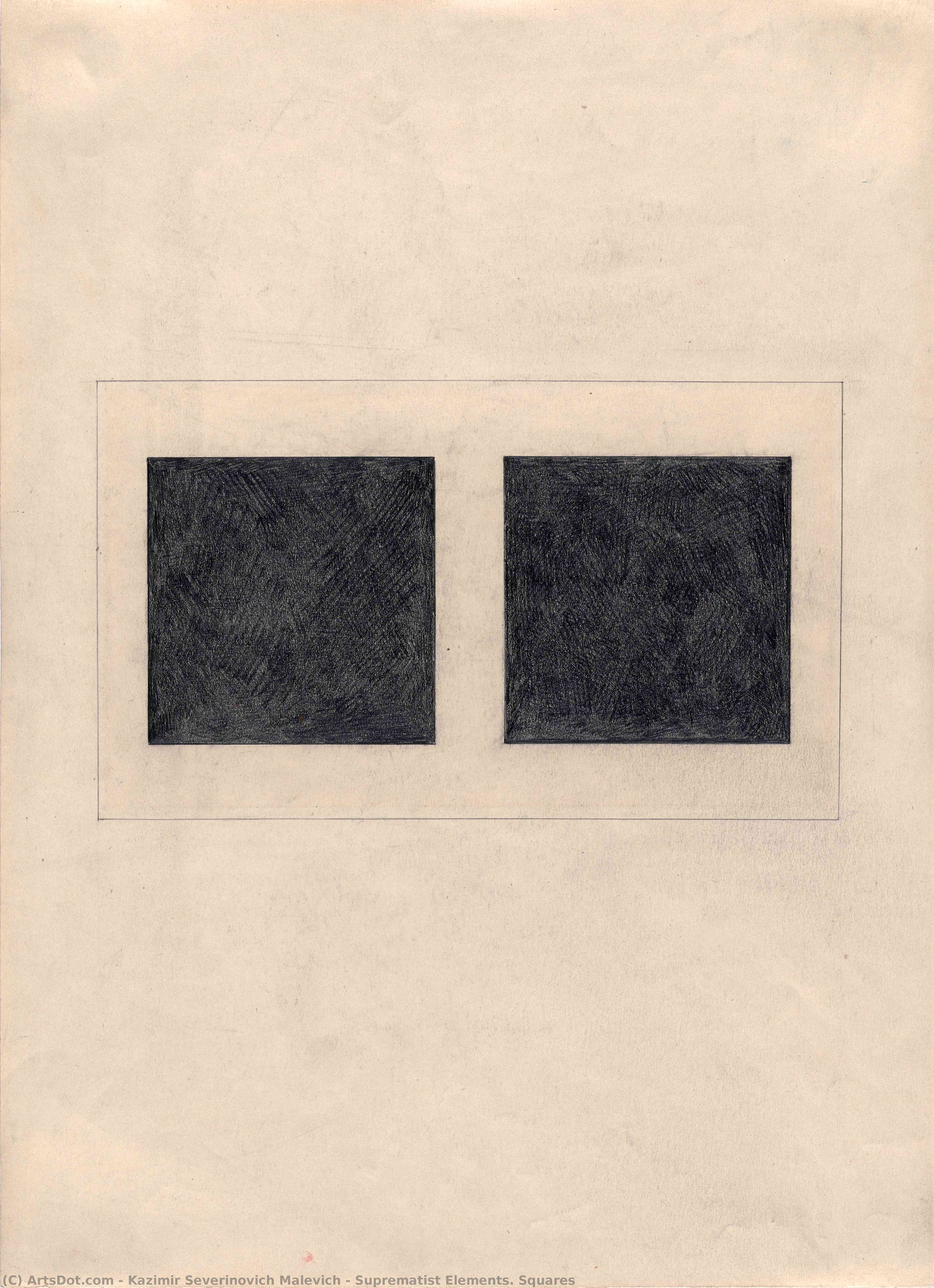
Suprematist Elements. Squares: A Journey into Pure Abstraction
Kazimir Malevich's "Suprematist Elements. Squares," created in 1923, stands as a pivotal work within the Suprematist movement and a cornerstone of abstract art history. This seemingly simple composition—two large squares positioned centrally against a pale beige background—holds profound implications for our understanding of artistic expression and the pursuit of pure feeling.
Geometric Abstraction: The Essence of Suprematism
Suprematism, coined by Malevich himself, sought to transcend representational art entirely. It aimed to express pure feeling through basic geometric forms – squares, circles, rectangles, and lines – liberated from any connection to the natural world. "Suprematist Elements. Squares" exemplifies this philosophy perfectly. The painting isn't about depicting an object or scene; it’s about exploring the inherent qualities of shape, color, and spatial relationships. Malevich believed that by stripping away all extraneous details, he could access a realm of pure artistic sensation—a "supremacy" of feeling.
Composition and Technique: Balance and Simplicity
The composition is remarkably balanced and symmetrical. Two dominant squares, rendered in dark gray ink, anchor the visual field. Smaller squares surround them, creating a sense of order and harmony. The use of black and white tones—or rather, varying shades of gray against the beige background—adds depth and contrast, drawing the viewer's eye to the geometric forms. Malevich employed a dry ink drawing technique, likely using a brush or pen, which resulted in a grainy texture within the darker areas. This textural quality adds another layer of visual interest to an otherwise minimalist work.
Historical Context: Revolution and Artistic Innovation
Created in 1923, "Suprematist Elements. Squares" emerged during a period of significant social and political upheaval in Russia following the Bolshevik Revolution. Malevich's Suprematism was part of a broader avant-garde movement that sought to break with tradition and forge new artistic paths aligned with the revolutionary spirit. However, the Soviet government’s evolving ideological stance eventually led to restrictions on abstract art, forcing artists like Malevich to navigate complex political landscapes while pursuing their creative visions. This painting reflects both the innovative fervor of the era and the challenges faced by avant-garde artists in a changing world.
Emotional Impact: Contemplation and Transcendence
Despite its apparent simplicity, "Suprematist Elements. Squares" evokes a powerful emotional response. The starkness of the composition encourages contemplation and invites viewers to engage with the work on a purely sensory level. There's a sense of quietude and stillness, as if suspended in a timeless space. Malevich’s intention was not to convey specific emotions but rather to create a platform for individual feeling—a space where viewers could project their own experiences and interpretations onto the abstract forms. The painting ultimately transcends its materiality, offering a glimpse into the realm of pure artistic expression and spiritual transcendence.