Kazimir Malevich (1878-1935): Ukrainian founder of Suprematism & pioneer of abstract art. Explore iconic works like Black Square, geometric forms, & pure feeling's impact on 20thC art.
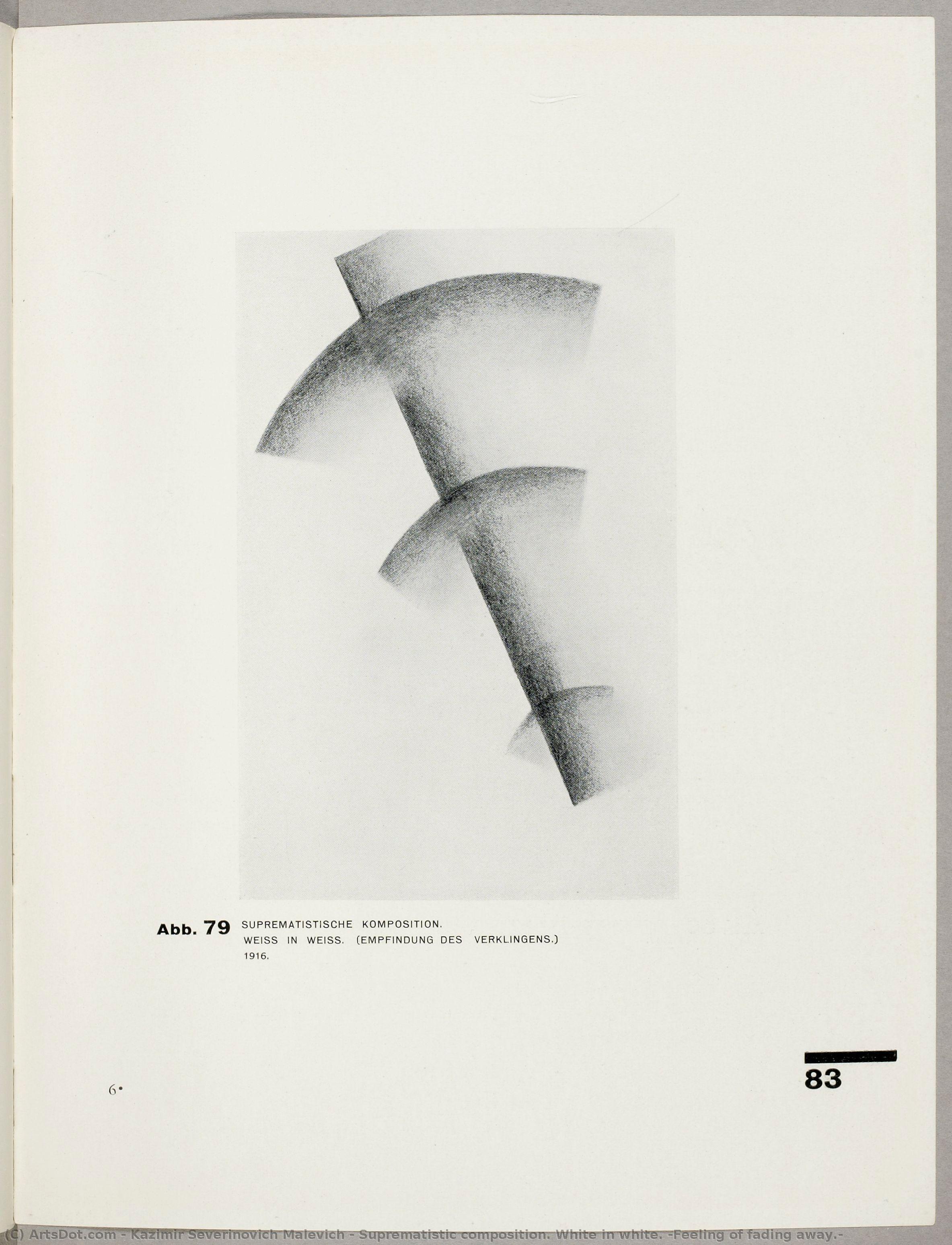
Kazimir Malevich: Suprematistic Composition – White on White (Feeling of Fading Away)
Kazimir Malevich’s “Suprematistic Composition: White on White” stands as an emblem of radical abstraction, born from the crucible of the Russian avant-garde and embodying a profound philosophical quest for pure feeling. Painted in 1927, this deceptively simple artwork—a monochrome square superimposed upon another white square—represents more than just visual form; it encapsulates Malevich’s audacious assertion that art should transcend representational illusion and tap into the primal essence of human experience.
A Revolutionary Aesthetic
Malevich’s Suprematism emerged from a fervent desire to liberate painting from the constraints of naturalism, rejecting the perceived distortions and compromises inherent in depicting the external world. Influenced by Cubism's fragmentation and Futurism’s dynamism, Malevich pushed these movements even further, distilling them into their most fundamental elements—geometric shapes—to achieve what he termed “pure feeling.” This intellectual underpinning is powerfully conveyed through the artwork itself: a deliberate rejection of color and depth, prioritizing instead the tactile qualities of pigment and surface texture. The painting's genesis coincided with the tumultuous period following the October Revolution, reflecting the revolutionary fervor that permeated Russian artistic circles and fueled experimentation with new expressive languages.
Composition and Technique – Minimalist Precision
The artwork’s composition is strikingly austere yet meticulously crafted. A square, slightly off-center and tilted subtly against a paler white background, dominates the visual field. Malevich achieved this ethereal effect through painstaking brushwork—thin, horizontal lines delicately applied to create an illusion of movement and depth without resorting to traditional perspective. The resulting surface possesses a remarkable smoothness, indicative of careful preparation and execution, demonstrating Malevich’s commitment to mastering the materiality of his chosen medium – oil paint on canvas. This technique prioritizes precision and control, mirroring Malevich's belief that art should be governed by rational principles rather than emotional impulses.
Symbolism: Transcendence and Dissolution
“White on White” is laden with symbolic significance, reflecting Malevich’s preoccupation with concepts of infinity and spiritual transcendence. The white square represents not merely emptiness but a state of pure consciousness—a realm devoid of form or substance where the individual ego dissolves into an overwhelming sense of unity. As Malevich himself articulated in his manifesto, “I have overcome the lining of the colored sky,” signifying liberation from illusionary perception. The subtle tilt of the square contributes to this feeling of instability and movement, suggesting that reality itself is fluid and mutable—a notion deeply resonant with Eastern Orthodox theology.
Emotional Impact – Calm Contemplation
Despite its apparent simplicity, “Suprematistic Composition: White on White” evokes a profound emotional response. The artwork invites viewers into a state of meditative contemplation, fostering a sense of calm detachment from worldly concerns. Its austere beauty speaks to the core of human experience—the yearning for spiritual illumination and the acceptance of impermanence. Malevich’s masterpiece continues to inspire artists and collectors alike, serving as a testament to the enduring power of abstract art to communicate complex ideas and emotions with unparalleled eloquence. It remains an unforgettable visual experience, prompting reflection on fundamental questions about existence and perception.