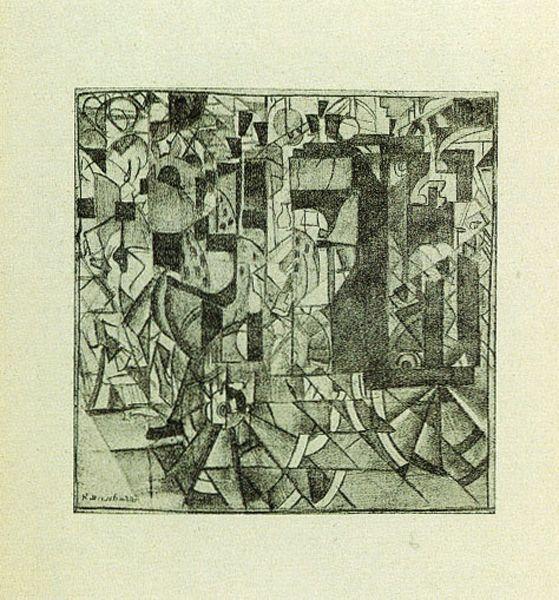
“The crew on the move” was created in 1914 by Kazimir Malevich in Cubo-Futurism style. Find more prominent pieces of genre painting at WikiArt.org – best visual art database.
Kazimir Malevich (1878-1935): Ukrainian founder of Suprematism & pioneer of abstract art. Explore iconic works like Black Square, geometric forms, & pure feeling's impact on 20thC art.
A Dynamic Lineage: Exploring Kazimir Malevich’s “The Crew on the Move”
“The Crew on the Move,” painted in 1914 by Kazimir Malevich, stands as an arresting testament to the burgeoning Cubo-Futurist movement and its radical rejection of traditional artistic conventions. More than just a depiction of figures walking in unison—though that visual element is undeniably striking—the painting embodies a profound conceptual exploration of rhythm, movement, and the very essence of human experience within the context of early 20th century Europe.
### Style & Technique: Embracing Geometric Abstraction
Malevich’s stylistic choices represent a decisive break from Impressionism and Symbolism that preceded him. He adopted the principles of Cubo-Futurism, championed by artists like Vladimir Tatlin and Marcel Duchamp, prioritizing geometric abstraction over realistic representation. The painting utilizes bold black lines—a signature element of Malevich's oeuvre—to delineate the figures and create a pulsating visual rhythm. These lines aren’t merely outlining shapes; they actively convey movement and energy, mirroring the collective effort of the individuals depicted. Furthermore, the artist employed a technique characterized by flatness – avoiding illusionistic depth – emphasizing the surface as the primary locus of artistic expression. This deliberate simplification served to heighten the impact of color and line, prioritizing conceptual clarity over visual fidelity.
### Historical Context: The Avant-Garde Spirit of Its Time
Painted during a period of intense intellectual ferment in Russia—marked by debates surrounding Futurism’s embrace of technology and its critique of bourgeois values— “The Crew on the Move” reflects the broader artistic ambitions of the era. Cubo-Futurism sought to liberate art from the constraints of academic tradition, envisioning it as a tool for social transformation. Malevich's work aligns with this ethos by rejecting representational imagery in favor of pure geometric forms, mirroring the movement’s fascination with dynamism and speed—qualities deemed crucial for expressing the anxieties and aspirations of a rapidly changing world. The painting emerged from discussions about how art could communicate ideas beyond visual perception.
### Symbolism & Conceptual Depth: Beyond Mere Appearance
Despite its apparent simplicity, “The Crew on the Move” is laden with symbolic significance. The black lines themselves can be interpreted as representing force, unity, and the relentless march of time—themes central to Futurist thought. The positioning of the figures—walking in a line—suggests an ordered progression but also hints at potential disruption or imbalance. Malevich deliberately eschewed narrative storytelling, opting instead for a visual language that communicates emotion and intellect directly. This approach invites viewers to contemplate not just what they see but also what it represents on a deeper level – questioning established notions of beauty and artistic purpose.
### Emotional Impact & Artistic Legacy: An Enduring Vision
Ultimately, “The Crew on the Move” succeeds in conveying a palpable sense of urgency and dynamism—capturing the spirit of its time with remarkable precision. It remains an influential work within the history of abstract art, demonstrating Malevich’s mastery of geometric abstraction and his unwavering commitment to conceptual innovation. Its enduring appeal lies in its ability to provoke contemplation about fundamental questions concerning human movement, rhythm, and artistic expression – a legacy that continues to inspire artists and collectors alike.