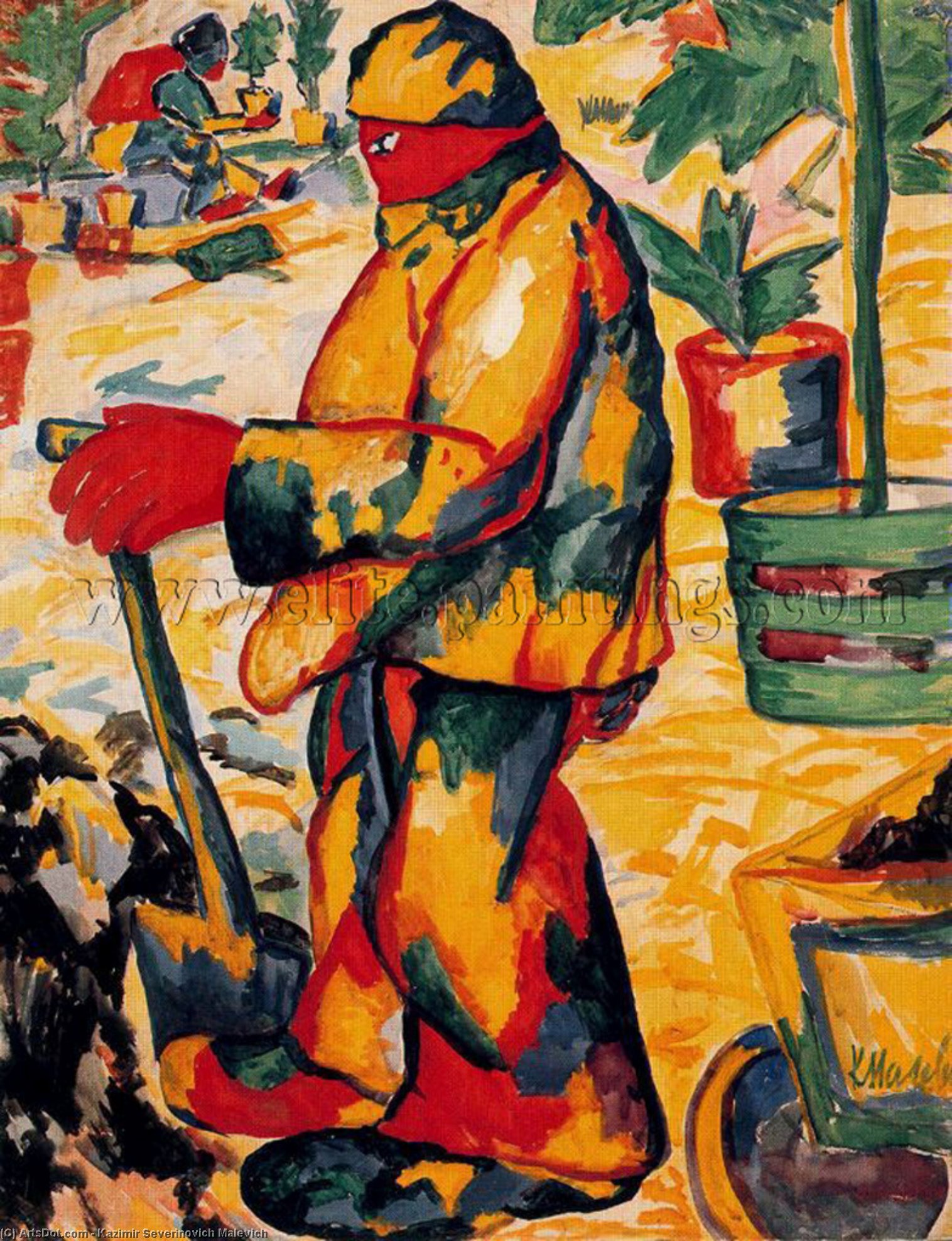
The Gardener by Kazimir Malevich
Kazimir Severinovich Malevich (1879–1935) stands as a monumental figure in the history of modern art, recognized globally for his pioneering role in establishing Suprematism—a radical departure from representational painting that profoundly influenced subsequent artistic movements. Born in Kyiv Oblast, Ukraine, to Polish parents who had fled Poland’s failed January Uprising against Russian rule, Malevich's formative years instilled within him a deep appreciation for the visual traditions of rural Ukraine and its rich folk culture. This early exposure would subtly permeate his artistic vision, shaping his distinctive approach to abstraction and solidifying his legacy as one of the most influential artists of the 20th century.
Formal training commenced in Kyiv, propelling Malevich towards Moscow where he immersed himself in the burgeoning avant-garde currents circulating throughout Europe. A pivotal journey to Paris in 1912 proved transformative, exposing him to the groundbreaking innovations spearheaded by Pablo Picasso and Georges Braque—the progenitors of Cubism—a movement that championed fragmented perspectives and multiple viewpoints. Recognizing the potential for artistic exploration beyond traditional conventions, Malevich embraced Cubist principles initially, diligently studying reproductions and analyzing the works amassed by discerning Russian collectors. However, he swiftly transcended stylistic constraints, forging his own path toward a more uncompromising vision of art.
- Early Influences: The Ukrainian landscape and folk traditions provided an initial bedrock for Malevich’s artistic sensibilities.
- Parisian Exposure: Picasso and Braque's Cubism ignited Malevich’s imagination, prompting him to experiment with innovative compositional strategies.
- Formal Training: Studying at Kyiv Art Institute solidified Malevich’s grounding in traditional techniques while simultaneously fostering his intellectual curiosity about artistic theory.
Malevich’s artistic development accelerated during the First World War years as he collaborated closely with fellow avant-garde artists like Mikhail Larionov and Natalia Goncharova, pushing boundaries of artistic expression. He championed a bold aesthetic that prioritized pure geometric forms—specifically squares, circles, and rectangles—over any illusionistic depiction of reality. This uncompromising stance culminated in his iconic masterpiece, Black Square (1915), which irrevocably demarcated the separation between “old art” and “new art,” establishing Suprematism as a cornerstone of modern artistic thought. Malevich articulated his theoretical framework in texts such as From Cubism and Futurism to Suprematism (1915) and The Non-Objective World (1926), cementing his position as a pivotal voice in shaping the intellectual landscape of his time.
- Collaboration: Working alongside Larionov and Goncharova fostered experimentation and broadened Malevich’s artistic horizons.
- Suprematism Theory: Malevich's writings championed pure geometric abstraction as a vehicle for conveying spiritual essence.
- Influence on Contemporaries: His work resonated with artists like August Macke and Morton Livingston Schamberg, inspiring them to explore similar stylistic approaches.
The October Revolution of 1917 profoundly impacted Malevich’s artistic trajectory, aligning him with the socialist ideals of his era. He held prominent teaching positions at Kyiv Art Institute alongside Alexander Bogomazov, Victor Palmov, and Vladimir Tatlin—a testament to his reputation as a visionary artist and educator. However, Stalin's repressive cultural policies soon curtailed Malevich’s creative freedom, forcing him back to Leningrad where he continued to produce artwork in representational styles while grappling with the constraints imposed by political dogma. Despite these challenges, Malevich persevered until his untimely death from cancer on May 15, 1935—leaving behind a legacy of groundbreaking artistic innovation that continues to inspire artists and art enthusiasts worldwide. His enduring influence extends beyond Russia, resonating across Europe and shaping the trajectory of subsequent abstract movements.
- Political Context: Stalin’s regime imposed limitations on artistic expression, prompting Malevich to adapt his style accordingly.
- Teaching Career: Holding positions at Kyiv Art Institute ensured Malevich's continued engagement with artistic pedagogy and intellectual discourse.
- Legacy: Malevich’s work continues to inspire artists globally, cementing his place as a pivotal figure in the history of modern art.
## Notable Works Beyond Black Square
Malevich’s artistic output encompassed a diverse range of projects that showcased his unwavering commitment to geometric abstraction and his exploration of spiritual concepts. Among his most celebrated paintings are “The Triumph of Heaven” (1927), which embodies Suprematism's core principles—a bold simplification of form and color designed to evoke profound emotional resonance; and “Composition VIII” (1928), a masterful demonstration of Malevich’s mastery over spatial illusionism, achieved through meticulous layering of geometric shapes. These artworks stand as enduring symbols of artistic innovation and represent pivotal milestones in the evolution of abstract art—testaments to Malevich's singular vision and his indelible contribution to the artistic canon.
- “The Triumph of Heaven”: Demonstrates Suprematism’s focus on pure feeling and spiritual contemplation
- “Composition VIII”: Exemplifies Malevich’s skillful manipulation of spatial illusionism through geometric forms
## Artistic Style & Influences Revisited
Malevich's artistic style was undeniably shaped by the pioneering efforts of Pablo Picasso and Georges Braque—the architects of Cubism—who revolutionized painting with their fragmentation of perspective and incorporation of multiple viewpoints. However, Malevich distinguished himself from his contemporaries by elevating geometric abstraction to its highest expression—a deliberate rejection of representational imagery in favor of pure visual elements. This uncompromising stance was further reinforced by influences drawn from Futurism, which championed dynamism and speed as aesthetic ideals—a stylistic impulse that mirrored Malevich’s desire to transcend traditional artistic conventions. His work profoundly impacted artists such as August Macke and Morton Livingston Schamberg, who embraced similar geometric approaches in their own artistic endeavors—underscoring Malevich's enduring influence on the broader artistic landscape of his era.
- Picasso & Braque: Provided inspiration for Cubist techniques
- Futurism: Shared Malevich’s fascination with dynamism and speed
- Influence on Artists: Macke and Schamberg adopted geometric styles inspired by Malevich
## Conclusion
Kazimir Malevich's artistic legacy transcends stylistic boundaries—he remains a beacon of innovation and intellectual rigor within the history of modern art. His unwavering dedication to geometric abstraction—coupled with his profound engagement with spiritual concepts—established Suprematism as a transformative force that reshaped artistic discourse and continues to inspire artists globally. The enduring power of Malevich’s vision lies in its ability to provoke contemplation and challenge conventional perceptions of beauty—a testament to his singular genius and his indelible contribution to the artistic heritage of humankind.