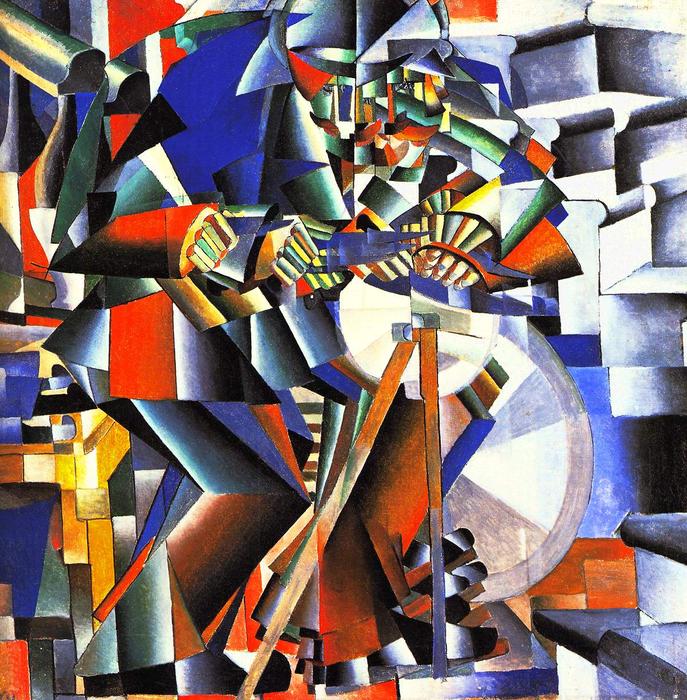
Explore 'The Knifegrinder' (1912) by Kazimir Malevich, a pivotal work blending Cubism & Futurism. Discover how this masterpiece foreshadowed abstract art.
Kazimir Malevich (1878-1935): Ukrainian founder of Suprematism & pioneer of abstract art. Explore iconic works like Black Square, geometric forms, & pure feeling's impact on 20thC art.
A Glimpse into Modernity: Kazimir Malevich’s *The Knifegrinder*
Kazimir Malevich's *The Knifegrinder*, painted in 1912, stands as a pivotal work bridging the gap between representational art and the radical abstraction that would soon define his Suprematist movement. It isn’t merely a depiction of a working man; it is an explosion of form and energy, a visual articulation of the dynamism inherent in modern life. The painting captures a knife grinder at work, yet this seemingly mundane subject is fractured and reassembled through the lens of Cubo-Futurism, a style Malevich embraced during a period of intense artistic experimentation. He doesn’t present us with a static portrait but rather an impression of movement, a sense of the grinder's labor as a forceful interaction between man and machine. The figure is almost swallowed by the angular planes and intersecting lines that define his surroundings, hinting at the overwhelming pace and mechanization of the industrial age.
The Fusion of Styles: Cubism, Futurism, and Russian Avant-Garde
To understand *The Knifegrinder*, one must appreciate its place within the burgeoning avant-garde movements of early 20th-century Europe and Russia. Malevich had recently returned from a transformative trip to Paris in 1912, where he encountered the groundbreaking work of Pablo Picasso and Georges Braque – the pioneers of Cubism. This exposure profoundly impacted his artistic direction, leading him to deconstruct forms and represent objects from multiple viewpoints simultaneously. However, *The Knifegrinder* doesn’t simply mimic Cubism; it infuses it with the energy and dynamism of Futurism, an Italian movement celebrating speed, technology, and the machine age. The fragmented composition, sharp angles, and sense of motion all echo Futurist principles. This synthesis created a uniquely Russian brand of avant-garde art, one that reflected the country’s own rapid industrialization and social upheaval. Malevich wasn't merely adopting foreign styles; he was forging something entirely new, a visual language capable of expressing the anxieties and excitements of a world on the brink of transformation.
Decoding the Symbolism: Labor, Industry, and the Modern Condition
Beyond its stylistic innovations, *The Knifegrinder* carries symbolic weight. The subject itself – a humble tradesman performing essential work – is significant. Malevich often focused on depicting everyday laborers, elevating them to subjects worthy of artistic attention. In this context, the knife grinder can be seen as representing the working class, the engine driving industrial progress. Yet, the painting doesn’t offer a romanticized view of labor. The fragmented forms and harsh angles suggest a sense of alienation and dehumanization, hinting at the potential costs of modernization. The metallic palette – dominated by blues, greens, and silvers – further reinforces this feeling, evoking the coldness and impersonality of the machine age. It’s as if Malevich is presenting us with a complex portrait of modernity, acknowledging both its promise and its perils.
A Precursor to Abstraction: The Path to Suprematism
*The Knifegrinder* occupies a crucial transitional space in Malevich's oeuvre. While still recognizably representational, it pushes the boundaries of form and composition to such an extent that it anticipates his later, fully abstract works. It’s a stepping stone towards Suprematism, the movement he would launch with his iconic *Black Square* in 1915. In this painting, Malevich begins to prioritize pure feeling and geometric forms over objective representation, laying the groundwork for a new visual language based on spirituality and non-objectivity. Viewing *The Knifegrinder* allows us to witness the genesis of this revolutionary artistic vision, to understand how Malevich arrived at his radical conclusion that art need not depict the visible world but could instead express something far more profound – the essence of pure sensation.