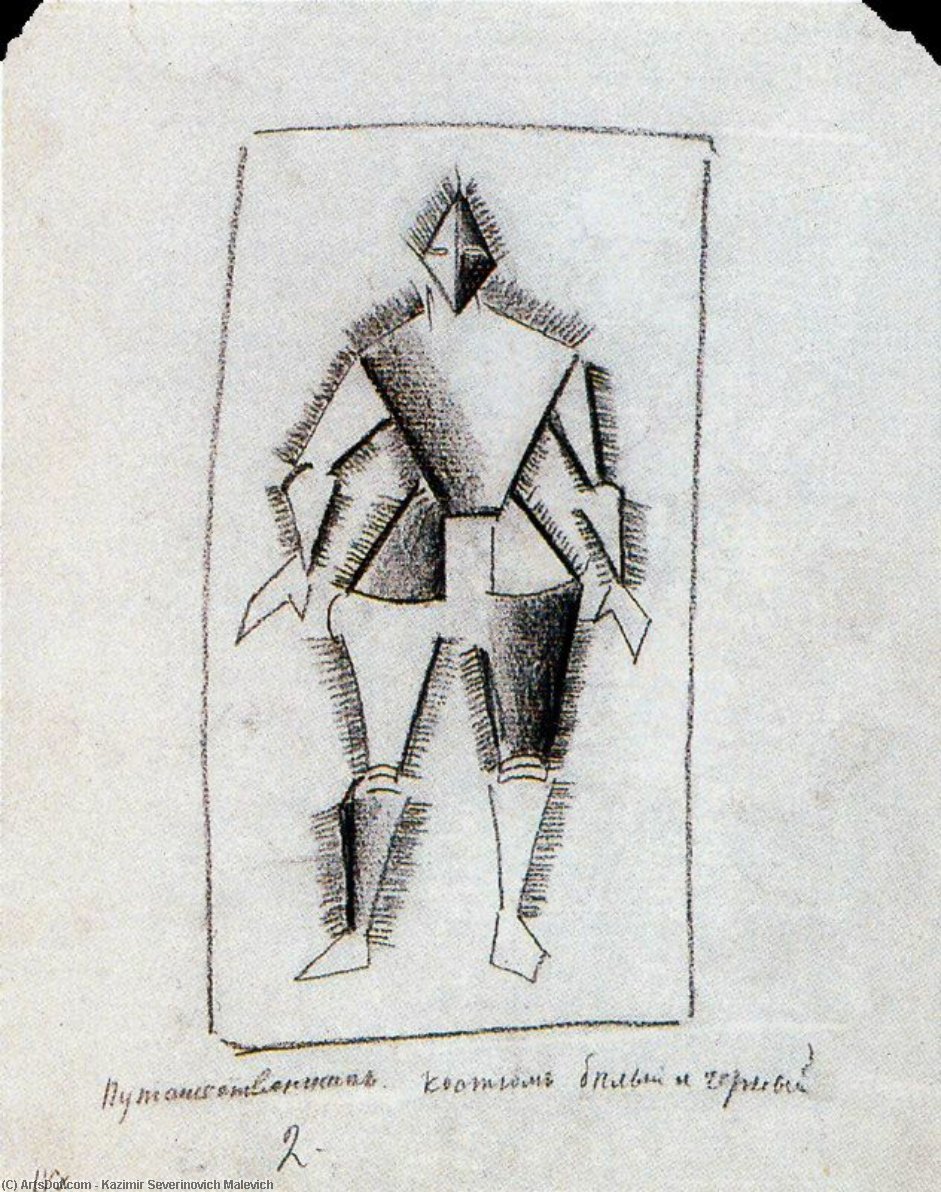
Kazimir Malevich’s “Traveler” (1913) is an early exploration into abstract art, showcasing angular shapes in grayscale on aged paper. Influenced by Cubism and Impressionism, it exemplifies Malevich’s pioneering approach to geometric abstraction—a precursor to his Suprematist movement's bold simplification of form.
Kazimir Malevich (1878-1935): Ukrainian founder of Suprematism & pioneer of abstract art. Explore iconic works like Black Square, geometric forms, & pure feeling's impact on 20thC art.
Kazimir Malevich’s “Traveler”: A Fragmented Vision of Modernity
Kazimir Malevich's "Traveler," painted in 1913, stands as a pivotal work demonstrating the burgeoning influence of Cubism and foreshadowing his groundbreaking Suprematist movement. This unassuming watercolor sketch—a study rather than a finished piece—captures an abstracted humanoid figure rendered primarily in grayscale tones on aged paper, offering a glimpse into Malevich’s experimental approach to form and color during this transformative period.
Composition & Style: Cubist Echoes
The artwork's composition prioritizes the dominant geometric shape – a stylized traveler – which occupies nearly the entire frame. Minimal background detail reinforces the focus on this singular element, mirroring the reductive aesthetic championed by Cubism. Malevich’s hand-drawn lines delineate angular forms with sharp precision, reflecting the fragmented perspective characteristic of Picasso and Braque's explorations. The hatching and crosshatching techniques subtly imbue texture into the paper surface and contribute to a sense of depth despite the flattened visual space. It’s clear that Malevich was actively grappling with the principles of Cubism, adapting them to his own artistic vision.
Technique & Materials: Watercolor's Delicate Dance
Executed in watercolor on aged paper—a deliberate choice reflecting Malevich’s fascination with materiality—the painting reveals a captivating interplay between pigment and texture. The artist skillfully utilizes grayscale hues – blacks, grays, and whites – to sculpt form and convey emotion. Subtle variations within these shades create an illusion of volume and depth, hinting at the complexities hidden beneath the surface simplicity. Evidence of handling on the paper—creases and slight discoloration—adds character and reinforces the artwork’s connection to its historical context. The watercolor medium itself lends a sense of vulnerability and immediacy to the image.
Historical Context & Symbolism: Embracing Abstraction
Painted in 1913, “Traveler” emerges from a climate of artistic experimentation fueled by Parisian avant-garde movements. Malevich’s journey to Paris solidified his conviction that art should transcend representational illusion, prioritizing pure geometric abstraction as a vehicle for expressing fundamental truths about existence. The fragmented figure embodies the anxieties and uncertainties of the era—a reflection of the broader societal shifts occurring during World War I. Like many early Suprematist works, “Traveler” symbolizes a rejection of traditional artistic conventions in favor of an uncompromising pursuit of visual purity.
Emotional Impact & Legacy: A Quiet Revolution
Despite its understated appearance, "Traveler" possesses a profound emotional resonance. The monochromatic palette evokes feelings of isolation and introspection, mirroring Malevich’s desire to communicate universal concepts beyond the confines of recognizable imagery. It represents a crucial step in Malevich's artistic evolution—a deliberate dismantling of pictorial illusion to arrive at a more elemental form of expression. This sketch serves as an enduring testament to Malevich’s pioneering spirit and his unwavering belief in the transformative power of abstract art, cementing its place within the canon of 20th-century visual culture.