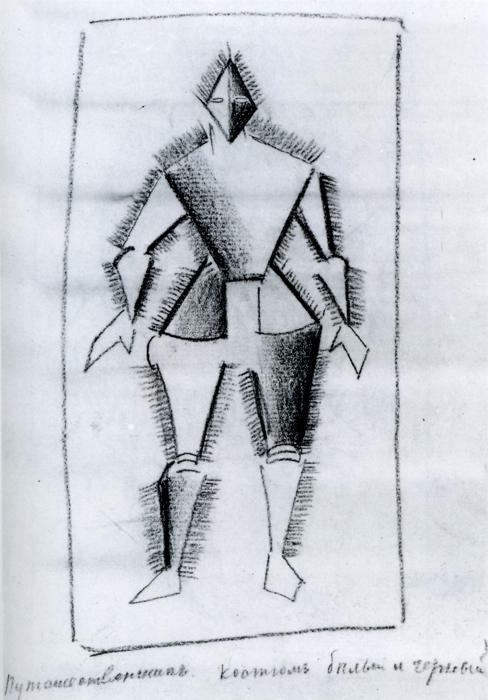
Traveler

Kazimir Malevich’s ‘Traveler’ (1913): A striking abstract sketch of an armored figure in black & white. Explore Cubist influences & deconstructed form – a key Suprematist work.


Kazimir Malevich (1878 - 1935)

Kazimir Malevich (1878-1935): Ukrainian founder of Suprematism & pioneer of abstract art. Explore iconic works like Black Square, geometric forms, & pure feeling's impact on 20thC art.

A Fragmented Glimpse: Decoding Malevich’s ‘Traveler’ (1913)

  • Kazimir Malevich's ‘Traveler,’ created in 1913, is a striking example of the artist’s pivotal transition towards abstraction. This work isn’t a traditional portrait; rather, it’s a dynamic study in form and line, depicting an armored figure rendered with remarkable stylistic freedom.
  • The artwork immediately captivates with its predominantly black and white palette and sketch-like quality. The subject – seemingly a warrior or knight – is deconstructed into geometric shapes, angular lines dominating the composition. This fragmentation isn’t accidental; it reflects Malevich's growing rejection of representational art in favor of exploring pure artistic feeling.

The Dawn of Suprematism & Cubist Influences

  • Historical Context: 1913 was a watershed year for avant-garde art. Malevich, having recently returned from Paris, was absorbing the radical ideas of Cubism while simultaneously forging his own unique path. ‘Traveler’ demonstrates this synthesis – the fractured planes and multiple perspectives echo Cubist principles, yet the work possesses an emotional intensity that foreshadows his later Suprematist paintings.
  • Suprematism, Malevich's groundbreaking movement, aimed to liberate art from any reference to the visible world. While ‘Traveler’ isn’t fully Suprematist – it still retains a recognizable (albeit abstracted) subject – it represents a crucial step in that direction. The emphasis on geometric form and the reduction of the figure to its essential elements are hallmarks of this emerging aesthetic.
  • The technique employed—likely charcoal or pencil on paper—is direct and gestural. Loose, expressive strokes create a sense of energy and immediacy, suggesting this may have been a preparatory study for a larger work or an exploration of form in itself.

Symbolism & Emotional Resonance

  • The armored figure invites interpretation. Is it a symbol of strength and protection, or does the fragmentation represent vulnerability and alienation? The lack of specific detail allows for multiple readings, making the artwork intellectually stimulating.
  • Considered within Malevich’s broader oeuvre, ‘Traveler’ can be seen as an exploration of the human condition in a rapidly changing world. The deconstruction of form might symbolize the breakdown of traditional values and beliefs, or the individual's struggle for identity in the face of modernity.
  • The absence of a distinct light source and minimal depth contribute to a sense of ambiguity and introspection. This isn’t an artwork that offers easy answers; it invites viewers to engage with its complexities and project their own emotions onto the fragmented form.

A Statement Piece for Modern Interiors

  • ‘Traveler’ is a compelling choice for those seeking artwork that embodies both historical significance and contemporary style. Its monochromatic palette and abstract composition make it incredibly versatile, complementing a range of interior design schemes – from minimalist lofts to modern galleries.
  • A high-quality reproduction of this work would serve as a striking focal point in any room, sparking conversation and adding a touch of intellectual sophistication. The artwork’s dynamic energy and emotional depth will resonate with art lovers and collectors alike.