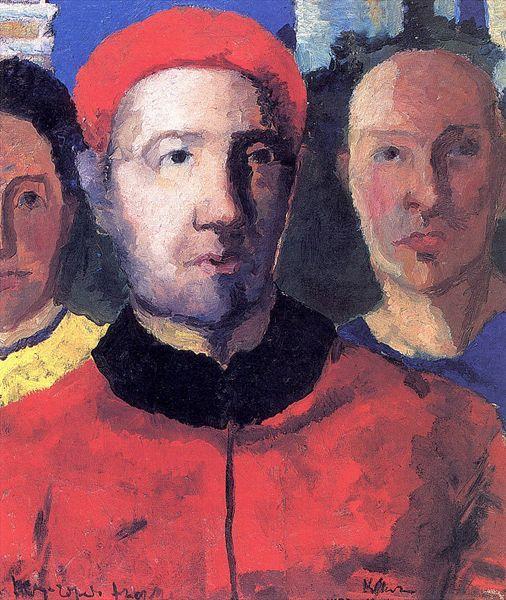
A Revolutionary Vision: Kazimir Malevich’s Composition VIII
Kazimir Malevich stands as one of the most influential figures in 20th-century art, irrevocably altering the course of artistic expression with his uncompromising embrace of abstraction. Born in Kyiv Oblast, Ukraine in 1878, Malevich's formative years instilled within him a deep connection to Ukrainian folklore and tradition – connections that would subtly permeate his groundbreaking explorations into pure geometric form.
His journey towards artistic innovation began in Kyiv’s art academies but swiftly propelled him toward Moscow’s avant-garde circles. This relocation proved crucial, exposing him to the transformative currents sweeping across Europe during World War I and fostering an intense engagement with movements like Cubism and Futurism. However, Malevich wasn't merely reacting to these trends; he was actively dismantling them, rejecting illusionistic representation in favor of a radical new aesthetic.
The pivotal moment arrived in 1912 when Malevich traveled to Paris – a pilgrimage that fundamentally reshaped his artistic sensibilities. Surrounded by the vibrant energy of Impressionism and Fauvism, he witnessed firsthand the burgeoning excitement for experimental art forms. Yet, Malevich refused to succumb to stylistic mimicry; instead, he embarked on a relentless quest to distill art down to its essential elements.
This pursuit culminated in 1915 with the creation of
, arguably his masterpiece and a cornerstone of Suprematism – Malevich’s own revolutionary artistic doctrine. This monumental canvas, measuring approximately 200 x 200 cm (78 ¾ x 78 ¾ inches), depicts a starkly simplified geometric composition dominated by a large square intersected by four smaller rectangles.
Technically masterful, Composition VIII exemplifies Malevich’s unwavering commitment to pure abstraction. Painted in cadmium yellow and black pigment on burlap – a deliberate rejection of traditional canvas – the artwork utilizes bold color contrasts to convey an overwhelming sense of dynamism and spiritual significance. The square represents stability and order, while the rectangles symbolize movement and energy—a visual paradox that encapsulates Suprematism's core philosophical proposition: art should transcend representational concerns and communicate directly with the viewer’s subconscious.
Beyond its formal brilliance, Composition VIII carries profound symbolic weight. Malevich viewed it as a vehicle for purging artistic dogma and achieving spiritual liberation – mirroring the broader anxieties of the era surrounding the devastation of World War I and the disintegration of established social hierarchies. The artwork's austere aesthetic speaks to an aspiration for transcendence, inviting contemplation on fundamental questions about existence and perception.
Today, Composition VIII continues to inspire artists and captivate audiences worldwide. Its enduring appeal lies not only in its striking visual impact but also in its intellectual depth—a testament to Malevich’s visionary genius and his unwavering conviction that art could serve as a catalyst for profound cultural transformation.