Kazimir Malevich (1878-1935): Ukrainian founder of Suprematism & pioneer of abstract art. Explore iconic works like Black Square, geometric forms, & pure feeling's impact on 20thC art.
Vertical Suprematist Construction: A Bold Statement of Pure Form
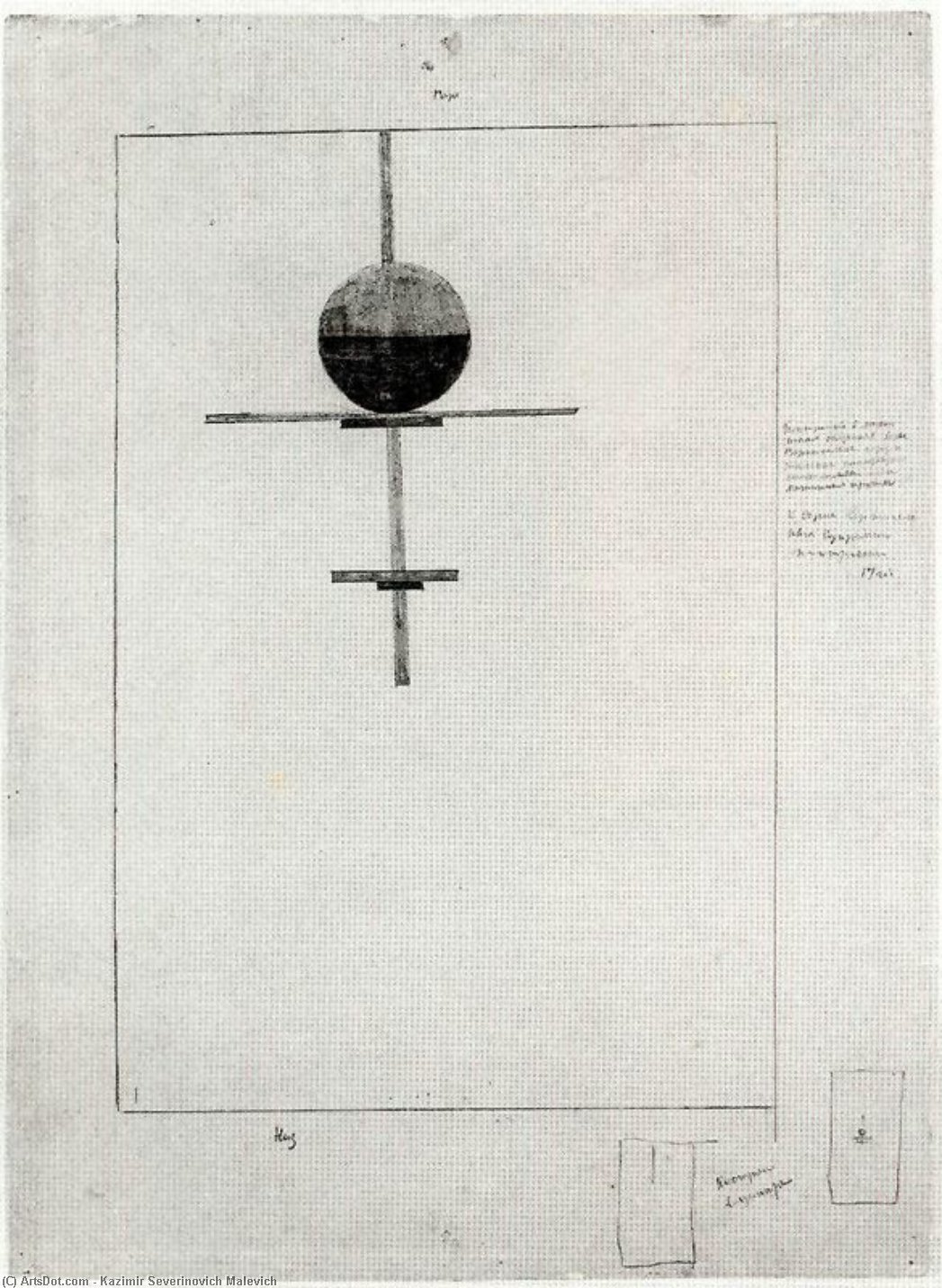
Kazimir Malevich’s “Vertical Suprematist Construction,” created in 1915, stands as a cornerstone of the Suprematist movement and an enduring emblem of abstract art's revolutionary ambition. More than just a drawing—it’s a deliberate dismantling of traditional artistic conventions, prioritizing geometric abstraction over representational imagery to express fundamental spiritual truths. This piece encapsulates Malevich’s unwavering belief that art should transcend visual illusion and tap into the primal essence of existence.
Composition and Technique: Simplifying Reality
The artwork's deceptively simple composition immediately commands attention. Dominating the canvas is a large, dark circle positioned slightly above its center—a bold departure from perspectival depth and naturalistic depiction. Beneath this monumental form stretches a vertical line terminating in a small ‘T’ shape, acting as an anchor for visual stability. Two horizontal lines intersect this axis at varying distances, creating a framework that emphasizes the interplay between these fundamental geometric elements. Malevich executed this drawing with meticulous precision using graphite or charcoal on paper—a technique chosen to minimize textural variation and maximize clarity of form. The resulting monochrome palette underscores the artist’s focus on pure visual experience, stripping away any distractions associated with color.
Historical Context: Challenging Artistic Tradition
Born in Kyiv Oblast, Ukraine in 1878, Kazimir Malevich emerged as a pivotal figure in the burgeoning avant-garde of early 20th century Russia. Influenced by movements like Cubism and Futurism, he swiftly rejected representational art altogether, recognizing its limitations in conveying profound ideas. His embrace of Suprematism—a movement founded on the principle that “art must be free from any objective representation”—represented a radical rejection of artistic dogma. Malevich envisioned Suprematist art as a vehicle for spiritual liberation, mirroring the broader cultural anxieties surrounding the rapid pace of industrialization and societal change. The artwork’s creation coincided with the turbulent period leading up to World War I, reflecting the movement's desire to confront existential questions and forge new paths toward artistic expression.
Symbolism and Emotional Resonance: Beyond Representation
The stark geometric forms—the circle and straight lines—are deliberately devoid of recognizable imagery, serving instead as symbols of universal concepts like unity and transcendence. Malevich’s intention wasn’t to depict a specific scene or object but rather to evoke an emotional response rooted in pure feeling. The emptiness of the white background amplifies the impact of these forms, creating a sense of isolation yet simultaneously conveying a profound stillness—a visual meditation on the sublime. Critics have interpreted “Vertical Suprematist Construction” as representing Malevich’s belief that art could communicate spiritual truths beyond the confines of language and sensory experience.
A Legacy of Minimalism: Influence and Inspiration
“Vertical Suprematist Construction” remains an influential work, demonstrating the transformative potential of abstract art to challenge conventional notions of beauty and artistic purpose. Its minimalist aesthetic continues to inspire artists and designers today, serving as a reminder that powerful visual statements can be achieved through the reduction of form to its most essential elements. A high-quality reproduction captures the artwork’s understated elegance and conveys its enduring message—a testament to Malevich's pioneering vision for art as a conduit to spiritual contemplation.