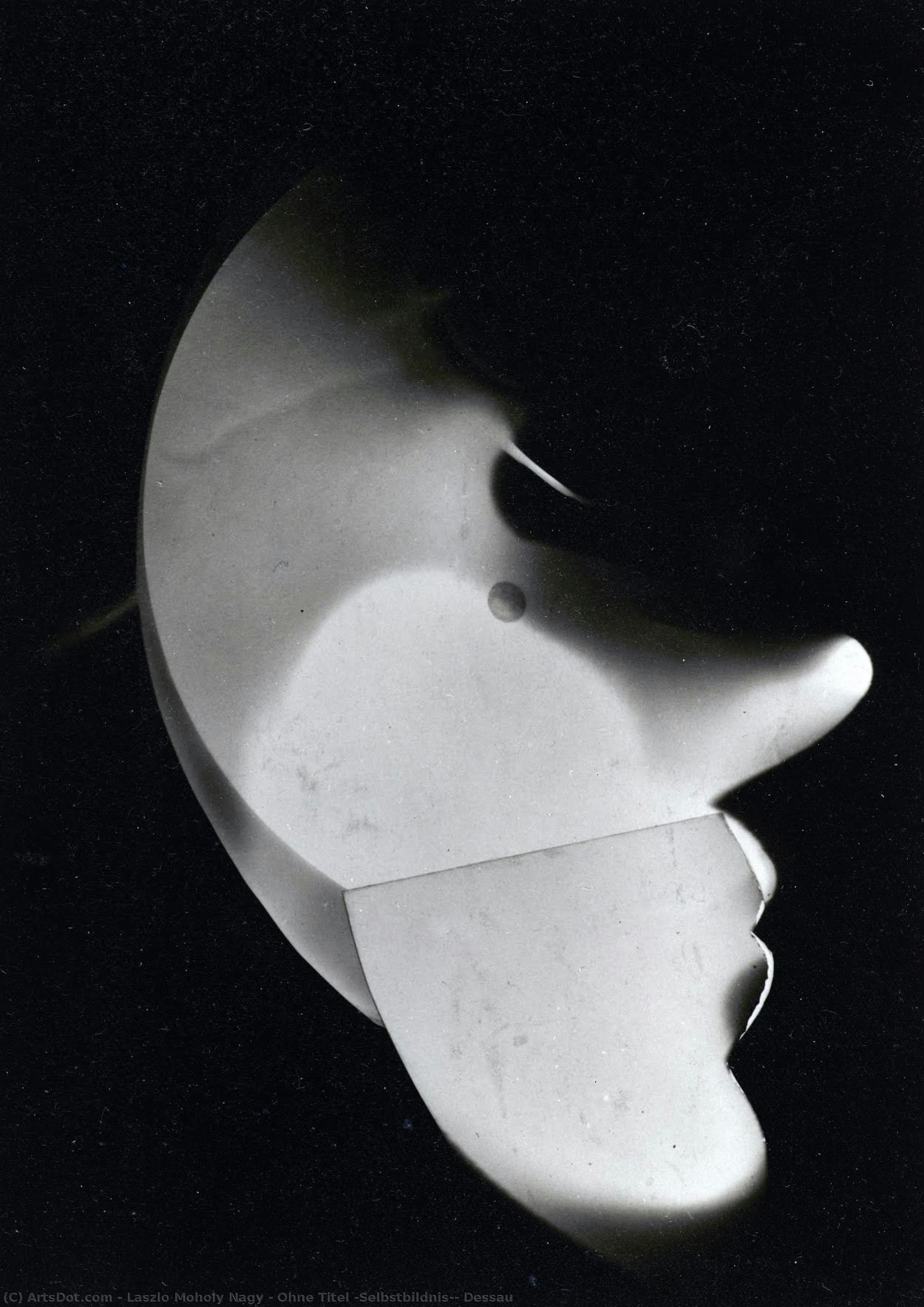
László Moholy-Nagy’s ‘Ohne Titel (Selbstbildnis), Dessau’ is an iconic black and white photogram embodying Constructivism's exploration of new artistic mediums. Featuring a fragmented self-portrait overlaid with geometric shapes, it exemplifies Moholy-Nagy’s commitment to integrating technology into art.
A Fragmented Soul: The Experimental Vision of László Moholy-Nagy
In the quiet, revolutionary atmosphere of 1926 Dessau, a new way of seeing was being forged. László Moholy-Nagy’s "Ohne Titel (Selbstbildnis)" is not merely a portrait; it is a profound psychological excavation rendered through the lens of modern technology. As a cornerstone of both Constructivism and New Objectivity, this work transcends the traditional boundaries of the self-portrait. Instead of capturing a static likeness, Moholy-Nagy presents a deconstructed identity, where the human face is reimagined through a symphony of geometric abstractions. For the discerning collector or designer, this piece offers more than visual intrigue; it provides a window into a moment in history when art and industry first began their radical dance.
The technique employed here is as groundbreaking as the subject matter itself. Utilizing the ethereal qualities of silver bromide gelatin photography—and likely experimenting with the light-sensitive magic of photograms—the artist achieves a haunting, luminous depth. The composition is a masterful interplay of light and shadow, where sharp, angular shapes collide with soft, organic contours. A prominent rectangular block overlays the facial profile, acting as a structural anchor that disrupts the viewer's expectation of a recognizable human form. This deliberate fracturing serves as a powerful metaphor for the modern psyche: complex, multifaceted, and perpetually in flux.
The Bauhaus Legacy and the Geometry of Modernity
To understand the emotional resonance of this work, one must look to the halls of the Bauhaus. During his tenure at this legendary institution, Moholy-Nagy championed the idea that art should not be a precious, isolated object, but a functional component of a new, technological society. This piece embodies that ethos perfectly. The stark lines and precise geometric forms reflect the clarity and precision sought by the Constructivist movement, while the experimental photographic process mirrors the era's fascination with light, motion, and mechanical reproduction.
For those looking to integrate fine art into contemporary interiors, "Ohne Titel (Selbstbildnis)" offers a sophisticated aesthetic that bridges the gap between historical significance and modern minimalism. The monochromatic palette provides a timeless elegance, making it an ideal focal point for spaces that value intellectual depth and structural harmony. It is a piece that invites contemplation, prompting the viewer to look past the surface and explore the layers of meaning hidden within its silver-toned shadows. Owning a high-quality reproduction of this masterpiece allows one to host a conversation between the avant-garde past and the design-driven present.