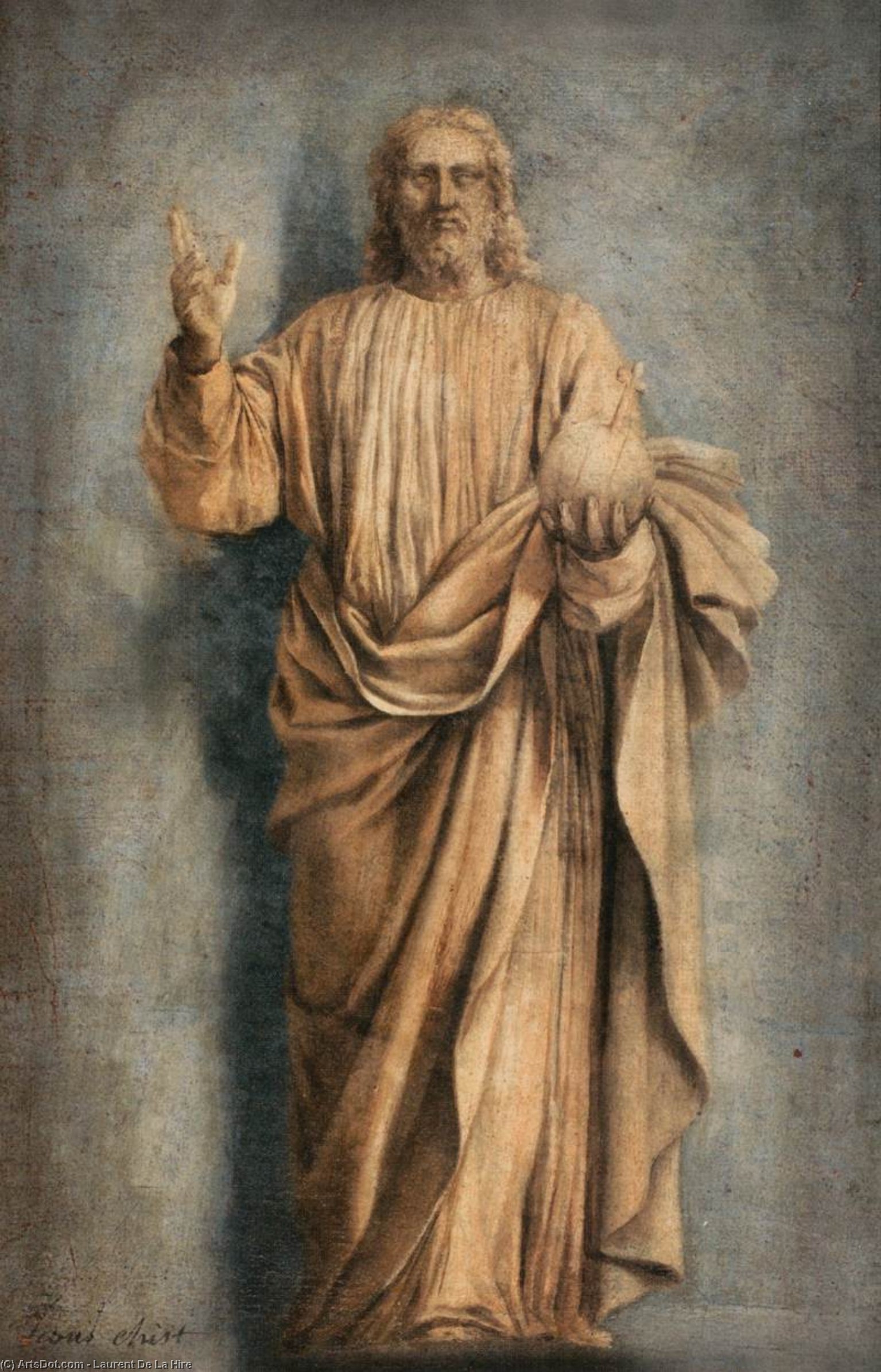
Christ The Judge by LA HYRE, Laurent de
Laurent de La Hyre’s “Christ The Judge” (c. 1630) stands as a testament to the enduring power of Renaissance artistic vision—a grisaille masterpiece that captures not merely an image but an essence of faith and divine authority. Found within the refectory of the Miinims on Place Royale in Paris, this monumental panel exemplifies La Hyre’s mastery of colorless pigment technique, offering a glimpse into the aesthetic sensibilities of its time.
The artwork depicts Jesus Christ in a commanding three-quarter pose, gesturing with one hand as if pointing towards heaven—a gesture laden with symbolic significance representing guidance and blessing. Beneath his gaze rests a sphere held delicately in his other hand; interpretations vary, ranging from symbolizing the cosmos – reflecting God’s dominion over creation – to embodying divine wisdom and contemplation. La Hyre meticulously rendered Christ's anatomy with remarkable accuracy, adhering to humanist ideals prevalent during the Renaissance period.
La Hyre’s technique—the application of thin glazes layered upon a gesso ground—is characterized by painstaking brushwork and an exceptional ability to achieve luminous effects despite the absence of color. This method, favored by artists like Rembrandt himself, allowed for subtle gradations of tone and texture, creating depth and dimensionality within the monochrome composition. The artist skillfully employed atmospheric perspective, subtly receding into the background to heighten the sense of space and grandeur.
The grisaille technique—the use of shades of grey—was particularly popular in ecclesiastical art during the Baroque era, serving as a deliberate choice to focus attention on spiritual contemplation rather than visual spectacle. It was considered appropriate for liturgical settings where subdued illumination would enhance the solemnity of prayer. The artwork’s emotional impact is profound – conveying reverence and humility before the majesty of God.
- Artist: Laurent de La Hyre
- Year Created: c. 1630
- Medium: Oil Paint on Gesso Ground (Grisaille)
- Location: Refectory of the Miinims, Place Royale, Paris
Additional Research & Context
Further exploration reveals that La Hyre’s “Christ The Judge” aligns with broader artistic trends of its era. Like Rembrandt, he embraced a humanist approach to art, prioritizing anatomical realism and psychological depth—a departure from earlier Gothic conventions. This grisaille panel exemplifies the stylistic sophistication of Parisian Baroque art during the reign of Louis XIII, reflecting the influence of Mannerism and emphasizing spiritual contemplation. The artwork’s placement within a religious institution underscores its purpose as a devotional image intended to inspire piety and reverence among worshippers.
Symbolic Elements
The composition is rich in symbolic references. Christ's gesture directs the viewer's gaze upwards, symbolizing faith and divine grace. The sphere represents cosmic order and God’s omnipresence—a visual metaphor for spiritual enlightenment. La Hyre’s masterful use of light and shadow contributes to the artwork’s dramatic effect, enhancing its emotional resonance and reinforcing its solemn character.
Technical Considerations
The grisaille technique demanded considerable skill and patience from La Hyre. Achieving luminous effects through monochrome pigment requires meticulous layering of thin glazes—a process that necessitated careful observation and precise brushwork. The resulting surface possesses a velvety smoothness, indicative of the artist’s dedication to achieving textural perfection. This remarkable artwork continues to inspire admiration for its artistic excellence and spiritual profundity.