A Fusion of Worlds: The Life and Art of Léonard Tsuguharu Foujita
Léonard Tsuguharu Foujita, a name that resonates with the vibrant energy of early 20th-century Paris and the delicate grace of Japanese artistic tradition, was an artist who defied easy categorization. Born in Tokyo in 1886, his journey took him from the rigorous training of traditional Japanese painting to the heart of the Europea
Still Life With Ink Bottle And Pen – A Reflection of Quiet Elegance
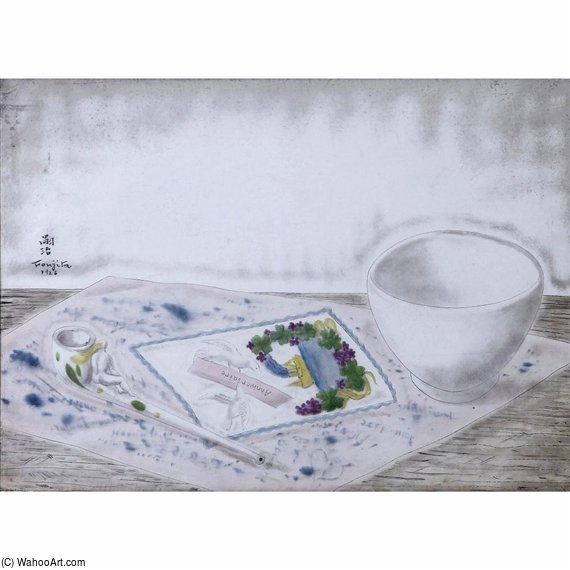
Léonard Tsuguharu Foujita’s “Still Life With Ink Bottle And Pen” stands as a testament to the harmonious fusion of Japanese artistic tradition and European modernist sensibilities. Executed around 1918, this deceptively simple composition—a grayscale depiction of an ink bottle alongside a folded letter—captures a profound sense of melancholy and contemplative beauty that resonates deeply with viewers.
- Composition: The artwork’s central focus is a white bowl positioned slightly off-center to the right, creating visual balance. A diagonally placed folded letter adds dynamism while subtly obscuring other elements on the table surface.
- Color Palette: Dominated by shades of gray, white, and black, the palette eschews vibrant hues in favor of muted tones that convey a feeling of stillness and introspection. Delicate touches of blue—found in the background washes and within the letter’s folds—introduce subtle color accents alongside hints of green from the foliage on the card and beige tones in the cup.
- Technique: Likely created using watercolor or gouache on paper, Foujita employs a masterful layering technique characterized by soft washes and blending to achieve atmospheric effects. Dry brushwork adds textural nuances, particularly visible in areas where the bowl’s surface is rendered.
Historical Context & Artistic Influences
Born in Tokyo in 1886, Foujita's artistic journey began with rigorous training in *yōga*, Western-style painting, guided by Seiki Kuroda at the Tokyo National University of Fine Arts and Music. Simultaneously, he immersed himself in *nihonga*, traditional Japanese painting, absorbing techniques that would become foundational to his distinctive style. This dual influence is palpable in “Still Life,” mirroring the broader artistic landscape of early 20th-century Europe—specifically Paris—where Foujita engaged with luminaries like Modigliani and Picasso.
Symbolism & Emotional Resonance
The muted color palette and understated arrangement deliberately evoke feelings of solitude, longing, and quiet contemplation. The inclusion of the folded letter serves as a poignant reminder of communication and memory, hinting at unspoken emotions beneath the surface. Like many works of his era, “Still Life” prioritizes mood over precise detail—a hallmark of Fauvist tendencies—creating an experience that invites viewers to engage with its emotional core.
A Legacy of Quiet Beauty
"Still Life With Ink Bottle And Pen" exemplifies Foujita’s ability to distill complex emotions into a deceptively simple visual form. It remains a captivating example of how Japanese artistic sensibilities can converge with European modernist ideals, resulting in an artwork that transcends its time and continues to inspire admiration for its understated elegance and profound psychological depth.