Anatomical Studies (Larynx and Leg): A Window into Leonardo da Vinci’s Scientific Vision
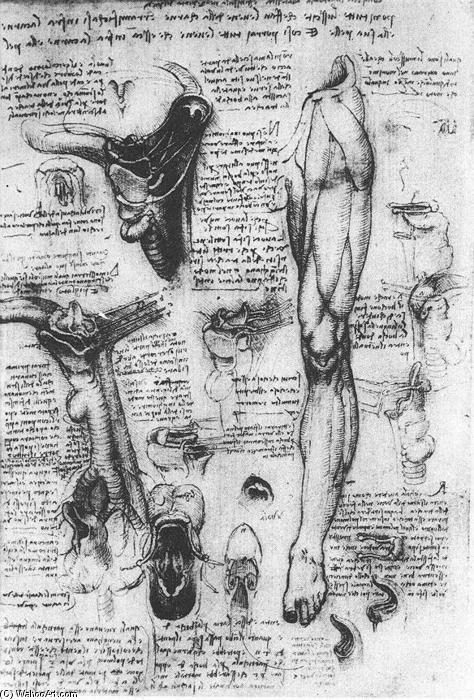
Leonardo da Vinci's Anatomical Studies (Larynx and Leg), executed in 1510 during his Milanese period, transcends mere artistic representation; it embodies the very essence of Renaissance humanism—a profound fascination with understanding the intricacies of the human body as a cornerstone of knowledge and beauty. This meticulously rendered sketch and study isn’t simply a depiction of musculature and bone structure; it's a testament to Da Vinci’s unwavering commitment to observation, experimentation, and pushing the boundaries of artistic convention.
- Subject Matter: The artwork focuses on anatomical dissection—specifically examining the larynx (voice box) and leg—subjects chosen not only for their visual appeal but also for their significance in comprehending human physiology. Alongside these primary subjects, Da Vinci incorporated a bird sketch – a recurring motif reflecting his interest in comparative anatomy and avian musculature – and a clock symbolizing time and meticulous measurement, elements indicative of the scientific mindset prevalent during the Renaissance.
- Style & Technique: Characterized by the High Renaissance style, “Anatomical Studies” exemplifies Da Vinci’s unparalleled mastery of artistic technique. Employing ink on paper with painstaking precision, he utilized hatching and cross-hatching to achieve remarkable tonal variations, conveying texture and volume with astonishing realism. Thick lines delineate contours while thinner lines define internal structures, demonstrating a dedication to capturing the subtleties of form.
- Historical Context: Created during Da Vinci’s formative years as an artist and scientist, this piece reflects the burgeoning humanist movement that championed reason and empirical observation alongside artistic excellence. The Renaissance fascination with dissecting human cadavers—a controversial practice at the time—was driven by a desire to unlock the secrets of human anatomy and physiology, mirroring Da Vinci's own relentless pursuit of knowledge.
- Symbolism & Emotional Impact: Beyond its scientific accuracy, “Anatomical Studies” communicates a deeper emotional resonance. The meticulous detail speaks volumes about Da Vinci’s reverence for the complexity of life—a profound appreciation for the interconnectedness of form and function. It serves as an emblem of intellectual curiosity and artistic ambition, reminding us that true beauty resides in understanding the underlying principles governing our physical world.
- Detailed Analysis: The drawing's composition is deliberately complex, prioritizing anatomical clarity over conventional perspective. Multiple viewpoints of the leg are presented simultaneously, highlighting Da Vinci’s commitment to representing the human body comprehensively. Scattered handwritten annotations—likely observations and descriptions—further enrich the artwork’s intellectual dimension, cementing its place as a seminal achievement in both art history and scientific illustration.
This remarkable reproduction captures the essence of Da Vinci's genius – a fusion of artistic skill and scientific inquiry that continues to inspire awe and admiration centuries later. Explore the beauty and intricacy of “Anatomical Studies” today!