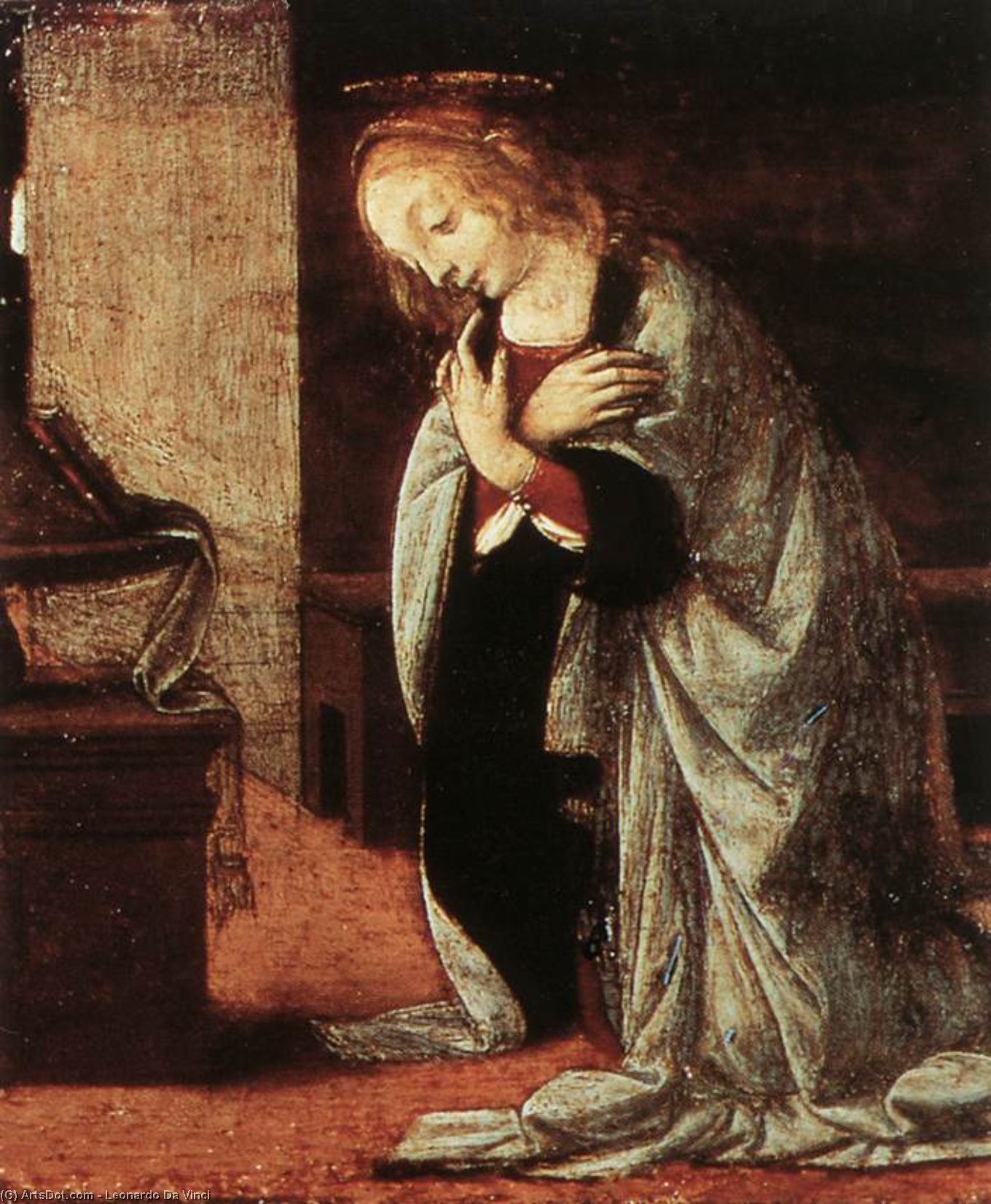
Annunciation (detail) (12)
The
Annunciation (detail) (12) by the renowned artist
Leonardo da Vinci is a captivating piece that showcases his mastery in capturing the essence of religious scenes. This painting, created in 1478, is part of the larger work titled Annunciation, which can be found at the
Musée du Louvre in Paris, France.
The Setting and Composition
The scene depicts the moment when the angel Gabriel announces to Mary that she will give birth to Jesus. The woman is shown kneeling down with her hands clasped together, intently listening to the message from the angel. The setting includes a bench on which the woman sits and a chair nearby. Two books are visible in the scene, one near the left side of the image and another closer to the right side. These elements contribute to a sense of solemn contemplation and underscore the importance of divine revelation within the domestic sphere. Leonardo’s meticulous attention to detail—particularly the positioning of objects and figures—reflects the humanist ideals prevalent during the Florentine Renaissance, where artists sought to represent reality with unprecedented accuracy.
Artistic Significance
This painting is significant not only for its religious theme but also for its artistic value. It exemplifies the
Florentine Renaissance art, a new approach to art and culture that emerged in Florence during the 15th century. This movement was characterized by innovations in figurative arts, which gradually became popular and were transmitted to other Italian courts and European courts. Artists like Leonardo Da Vinci experimented with techniques such as sfumato—a subtle blending of colors and tones—to create an ethereal atmosphere and imbue their subjects with psychological depth. The use of chiaroscuro—the dramatic interplay between light and shadow—further enhances the painting’s expressive power, guiding the viewer's eye and emphasizing key figures within the composition.
Leonardo da Vinci's Contribution
Leonardo da Vinci was one of the key figures of the High Renaissance, a period marked by experimentation and innovation. His work had a profound influence on many artists, including those who followed in his footsteps. The
Annunciation (detail) (12) is a testament to his skill in capturing the subtleties of human emotion and the intricacies of religious narratives. He meticulously studied anatomy—particularly the musculature of the human body—to achieve unparalleled realism in his depictions of figures. This dedication to scientific observation informed his artistic practice, resulting in works that transcend mere representation and convey profound spiritual meaning.
Relevance in Art History
The history of art often focuses on masterpieces created during each civilization. The
Annunciation (detail) (12) is a prime example of such a masterpiece, epitomizing high culture and artistic excellence. It can be framed as part of the broader narrative of visual culture or material culture, contributing to fields related to art history. Its influence extends beyond its immediate aesthetic qualities—the painting served as inspiration for countless subsequent artists who sought to emulate Leonardo’s mastery of technique and his ability to convey emotion—solidifying its place as a cornerstone of Western artistic heritage. For those interested in exploring more works by Leonardo da Vinci,
Leonardo Da Vinci: Annunciation is available on ArtsDot.com. For a deeper understanding of the Florentine Renaissance and its impact on art history, refer to
Florentine Renaissance art. Additionally, the list of artists in the Web Gallery of Art can be found at
List of artists in the Web Gallery of Art (A–K).
## Photo Description:
The painting is a depiction of the Annunciation, which is a religious scene where the angel Gabriel announces to Mary that she will give birth to Jesus. The woman in the painting is kneeling down with her hands clasped together and looking upwards, as if listening intently to the message from the angel. The setting of the painting includes a bench on which the woman is sitting, and a chair nearby. There are also two books visible in the scene, one located near the left side of the image and another closer to the right side. The overall atmosphere of the painting conveys a sense of reverence and devotion to the religious theme.
## Size:
Unknown
## Date:
1478