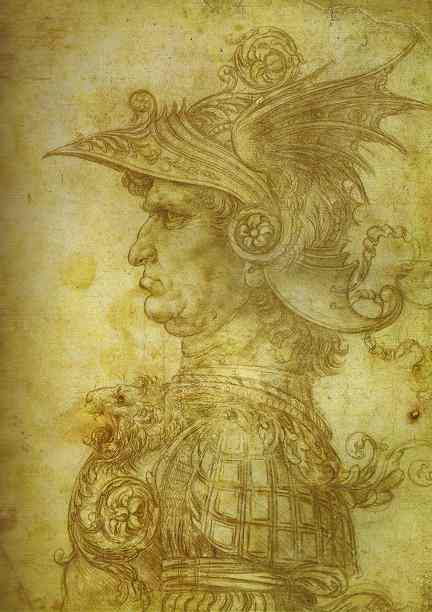
The Enigmatic Warrior: Leonardo da Vinci’s Early Masterpiece
Leonardo da Vinci's Antique Warrior, a captivating oil painting from 1472, stands as a pivotal work in the artist’s burgeoning career and offers a remarkable glimpse into his evolving artistic vision. Housed within the venerable halls of the British Museum in London, this seemingly simple depiction of a medieval warrior transcends its historical subject matter to reveal layers of symbolism, technical innovation, and the nascent genius that would define da Vinci's legacy. The painting’s power lies not just in its meticulous detail but also in the way it foreshadows the grand narratives and psychological depth he would later master.
The image itself presents a powerfully rendered figure, clad in an imposing helmet adorned with dramatic horns – a motif frequently associated with both Roman emperors and mythical figures. The warrior’s stance is one of controlled readiness, his hand firmly gripping a sword poised at his side, suggesting both strength and vigilance. Da Vinci's early mastery of portraiture shines through in the remarkably lifelike depiction of the face; every line, shadow, and subtle expression conveys an intensity that belies the painting’s relatively small scale. The artist skillfully employs sfumato – a technique he would later perfect – to soften the edges and create a hazy atmosphere around the figure, lending him an aura of mystery and timelessness.
A Renaissance Experiment: Technique and Style
Created during da Vinci's apprenticeship under Andrea del Verrocchio, Antique Warrior represents a crucial stage in the artist’s development. It demonstrates his growing command of oil painting techniques – a relatively new medium at the time – and his willingness to experiment with different approaches to rendering form and texture. The use of layered glazes creates a rich, luminous surface, while the careful modeling of the armor reveals an understanding of three-dimensional space. Notably, da Vinci’s choice of a helmet with horns is intriguing; it hints at a fascination with classical mythology and heraldry, reflecting the humanist ideals that were beginning to shape Renaissance art.
The painting's style aligns closely with Early Renaissance conventions, yet it also possesses a distinctly individual character. Da Vinci departs from purely representational approaches by imbuing the warrior with a sense of psychological depth – a subtle suggestion of determination and perhaps even melancholy. This foreshadows his later ability to capture not just outward appearances but also inner emotions in his portraits, most famously exemplified in the Mona Lisa.
Historical Context and Da Vinci’s Oeuvre
To understand the significance of Antique Warrior, it's essential to consider its place within da Vinci’s broader artistic trajectory. The painting emerged during a period of intense cultural and intellectual ferment in Florence – a time when classical antiquity was being rediscovered and reinterpreted through the lens of humanism. Da Vinci’s fascination with classical themes is evident throughout his work, from his anatomical studies to his architectural designs. This piece serves as an early example of his ability to synthesize these influences into a uniquely personal style.
It's important to note that this painting isn’t a fully realized masterpiece in the manner of his later works; rather, it represents an experiment – a stepping stone on da Vinci’s path toward artistic mastery. Works like Studies of a horse and the numerous preparatory sketches in his notebooks reveal a relentless pursuit of knowledge and innovation that characterized his entire career. These studies demonstrate his meticulous observation of nature, his deep understanding of anatomy, and his willingness to push the boundaries of artistic representation.
A Timeless Icon: Reproduction and Legacy
Today, Antique Warrior continues to captivate audiences with its enigmatic beauty and historical significance. ArtsDot offers meticulously crafted hand-painted reproductions that faithfully capture the essence of da Vinci’s original work, allowing art lovers around the world to experience this iconic painting in stunning detail. These reproductions are not merely copies; they are artistic interpretations created by skilled artisans who share a deep appreciation for da Vinci's genius.
For those interested in exploring further aspects of Renaissance sculpture and its influence on artists like Da Vinci, we recommend consulting resources such as Italian Renaissance sculpture on Wikipedia. Additionally, a visit to the Louvre Museum, where many of da Vinci’s celebrated works reside, offers an unparalleled opportunity to immerse oneself in his artistic world. And for those seeking insights into Leonardo's personal life and final years, exploring resources like Louvre can be enlightening.