Explore the life & works of Leonardo da Vinci (1452-1519), High Renaissance master! Painter, sculptor, engineer, scientist – a true polymath behind iconic art like the Mona Lisa & The Last Supper. Discover his inventions & enduring legacy.
The Mechanical Vision of Leonardo
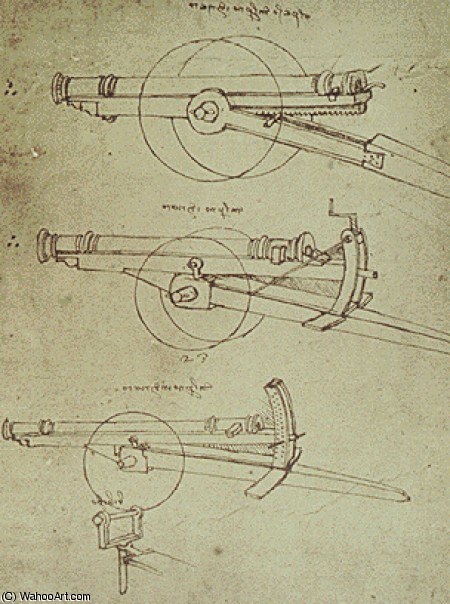
Leonardo da Vinci’s “Artiglieria,” or Cannons, transcends mere depiction; it embodies the very spirit of Renaissance innovation—a testament to a mind obsessed with understanding and manipulating the natural world. This drawing, meticulously crafted around 1490, isn't simply an illustration of weaponry; it’s a profound statement about human ingenuity and its potential for transformative change. Found amongst Da Vinci’s notebooks at Codex Atlanticus, this piece reveals his fascination with military engineering alongside his artistic pursuits—a duality that defines his legacy as one of the greatest thinkers of all time.
- Subject Matter: The drawing focuses on a detailed representation of a cannon – specifically, a self-spanning infantry weapon known as the Rapid Fire Crossbow (Balestra Veloce). It showcases an impressive array of internal components, capturing the essence of siege warfare technology.
- Style & Technique: Da Vinci’s masterful draughtsmanship is evident in the precise lines and shading employed to convey depth and realism. The artist utilized sfumato—a technique pioneered by Leonardo himself—to soften edges and create subtle gradations of tone, lending an air of sophistication and capturing the nuances of light and shadow.
Historical Context: Warfare & Renaissance Curiosity
“Artiglieria” emerged during a period marked by intense political rivalry between Milanese and Florentine factions—a time when military prowess was paramount to securing dominance. Da Vinci’s sketches weren't born out of idle contemplation; they stemmed from a genuine desire to improve defensive capabilities, reflecting the broader Renaissance preoccupation with applying scientific principles to practical problems. The crossbow design itself represents an evolution of earlier siege weapons, demonstrating Da Vinci’s commitment to advancing engineering knowledge. As evidenced by the linked Wikipedia article on Leonardo’s crossbow designs, he actively explored innovative solutions for bolstering military defenses.
- Symbolism: Beyond its functional purpose, the cannon symbolizes power and control—themes central to Renaissance ideals of civic virtue and aristocratic ambition. The arrow pointing towards the cannon underscores Da Vinci's meticulous attention to detail and his desire to communicate complex concepts with clarity.
Influence & Legacy: Beyond the Battlefield
The Museo Nazionale della Scienza e Tecnologia Leonardo Da Vinci’s exhibit on Leonardo and Military Engineering highlights Da Vinci’s broader impact on technological advancement. His designs extended far beyond cannons, encompassing fortifications, ships with moving spurs, and other ingenious devices—demonstrating his visionary capacity to envision futures shaped by scientific innovation. As illustrated in the Google Arts & Culture article, Da Vinci's explorations into military engineering cemented his reputation as a pioneer of applied science.
Emotional Impact: A Window Into Genius
“Artiglieria” isn’t merely an object of study; it’s a conduit to understanding Leonardo da Vinci’s intellectual universe—a glimpse into the mind of a man who relentlessly pursued knowledge across disciplines. The drawing speaks to our fascination with invention and our enduring admiration for those who dare to challenge conventional wisdom. It serves as a reminder that true brilliance lies not only in artistic beauty but also in the unwavering pursuit of understanding the mechanics of existence.