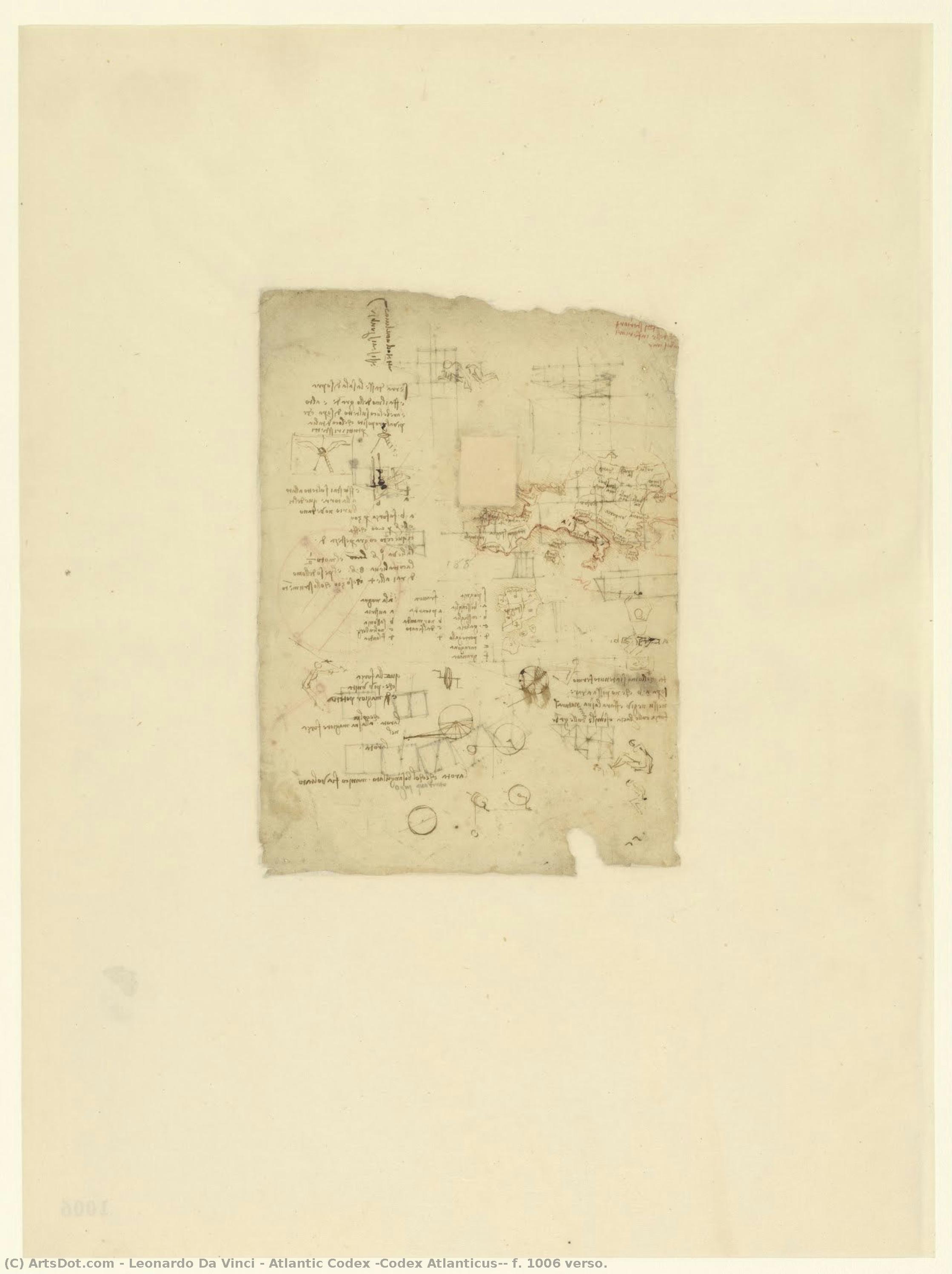
A Blueprint for Dreams: Unveiling Leonardo da Vinci’s *Atlantic Codex*, f. 1006 verso
The image before us—a meticulously rendered drawing from the *Codex Atlanticus*, Leonardo da Vinci's personal notebook—isn’t merely a technical diagram; it’s a window into the restless mind of a genius, a testament to his relentless pursuit of understanding the world through observation and invention. Dating back to 1495, this sheet captures a moment of intense intellectual activity, a fleeting glimpse of Leonardo wrestling with concepts that stretched far beyond the confines of traditional art. It’s a blueprint not just for buildings or machines, but for the very structure of knowledge itself.
The drawing itself is dominated by geometric forms—circles, squares, and lines—arranged in a complex network suggestive of architectural plans or perhaps even intricate mechanical devices. Scattered amongst these precise shapes are handwritten notes in Leonardo’s characteristic mirror script, offering tantalizing fragments of information about the subject matter. While the exact purpose remains debated among scholars, prevailing theories suggest it relates to designs for canals, fortifications, or possibly even a complex system of water management – reflecting Leonardo's deep interest in practical engineering and his desire to improve human life through innovative solutions.
The Renaissance Mind: Observation and Innovation
To truly appreciate *Atlantic Codex*, f. 1006 verso, we must understand the intellectual climate within which it was created. The late fifteenth century marked a pivotal moment in European history – the High Renaissance. Humanism, with its emphasis on classical learning and human potential, flourished alongside burgeoning scientific inquiry. Leonardo da Vinci embodied this spirit perfectly. He wasn’t simply an artist; he was a scientist, an anatomist, an engineer, and a visionary who sought to synthesize knowledge from disparate fields. This drawing exemplifies his method: meticulous observation of the natural world combined with rigorous mathematical analysis – a cornerstone of his approach to both art and invention.
Notice the incredible detail evident in the rendering. Leonardo’s hand demonstrates a mastery of perspective and proportion, skills honed through years of studying human anatomy and architectural principles. The precision suggests not just artistic skill but also a deep understanding of spatial relationships – crucial for any engineer or architect. It's a remarkable display of technical proficiency, yet it’s tempered by an underlying sense of mystery; the purpose remains partially obscured, adding to the drawing’s enduring allure.
Symbolism and the Pursuit of Knowledge
Beyond its immediate function as a design document, *Atlantic Codex*, f. 1006 verso, is rich in symbolic meaning. The act of drawing itself represents the process of translating observation into representation – a fundamental aspect of both artistic creation and scientific discovery. The geometric forms can be interpreted as metaphors for universal principles, reflecting Leonardo’s belief that all things are interconnected through mathematical laws.
- The circles might symbolize wholeness or cycles; the lines, pathways or connections.
- The notes themselves represent the vital link between theory and practice – the crucial step of translating abstract ideas into tangible forms.
Furthermore, the *Codex Atlanticus* as a whole serves as a testament to Leonardo’s lifelong quest for knowledge. It's a sprawling collection of his diverse interests—sketches of flying machines, anatomical studies, musical compositions, and philosophical reflections – all meticulously documented in a single book. This drawing is but one small fragment of this extraordinary record, offering a glimpse into the mind of a man who sought to understand and represent everything around him.
Bringing Leonardo’s Vision Home: A High-Quality Reproduction
ArtsDot offers exquisite, hand-painted reproductions of *Atlantic Codex*, f. 1006 verso, allowing you to bring this captivating piece into your home or office. Our skilled artisans meticulously recreate Leonardo's intricate details and nuanced shading, ensuring that the reproduction captures not only the visual appearance but also the spirit and intellectual depth of the original drawing.
Choose from a range of sizes and canvas materials to perfectly complement your décor. Each reproduction is created with archival-quality pigments on premium canvas, guaranteeing lasting beauty and vibrancy for generations to come. Invest in a piece of art history – an embodiment of the Renaissance spirit—and let Leonardo da Vinci’s boundless curiosity inspire you.