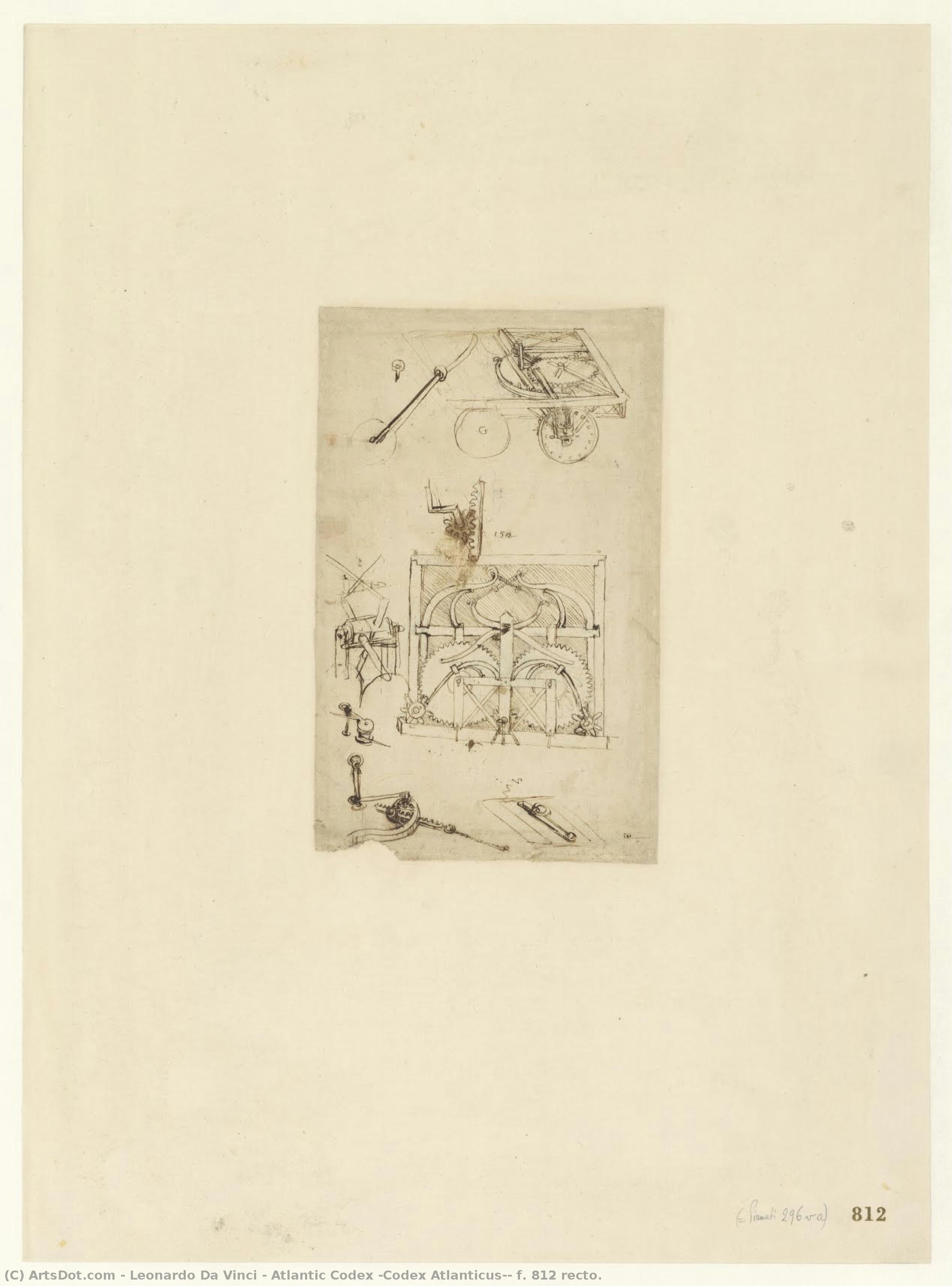
The Automaton's Blueprint: Decoding Leonardo da Vinci’s Atlantic Codex F. 812 recto
Leonardo da Vinci’s *Atlantic Codex*, specifically folio 812 recto, presents a singular enigma—a meticulously rendered drawing of an automated cart, or “Leonardo’s car,” that transcends mere mechanical depiction and embodies the very essence of Renaissance ingenuity. Created around 1478, this artwork isn't simply a visual record; it’s a testament to Da Vinci’s relentless pursuit of understanding the natural world through scientific observation and mathematical precision—a cornerstone of his broader intellectual framework.
- Subject Matter: The drawing focuses on a complex machine design, featuring numerous labeled components illustrating gears, levers, and axles. Notably positioned in the upper left corner is a detailed depiction of a bicycle – an unexpected inclusion that speaks to Da Vinci’s fascination with harnessing mechanical principles for practical applications beyond architectural endeavors.
- Style & Technique: Executed in graphite on parchment, F. 812 recto exemplifies Da Vinci's signature style characterized by painstaking detail and anatomical accuracy. The drawing utilizes shading techniques—hatching and cross-hatching—to convey depth and texture, reflecting the artist’s mastery of chiaroscuro – a technique perfected during his Florentine apprenticeship under Andrea del Verrocchio.
Historical Context: Bridging Art & Engineering Thought
The Atlantic Codex stands as an extraordinary intersection between artistic vision and scientific inquiry. Da Vinci’s notebooks were filled with sketches spanning anatomy, botany, geology, hydraulics, and aeronautics—demonstrating his conviction that art and science weren't mutually exclusive pursuits but rather complementary pathways to unlocking the secrets of existence. This folio reflects the humanist spirit of the Renaissance, where observation and experimentation challenged medieval dogma and fostered a belief in human potential.
- Symbolism: Beyond its mechanical representation, F. 812 recto embodies Da Vinci’s broader philosophical stance—a desire to comprehend the universe through rational analysis. The bicycle itself symbolizes innovation and progress, mirroring Da Vinci's ambition to push the boundaries of human knowledge.
- Emotional Impact: Viewing this drawing evokes a profound appreciation for Da Vinci’s intellectual curiosity and artistic brilliance. It serves as a reminder that true genius lies not merely in aesthetic beauty but also in the unwavering pursuit of understanding—a legacy that continues to inspire artists and scientists alike.
Replicas & Inspiration: Bringing Renaissance Precision Home
ArtsDot.com offers exceptional reproductions of Leonardo da Vinci’s *Atlantic Codex*, f. 812 recto, allowing art enthusiasts worldwide to experience the grandeur of this seminal artwork. Our artisans meticulously recreate Da Vinci's technique and shading nuances using archival-quality materials, ensuring that your home decor reflects the timeless elegance and intellectual depth of the Renaissance.