Codex Madrid I, f.45r: A Window into Leonardo da Vinci’s Mechanical Vision
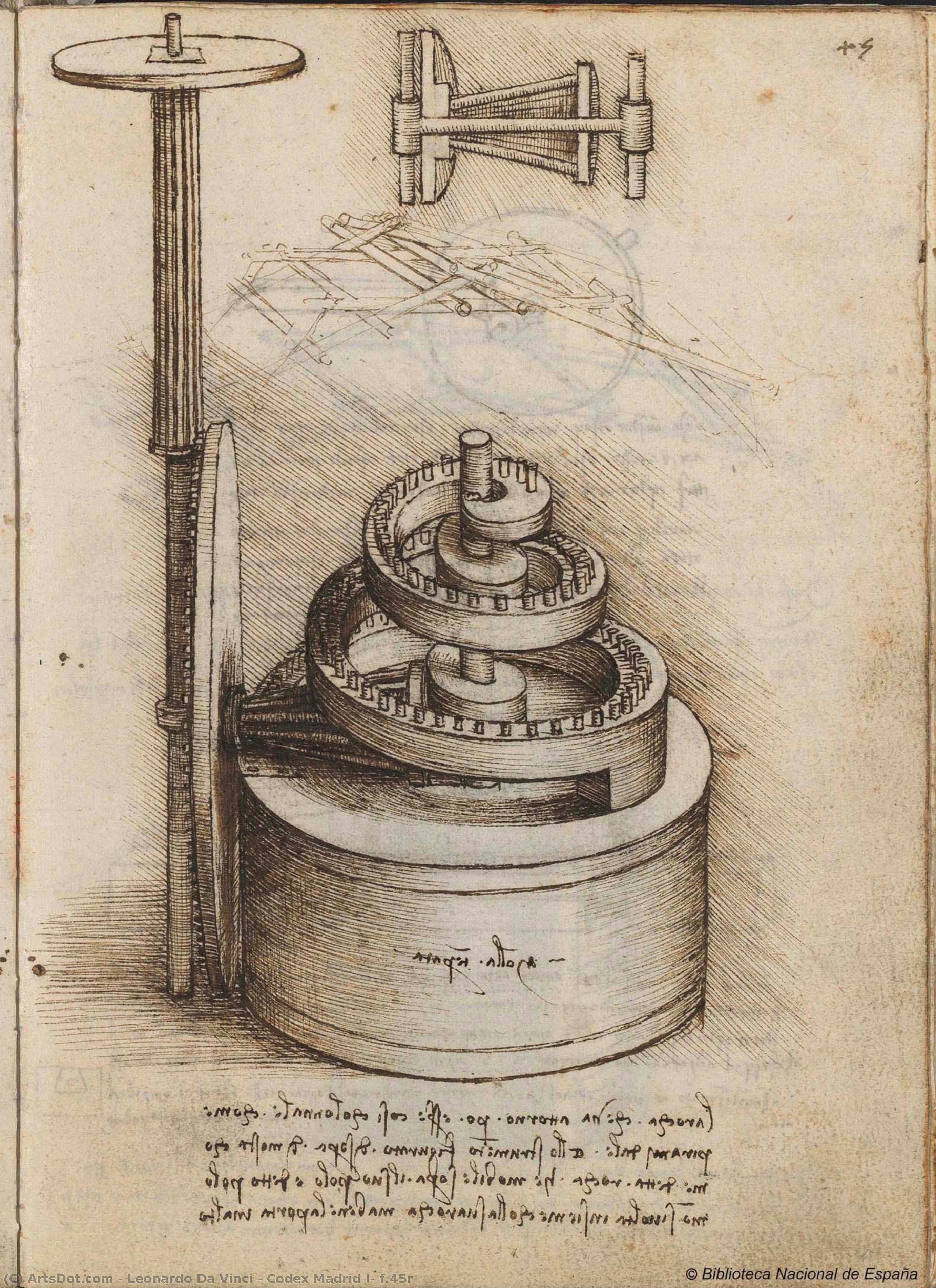
Leonardo da Vinci's Codex Madrid I, folio 45 recto, stands as a singular testament to the Renaissance artist’s boundless curiosity—a meticulously rendered depiction of a complex machine that transcends mere illustration and embodies Da Vinci’s profound engagement with both art and science. This monochrome drawing, executed around 1506, offers an unprecedented glimpse into his inventive mind, showcasing not just an understanding of mechanics but also a masterful command of artistic representation.
- Subject Matter: The image portrays a detailed schematic of what appears to be a windmill or similar rotating device. Its intricate gears and wheels are rendered with remarkable precision, reflecting Da Vinci’s fascination with harnessing natural forces for practical applications.
- Style & Technique: Executed in black ink on parchment, the drawing exemplifies Da Vinci's signature sfumato technique—a subtle blending of tones that creates an illusion of depth and atmosphere. The artist skillfully captures the textures and contours of the machine components with painstaking detail, demonstrating his dedication to anatomical accuracy and observational observation.
- Historical Context: Created during Da Vinci’s prolific period in Milan, Codex Madrid I reflects the burgeoning interest in scientific inquiry that characterized the High Renaissance. It aligns perfectly with Da Vinci's broader explorations into hydraulics, aerodynamics, and engineering—fields where he sought to unlock the secrets of nature through experimentation and mathematical modeling.
- Symbolism: Beyond its technical representation, the machine itself serves as a symbol of human ingenuity and aspiration. Da Vinci’s depiction underscores his belief in the transformative power of knowledge and invention, mirroring the humanist ideals that underpinned the Renaissance spirit.
The Codex Madrid I: More Than Just Gears and Wheels
This drawing isn't simply a technical diagram; it’s infused with Da Vinci’s artistic sensibility. The careful positioning of the gears and wheels contributes to a dynamic composition that draws the eye inward, inviting contemplation about the principles governing movement and energy. Furthermore, the inclusion of a small human figure—likely intended as a scale or reference point—highlights Da Vinci's commitment to integrating anatomical observation into his engineering designs.
A Legacy of Innovation
Codex Madrid I exemplifies Leonardo da Vinci’s unparalleled ability to synthesize disparate disciplines. It stands alongside masterpieces like *The Mona Lisa* and *The Last Supper*, cementing his reputation as the quintessential Renaissance genius—a visionary artist who dared to challenge conventional wisdom and pursue knowledge wherever it led him. This drawing serves as a poignant reminder of Da Vinci's enduring influence on art history and scientific advancement.
Bringing Da Vinci’s Vision Home
A high-quality reproduction of Codex Madrid I allows you to appreciate the artistry and intellectual depth of this extraordinary work firsthand. ArtsDot offers stunning prints that faithfully capture the nuances of Da Vinci's technique, transporting you back to the heart of the Renaissance—a celebration of beauty, innovation, and the boundless potential of human creativity.