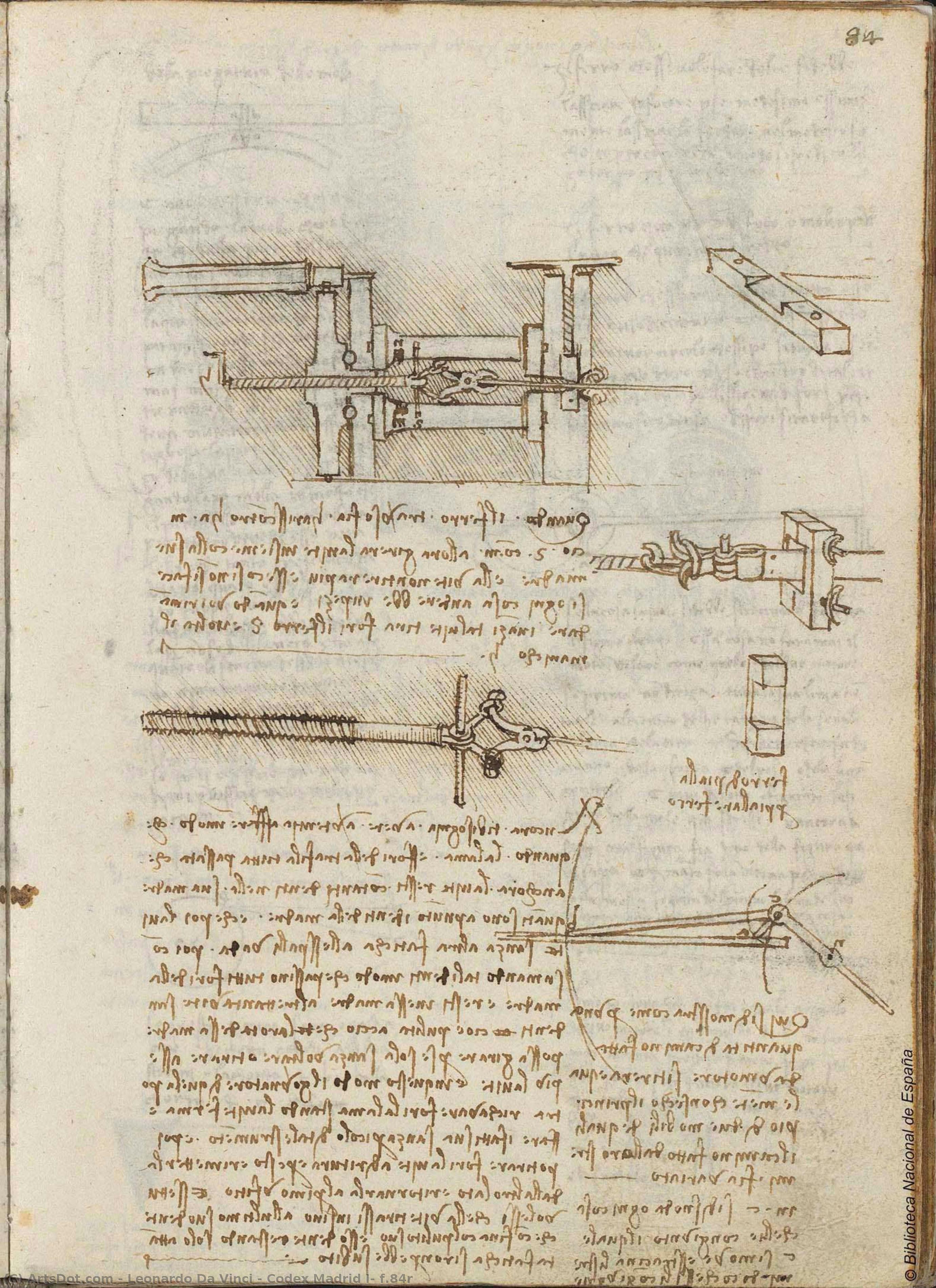
Codex Madrid I, f.84r: A Blueprint for Genius
Leonardo da Vinci’s Codex Madrid I, folio 84r – “Treaty of Statics and Mechanics” – stands as a singular testament to the Renaissance mind, capturing not merely visual beauty but also an intellectual fervor that continues to fascinate scholars and artists alike. This meticulously rendered drawing, housed within the Biblioteca Nacional de España in Madrid, transcends its formal appearance as a technical schematic; it embodies Da Vinci’s relentless pursuit of understanding the natural world through observation and experimentation – principles that underpinned his groundbreaking achievements across disciplines.
The Drawing's Anatomy: Precision Meets Imagination
The image itself depicts four distinct drawings meticulously executed in graphite on parchment. Each portrays components of a complex machine, likely conceived as a conceptual exploration into the mechanics of fortification and structural stability. Notice the remarkable detail—the careful shading and hatching techniques characteristic of Da Vinci’s sfumato style – demonstrate an unparalleled command of perspective and anatomical accuracy. These aren't simply representations; they are embodiments of Da Vinci’s belief that art should serve as a conduit for scientific inquiry.
A Window into Renaissance Thought
Beyond its artistic merit, Codex Madrid I offers invaluable insight into the intellectual landscape of Florence during Da Vinci’s formative years. The accompanying text—written in Latin—details principles of mechanics and engineering, reflecting the burgeoning interest in applying mathematical reasoning to practical problems. This preoccupation with observation and calculation aligns perfectly with Da Vinci's broader ambition: to synthesize art and science into a unified worldview – a vision that foreshadowed many innovations of subsequent centuries.
Symbolism Beyond Mechanics
While ostensibly focused on engineering concepts, the drawing’s composition subtly communicates deeper symbolic meanings. The careful arrangement of lines and shapes speaks to Da Vinci's fascination with geometric harmony—a cornerstone of Renaissance aesthetics. Furthermore, the depiction of intricate mechanisms can be interpreted as representing the human desire to control and manipulate nature – a theme recurrent throughout Da Vinci’s oeuvre.
Emotional Resonance: Capturing the Spirit of Innovation
Ultimately, Codex Madrid I resonates with an emotional intensity that transcends its technical precision. It embodies Da Vinci's unwavering curiosity, his dedication to mastering knowledge, and his conviction that art could illuminate the workings of the universe. Reproductions from ArtsDot offer a chance to experience this spirit of innovation—to possess a tangible connection to one of history’s most brilliant minds and to adorn your home with an artwork that speaks volumes about the transformative power of human intellect.