A Window into Renaissance Ingenuity: Decoding Codex Madrid II, f.154v
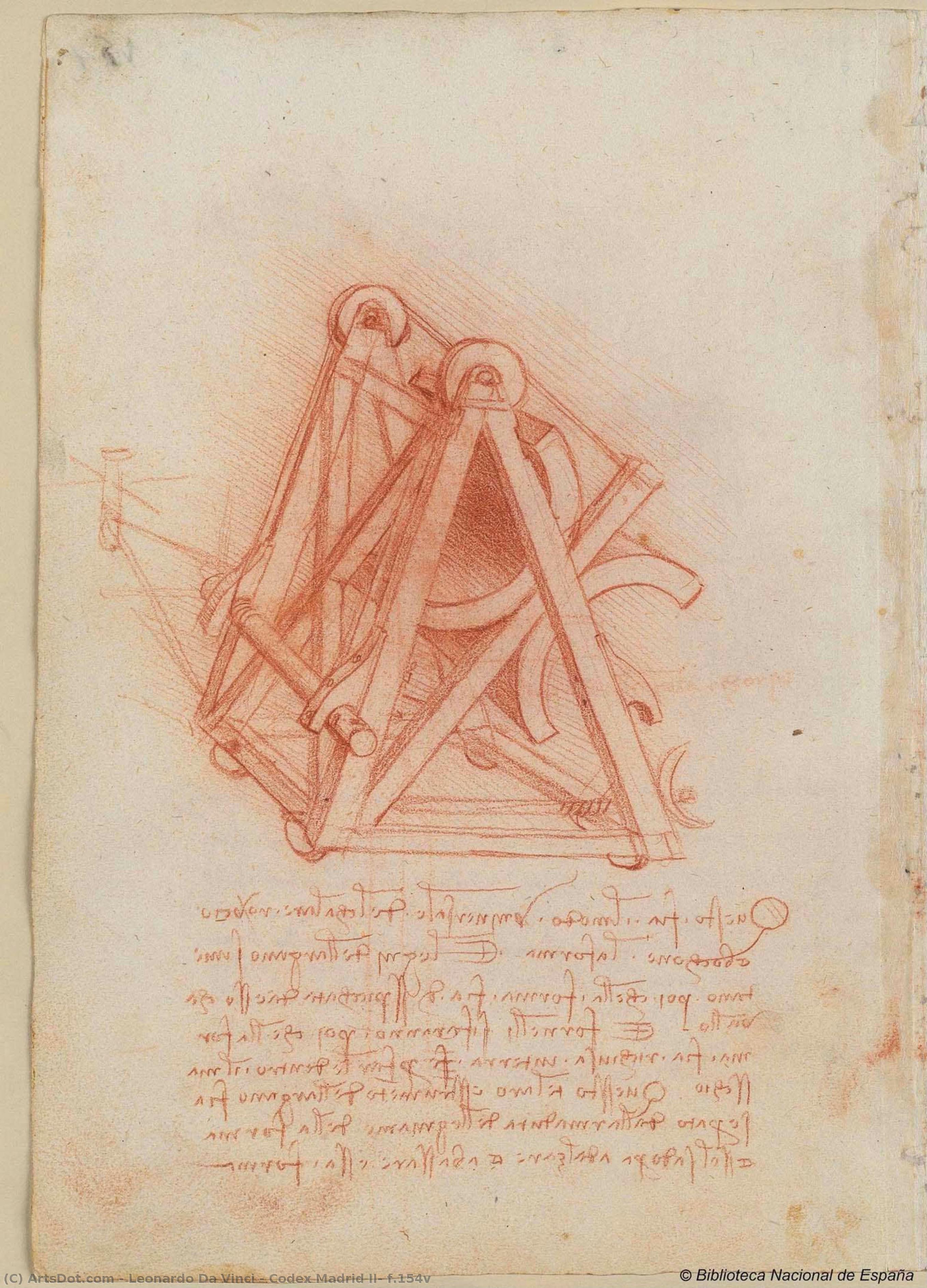
Codex Madrid II, f.154v offers a captivating glimpse into the mind of Leonardo da Vinci – not as the celebrated painter, but as the relentlessly curious engineer and inventor. This remarkable work on aged parchment isn’t merely a drawing; it's a testament to the Renaissance spirit of inquiry, blending art, science, and technical prowess.
Subject & Composition: A Mechanical Marvel
The image centers around an intricately detailed architectural drawing of what appears to be a complex siege engine or similar mechanical device. Rendered in striking red chalk, the composition is dominated by a network of gears, levers, and structural components. The machine’s design suggests a sophisticated understanding of mechanics and physics – a hallmark of da Vinci's inventive genius. Below the drawing, dense layers of Latin script provide accompanying notes and calculations, hinting at the meticulous planning behind this ambitious project.
Technique & Materials: Da Vinci’s Artistic Process
Da Vinci masterfully employs red chalk (a carbonaceous pigment) on parchment to create this technical illustration. The technique showcases a skillful use of dry point, where varying pressure creates nuanced line weights and tonal values. This allows for a remarkable level of detail and depth within the drawing itself. The aged texture of the parchment adds to the artwork’s historical weight and authenticity, reminding us of its centuries-long journey through time. Measuring 22 x 15 cm, the scale invites close inspection, revealing the precision and artistry inherent in every line.
Historical Context: Beyond the Brushstrokes
This page originates from the *Codex Madrid II*, also known as the “Treaty of Fortification, Statics and Geometry.” The codex reflects da Vinci’s multifaceted role during his time – he wasn't solely an artist but a sought-after engineer, architect, and sculptor. This particular section likely relates to designs for military applications or ambitious construction projects. It is important to note that the *Codex Madrid II* contains two distinct parts: personal reflections alongside scientific explorations, and detailed plans for casting a monumental equestrian statue of Francesco Sforza, Duke of Milan – a project da Vinci never fully completed.
Symbolism & Interpretation: The Pursuit of Knowledge
While lacking overt symbolic elements, the artwork’s power lies in its representation of human ingenuity and the relentless pursuit of knowledge. It embodies the Renaissance ideal of *uomo universale* – the “universal man” skilled in multiple disciplines. The complex machine itself can be interpreted as a metaphor for the intricate workings of the universe, which da Vinci sought to understand through observation, experimentation, and artistic expression.
Emotional Impact & Aesthetic Appeal
Despite its technical nature, *Codex Madrid II, f.154v* evokes a sense of wonder and fascination. The sheer complexity of the design invites contemplation, while the artistry of the drawing demonstrates da Vinci’s exceptional skill. For art lovers, collectors, and interior designers, this piece offers a unique blend of historical significance, intellectual stimulation, and aesthetic beauty – a conversation starter that transcends time and disciplines. A reproduction of this work would bring an air of Renaissance sophistication to any space, celebrating the enduring legacy of one of history’s greatest minds.
- Artist: Leonardo da Vinci (1452-1519)
- Date: Unknown
- Medium: Red chalk on parchment
- Dimensions: 22 x 15 cm