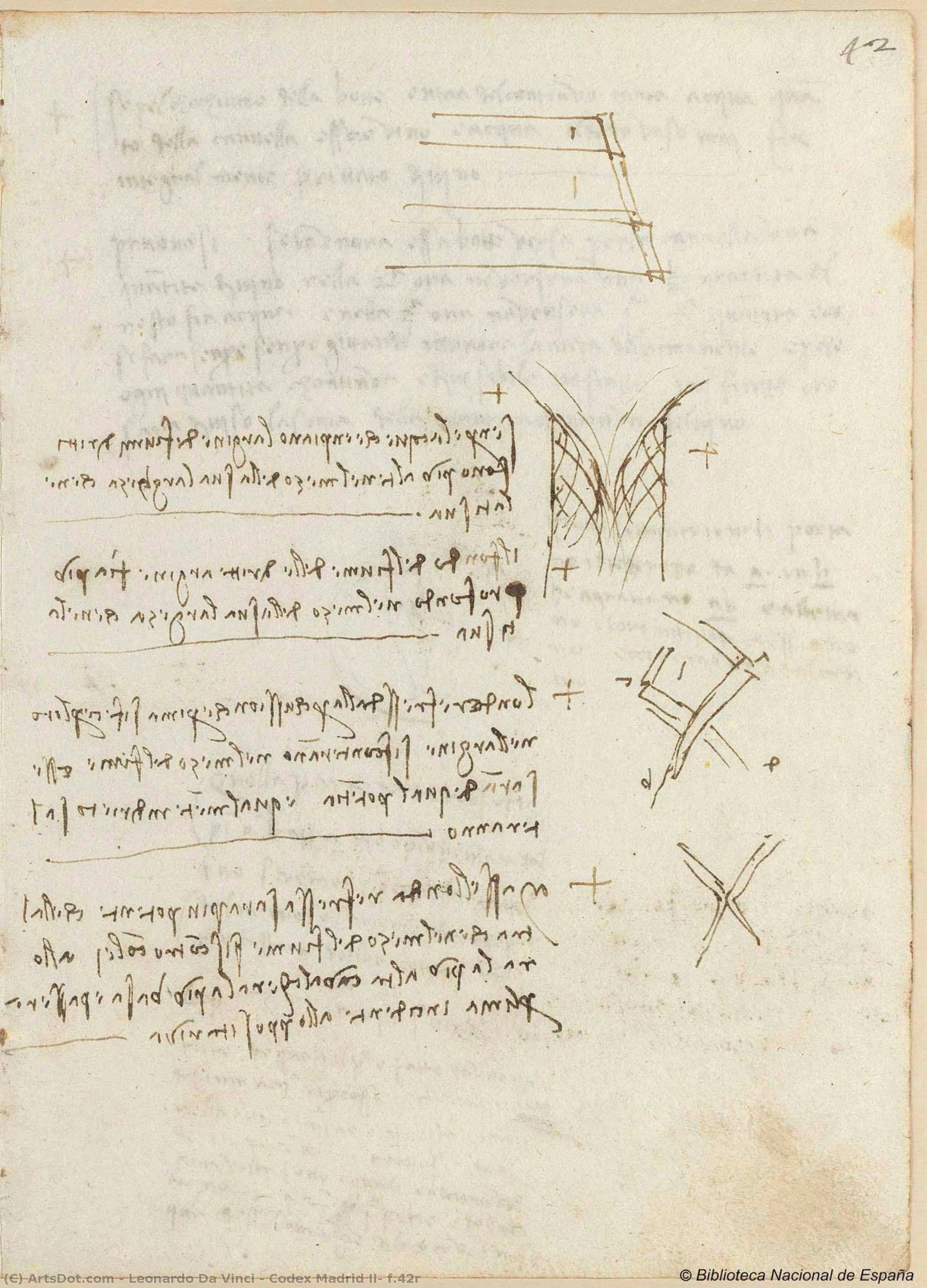
Codex Madrid II, f.42r: A Glimpse into Leonardo da Vinci's Scientific Mind
This remarkable page from Codex Madrid II, also known as the Treaty of Fortification, Statics and Geometry, offers a fascinating window into the multifaceted genius of Leonardo da Vinci. Created during the late 15th to early 16th century, this manuscript represents a crucial part of Da Vinci's extensive notebooks, revealing his explorations in diverse fields ranging from personal observations to complex scientific calculations.
Subject and Historical Context
Codex Madrid II is divided into two distinct sections. The first encompasses a wide array of notes on various subjects, while the second focuses primarily on the ambitious project of casting a monumental bronze horse intended as a tribute to Francesco Sforza, Duke of Milan. Da Vinci dedicated considerable time and effort to this endeavor, but tragically, he was never able to complete it. This particular page, f.42r, is part of that second section, providing insights into the technical challenges and calculations involved in such an immense undertaking.
Style and Technique: Renaissance Scientific Illustration
The visual style of Codex Madrid II, f.42r, exemplifies the aesthetic principles of Renaissance scientific illustration. The page is densely packed with handwritten text rendered in dark brown ink, accompanied by intricate geometric drawings. Lines are precise and deliberate, reflecting Da Vinci's meticulous attention to detail. Angular shapes—triangles, lines, and intersecting forms—dominate the composition, suggesting a focus on geometry, perspective, or possibly astronomical calculations. The aged parchment paper exhibits a rough texture and displays signs of wear and tear, adding to its historical authenticity and character. The technique employed is primarily manual pen and ink drawing on parchment, showcasing Da Vinci's mastery of this traditional medium.
Symbolism and Emotional Impact
While seemingly technical in nature, Codex Madrid II, f.42r, evokes a sense of intellectual curiosity and the relentless pursuit of knowledge that defined Leonardo da Vinci’s approach to art and science. The crosses marking certain points within the drawings may represent specific measurements or reference points within his calculations. The overall impression is one of intense concentration and methodical exploration – a testament to Da Vinci's dedication to understanding the underlying principles governing the natural world. Viewing this page allows us to connect with the mind of one of history’s greatest thinkers, appreciating the meticulous process behind his groundbreaking innovations.
A Legacy in Reproduction
Owning a reproduction of Codex Madrid II, f.42r, is more than acquiring a piece of art; it's possessing a tangible link to the Renaissance era and the extraordinary mind of Leonardo da Vinci. This artwork serves as an inspiring conversation starter, perfect for study rooms, libraries, or any space where intellectual curiosity is celebrated. The intricate details and historical significance make it a captivating addition to any collection.