A Fragment of Genius: Unveiling Leonardo’s Codex Trivulzianus 2162
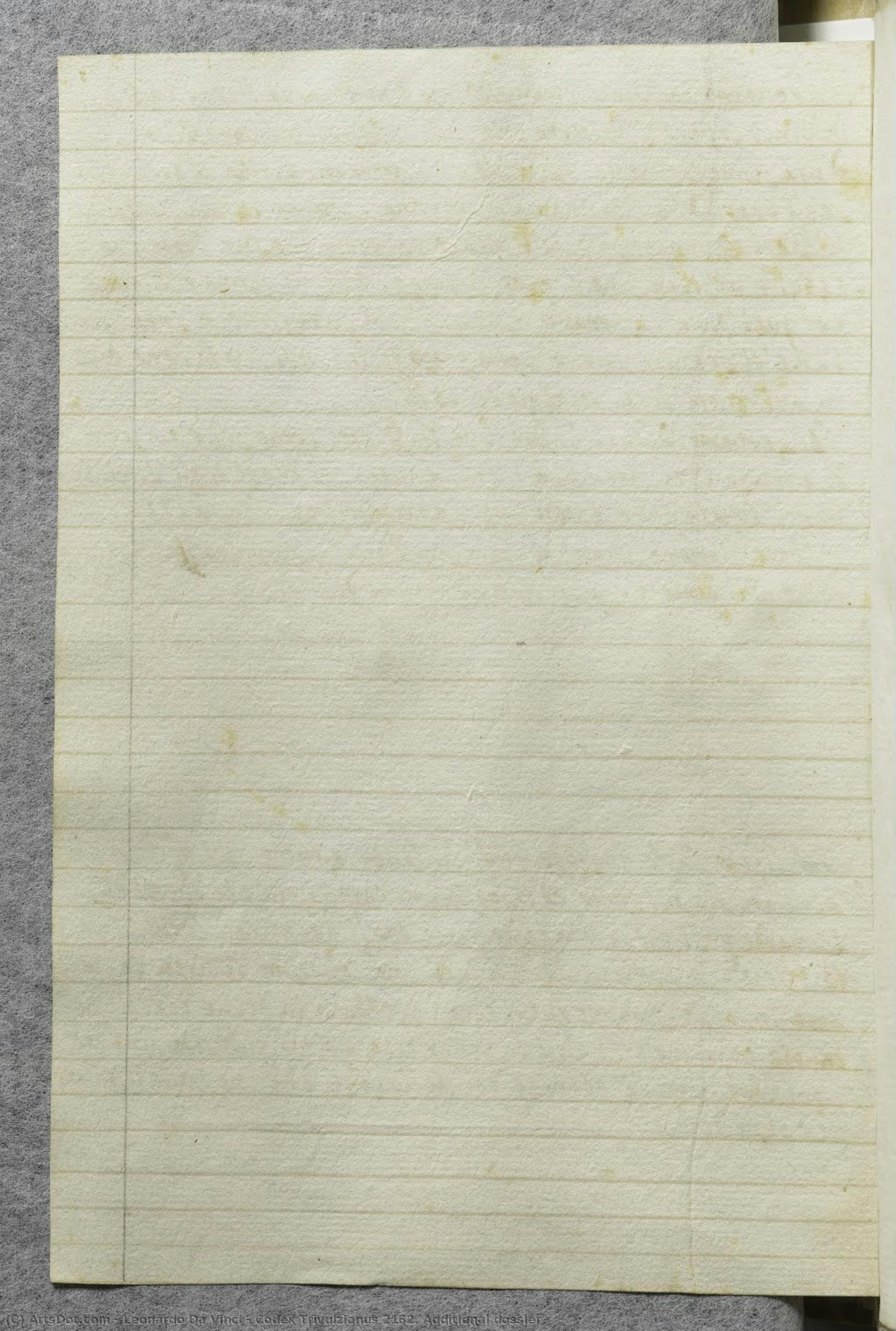
The image presented here—a seemingly simple sheet of aged parchment—holds within it the tantalizing whisper of Leonardo da Vinci's boundless intellect. This “Additional Dossier,” as it’s known, from the Codex Trivulzianus, a collection of Leonardo’s personal notes and sketches, offers a rare glimpse into his working process, a moment captured outside the finished grandeur of his paintings or the meticulously documented pages of his notebooks. The paper itself speaks volumes: its yellowed hue hints at years spent tucked away, perhaps forgotten, yet retaining an undeniable aura of importance. It's not a polished treatise; rather, it’s a raw, intimate record—a testament to the ceaseless flow of ideas that defined Leonardo’s extraordinary life.
The handwriting is deliberately obscured, suggesting it may be in a language other than Italian or Latin – languages frequently employed by Leonardo for his scientific observations and anatomical studies. This deliberate ambiguity adds another layer of intrigue, prompting us to consider the nature of these notes: were they preliminary sketches for a commission, detailed observations on human anatomy, perhaps even cryptic reflections on philosophical concepts? The lack of discernible words invites speculation, reinforcing the notion that this document represents a private, internal dialogue—a crucial element in understanding Leonardo’s creative process. It's a reminder that genius rarely emerges from sterile perfection but often from the messy, iterative stages of exploration and experimentation.
Decoding the Codex: Context and Purpose
The Codex Trivulzianus itself is a remarkable artifact, assembled primarily during the 16th century by Cardinal Ludovico Sforza’s librarian, Giovanni Battista Gaddi. It comprises over 200 sheets, meticulously compiled from Leonardo's personal papers, drawings, and writings accumulated throughout his career. The “Additional Dossier” we examine here is a fragment of this larger collection, offering a window into the breadth of Leonardo’s interests – a convergence of art, science, engineering, and anatomy. Leonardo wasn’t simply an artist; he was a relentless investigator, driven by a profound desire to understand the mechanics of the world around him.
The Codex served as more than just a record-keeping system. It functioned as Leonardo's personal laboratory, a space where ideas could be freely explored and developed without the constraints of patronage or expectation. It’s believed that Sforza intended for the Codex to be a legacy—a testament to Leonardo’s unparalleled genius, a collection to be studied and admired long after his death. The inclusion of this seemingly unassuming sheet underscores the multifaceted nature of Leonardo's work; it highlights the interconnectedness of his diverse pursuits.
The Language of Detail: Technique and Symbolism
While the content remains largely obscured, the physical characteristics of the parchment itself offer clues about its age and origin. The texture suggests a relatively coarse material, likely sourced from Italy during Leonardo’s lifetime. The faint traces of ink reveal a deliberate hand – not necessarily flamboyant or ornate, but precise and observant, mirroring the meticulous nature of Leonardo's own artistic approach. Even in this fragment, we can sense the artist’s inherent control over his materials, a hallmark of his unparalleled skill.
Considering Leonardo’s broader practice, it is likely that the notes contained within this dossier were accompanied by sketches and diagrams – visual representations of concepts he was exploring. The act of recording ideas visually, whether through writing or drawing, was integral to his creative process. The very existence of this fragment speaks to a dedication to documenting every observation, every experiment, every fleeting thought—a characteristic that fueled his extraordinary output.
A Window into the Soul: Emotional Resonance and Reproduction
This “Additional Dossier” transcends its physical form; it’s an invitation to connect with the mind of one of history's greatest geniuses. The fragility of the parchment, the obscured text, and the sense of mystery all contribute to a powerful emotional resonance. It evokes a feeling of intimacy, as if we are privy to a private moment of intellectual exploration.
ArtsDot is proud to offer a meticulously crafted hand-painted reproduction of this extraordinary fragment. Our artists have painstakingly recreated the texture and tone of the original parchment, capturing not only its visual appearance but also the inherent sense of history and intrigue. This reproduction serves as a tangible link to Leonardo’s world—a beautiful and thought-provoking addition to any collection or interior space. It's more than just an image; it’s a portal into the mind of a true visionary, allowing you to experience the essence of Leonardo da Vinci’s genius firsthand.