A Window into Leonardo’s Mind: The Design for a Parabolic Compass
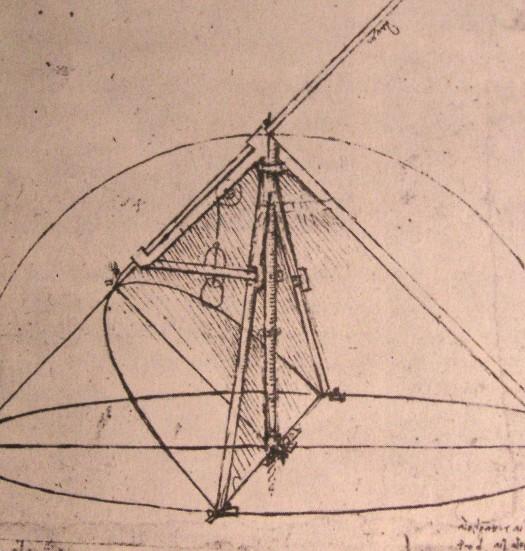
This exquisite drawing, “Design for a Parabolic Compass,” offers a rare glimpse into the boundless curiosity and inventive genius of
Leonardo da Vinci. Created around
1500, during the height of the High Renaissance, it’s not a finished artwork intended for display, but rather a meticulously detailed study – a testament to Da Vinci's relentless pursuit of knowledge across art, science, and engineering. The image reveals a complex arrangement of circles, lines, and geometric forms rendered with astonishing precision.
Decoding the Design: Style & Technique
The drawing exemplifies Da Vinci’s mastery of technical illustration. Executed in pen and ink on paper, it showcases his signature *sfumato* technique – not in terms of shading for a painting, but through subtle variations in line weight to create depth and form within the intricate network of shapes. The style is characterized by its analytical nature; every element serves a purpose, contributing to the overall design’s functionality. It's less about aesthetic beauty in the traditional sense, and more about the elegant expression of mathematical principles. The monochromatic palette focuses attention on the clarity of the lines and the complexity of the geometric construction.
Historical Context: Renaissance Innovation
The High Renaissance was a period defined by intellectual ferment and artistic flourishing. Da Vinci stood at its epicenter, embodying the ideal of the “Renaissance man” – someone proficient in multiple disciplines. This design reflects that spirit perfectly. It wasn’t created in isolation; it emerged from a time when artists were increasingly interested in scientific observation and mathematical proportion. Da Vinci's work on perspective, anatomy, and engineering all informed his artistic endeavors, and vice versa. The parabolic compass itself was likely intended as a tool for architects or engineers, demonstrating Da Vinci’s commitment to practical application of theoretical knowledge. Interestingly, Leonardo da Vinci noted the principle of underwater sound transmission in his notebooks around 1490, foreshadowing modern sonar technology – a connection that highlights the enduring relevance of his insights.
Symbolism & Interpretation
While primarily a technical drawing, “Design for a Parabolic Compass” isn’t devoid of symbolic resonance. The central circle can be interpreted as representing unity and wholeness, while the smaller inner circle suggests focus and precision. The radiating lines symbolize movement, direction, and the expansion of knowledge. More broadly, the design embodies Da Vinci's belief in the underlying order of the universe – a harmony that could be understood through observation, experimentation, and mathematical reasoning.
Emotional Impact & Aesthetic Appeal
Despite its technical nature, the drawing possesses a captivating aesthetic quality. The intricate patterns and precise lines create a sense of intellectual stimulation and visual intrigue. It evokes a feeling of awe at Da Vinci’s extraordinary intellect and his ability to visualize complex concepts with such clarity. For collectors and interior designers, a reproduction of this work offers a sophisticated touch – a subtle nod to the power of human ingenuity and the enduring legacy of the Renaissance. It's an artwork that invites contemplation and sparks curiosity, making it a compelling addition to any space.
It’s a reminder that art and science are not mutually exclusive, but rather complementary forces in our understanding of the world.
Key Elements at a Glance
- Dominant Shapes: Circles, arcs, radiating lines, triangles.
- Technique: Pen and ink on paper; meticulous line work with varying weight.
- Style: Renaissance technical illustration; analytical and precise.
- Color Palette: Monochromatic – primarily black ink on a cream or aged paper background.