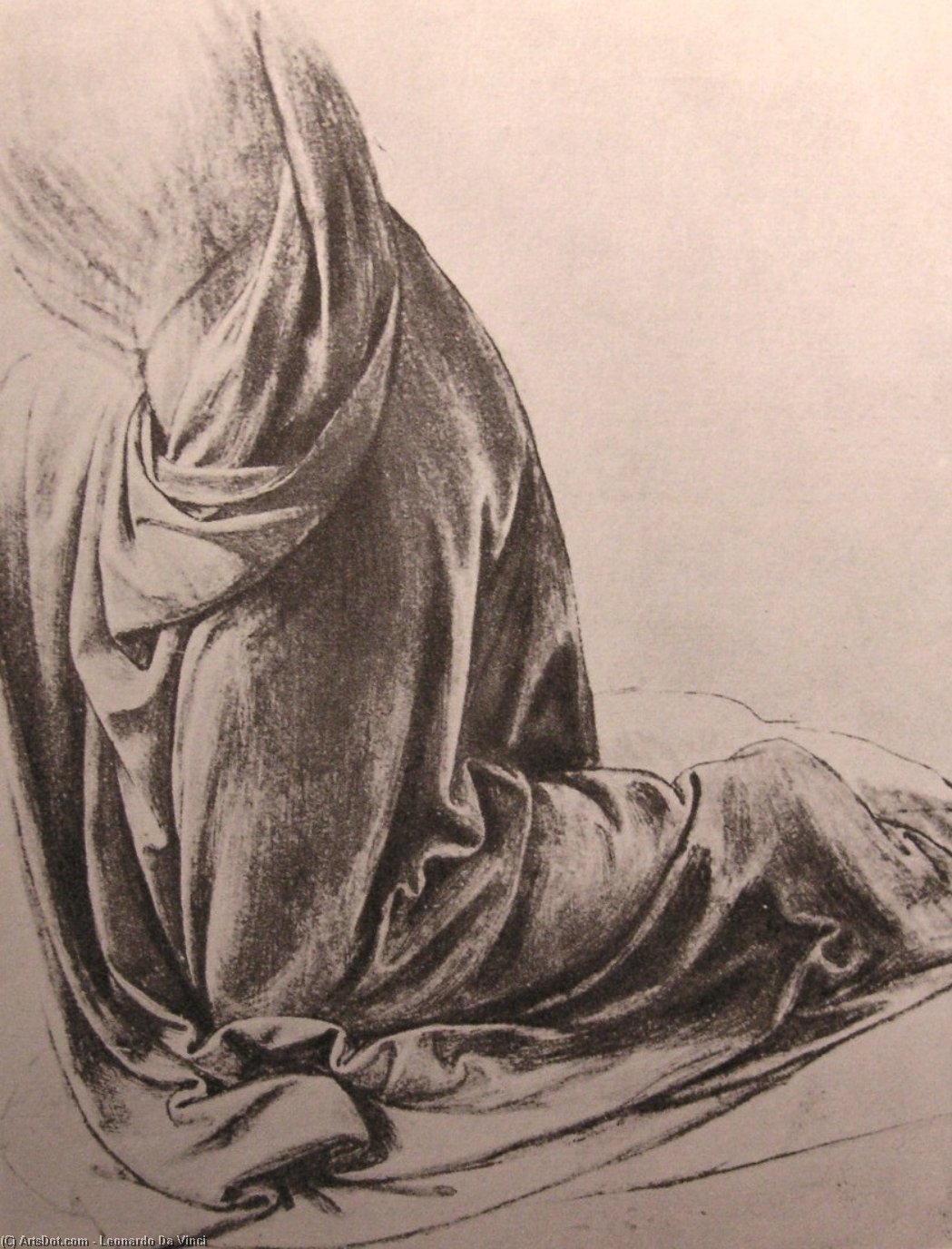
Drawing of Drapery by Leonardo da Vinci: A Study in Light and Form
- Artist: Leonardo da Vinci
- Date: c. 1500
- Medium: Pen and ink on paper
- Dimensions: Unknown
- Current Location: Royal Collection Trust
The Renaissance Master's Exploration of Fabric
Leonardo da Vinci, the quintessential Renaissance polymath, was renowned not only for his iconic paintings like the Mona Lisa but also for his meticulous and insightful drawings. Among his vast body of work, studies of drapery hold a unique significance. This particular drawing, "Drawing of Drapery," created around 1500, exemplifies da Vinci's profound understanding of anatomy, light, and form as applied to the depiction of fabric. It is not merely a representation of cloth; it’s an exploration of how folds and shadows can convey volume, texture, and even emotion.
Technique and Artistic Innovation
Da Vinci approached the study of drapery with scientific precision combined with artistic flair. Rather than simply observing fabric, he often constructed models using wet clay or linen stiffened with plaster to manipulate the folds and observe their behavior under different lighting conditions. This drawing showcases his mastery of pen and ink techniques, utilizing subtle variations in line weight and density to create a remarkable sense of depth and three-dimensionality. The absence of color allows the viewer to focus entirely on the interplay of light and shadow – a hallmark of da Vinci’s artistic style. He employed chiaroscuro, the use of strong contrasts between light and dark, to sculpt the fabric with an almost sculptural quality.
Historical Context and Symbolism
During the High Renaissance, artists increasingly sought to depict realistic human forms and their surroundings. Da Vinci's drapery studies were integral to this pursuit. Accurate representation of clothing was crucial in portraits and religious scenes, as it could convey social status, character traits, and symbolic meaning. In religious paintings, for instance, the folds of a figure’s garment might signify divinity or humility. While this particular drawing is a study rather than part of a larger composition, it demonstrates da Vinci's commitment to meticulous observation and his understanding that even seemingly mundane subjects could be elevated through artistic skill.
Emotional Impact and Enduring Legacy
Despite its simplicity – a monochrome depiction of draped fabric – this drawing possesses an undeniable emotional resonance. The graceful curves and flowing lines evoke a sense of tranquility and elegance. Da Vinci’s ability to capture the subtle nuances of light and shadow creates a captivating visual experience, inviting viewers to contemplate the beauty inherent in everyday objects. "Drawing of Drapery" stands as a testament to da Vinci's genius – a profound exploration of form, light, and the enduring power of observation.